
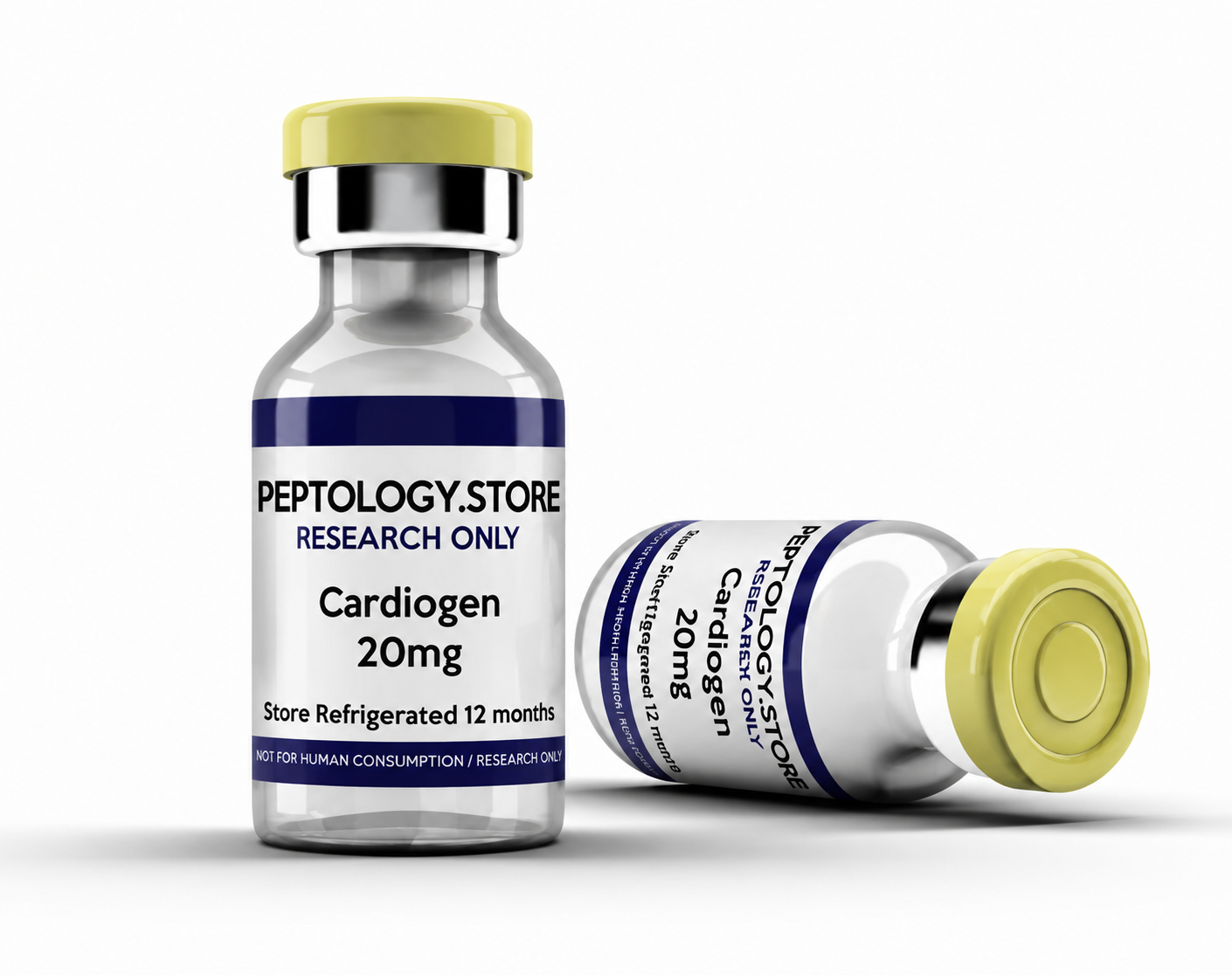
Cardiogen 20mg
Bioregulator Peptide Premium Cardiogen Research Peptide | 20mg Lyophilized Powder | ≥99% Purity | Research Use Only
Yes. Since Cardiogen 20mg is a different compound from PT-141, the scientific sections should be changed rather than simply replacing the name. Cardiogen is generally described as the short tetrapeptide Ala-Glu-Asp-Arg (AEDR) associated with the Khavinson bioregulator research program; its evidence base is preclinical and limited, so I would avoid claims of proven cardiovascular benefits or human efficacy.
Cardiogen 20mg: A Short Bioregulator Peptide for Cardiac Tissue Research
Buy Cardiogen 20mg Research Peptide EU & UK — PEPTOLOGY.STORE presents Cardiogen 20mg, a research-grade synthetic tetrapeptide supplied as lyophilized powder for laboratory and analytical research. Cardiogen, also known as Ala-Glu-Asp-Arg (AEDR), belongs to the short-peptide bioregulator family associated with the Khavinson research program and has been investigated primarily in preclinical models involving cardiac-derived tissues and cellular processes.
For qualified researchers investigating cardiac tissue biology, gene-expression regulation, cellular signaling, peptide-DNA interactions, and age-related tissue research, Cardiogen provides a defined short-peptide research material suitable for controlled laboratory investigation. Cardiogen is supplied strictly for research use only and should not be represented as an approved medicine or as a treatment for cardiovascular conditions.
Cardiogen 20mg: Scientific Overview
Cardiogen is reported as a synthetic tetrapeptide consisting of the amino-acid sequence Ala-Glu-Asp-Arg (AEDR). It is associated with the Khavinson family of short bioregulator peptides and is commonly described in research literature as a peptide investigated in relation to cardiac tissue. Its reported molecular formula is C18H31N7O9, with a molecular weight of approximately 489.5 g/mol.
Unlike larger peptide molecules that are typically investigated through conventional receptor-mediated mechanisms, Cardiogen belongs to a class of very short peptides for which researchers have proposed interactions involving cellular and nuclear processes. However, the precise molecular mechanism and tissue-specific activity of Cardiogen remain insufficiently established and require further independent investigation.
Molecular Characteristics
- Compound: Cardiogen
- Alternative designation: AEDR
- Sequence: Ala-Glu-Asp-Arg
- Peptide class: Synthetic tetrapeptide bioregulator
- Molecular formula: C18H31N7O9
- Molecular weight: Approximately 489.5 g/mol
- Research format: Lyophilized powder
- Quantity: 20mg per vial
- Intended use: Laboratory and analytical research only
Scientific Foundation of Cardiogen Research
Discovery and Development
Cardiogen belongs to the broader family of short peptide bioregulators developed through research associated with the St. Petersburg Institute of Bioregulation and Gerontology. These compounds were investigated under the hypothesis that short, tissue-associated peptides could influence cellular regulation and gene-expression processes.
Cardiogen is commonly associated with cardiac or myocardial research within this peptide family. Published work has investigated Cardiogen and related peptides in experimental cellular and animal models, including research examining myocardial cell behavior and cellular regulation.
Importantly, the available evidence should be interpreted as preclinical research rather than established clinical efficacy. Current sources report no robust body of independently replicated human clinical evidence for Cardiogen.
Proposed Mechanistic Research
Research surrounding Cardiogen has focused on the possibility that short bioregulator peptides may influence cellular gene-expression processes.
Cardiac-Cell Research
Experimental studies have investigated Cardiogen in cardiac-derived cellular systems, with reported observations involving cellular proliferation and proteins associated with cellular structure. These findings remain preclinical and should not be interpreted as evidence of a demonstrated therapeutic effect in humans.
Gene-Expression Research
The broader Khavinson bioregulator model proposes that short peptides may interact with DNA, chromatin-associated structures, or other nuclear components and thereby influence gene-expression patterns. For Cardiogen specifically, the extent and biological significance of these proposed interactions remain an area for further research.
Cellular Structure Research
Research reports have examined Cardiogen in relation to proteins involved in the cytoskeleton and nuclear matrix, including actin, tubulin, vimentin, and lamin proteins. Such observations provide potential avenues for laboratory investigation but do not establish a confirmed therapeutic mechanism.
Key Research Applications
Cardiac Tissue Research
Cardiogen may be investigated as a research tool in studies involving:
- Cardiac-derived cell models
- Myocardial cellular biology
- Cardiomyocyte research
- Cellular proliferation and differentiation
- Age-related cardiac tissue models
- Cardiac gene-expression studies
Molecular Biology Research
Potential laboratory research areas include:
- Peptide-DNA interaction studies
- Gene-expression analysis
- Nuclear-matrix protein research
- Cellular signaling investigations
- Structure-function studies of short peptides
- Comparative bioregulator research
Cellular Aging Research
Because Cardiogen is associated with the broader study of age-related tissue regulation, researchers may investigate its effects in experimental models examining:
- Cellular aging
- Tissue-specific gene regulation
- Cellular proliferation
- Protein-expression changes
- Age-associated changes in cardiac-derived cells
Peptide Bioregulator Research
Cardiogen can also serve as a reference compound for comparative studies involving other short peptides in the Khavinson bioregulator family. Researchers can investigate differences in molecular structure, sequence, cellular response, and proposed tissue specificity.
Research Quality & Analytical Standards
For laboratory applications, Cardiogen should be characterized using appropriate analytical techniques and batch-specific documentation.
Recommended Quality Documentation
- HPLC: Purity assessment
- Mass Spectrometry: Molecular-mass and identity confirmation
- Certificate of Analysis: Batch-specific analytical documentation
- Appearance: White to off-white lyophilized powder
- Research-use labeling: Clearly identified as a laboratory research material
A supplier should provide analytical documentation corresponding to the specific production batch rather than relying solely on a general product specification.
Research-Only Disclaimer
Cardiogen 20mg is supplied for laboratory and research purposes only. It is not presented as a pharmaceutical drug, dietary supplement, food product, or approved treatment. Cardiogen is not established as a clinically proven treatment for cardiovascular disease or other human medical conditions. Available evidence is primarily preclinical, with important limitations concerning independent replication and human clinical data.
Researchers should conduct all work in accordance with applicable institutional, laboratory, safety, and regulatory requirements.
Chemical and Product Specifications
Cardiogen 20mg — Technical Specifications
| Specification | Detail |
|---|---|
| Product Name | Cardiogen Peptide |
| Synonyms | Cardiogen; AEDR |
| CAS Number | Not assigned / verify against batch COA |
| Molecular Formula | C₁₈H₃₁N₇O₉ |
| Molecular Weight | ~489.48 Da |
| Amino Acid Sequence | Ala-Glu-Asp-Arg (AEDR) |
| Structure | Linear tetrapeptide |
| Purity | ≥99% HPLC, where supported by the specific batch COA |
| Appearance | White to off-white lyophilized powder |
| Form | Lyophilized powder |
| Solubility | Reported to be soluble in water and aqueous buffers |
| Research Classification | Synthetic short-peptide bioregulator |
| Storage | Store according to the batch-specific Certificate of Analysis; −20°C or below is commonly specified for long-term storage |
| Intended Use | Research and laboratory use only |
| Documentation | Batch-specific Certificate of Analysis, where provided |
Cardiogen is a defined synthetic tetrapeptide with the sequence Ala-Glu-Asp-Arg (AEDR). Analytical references report a molecular formula of C₁₈H₃₁N₇O₉ and molecular weight of approximately 489.48 Da.
Stability and Handling
Lyophilized Powder
Store the material in accordance with the manufacturer’s batch-specific Certificate of Analysis. For long-term storage, −20°C or below is commonly specified for synthetic Cardiogen research material. Protect the vial from excessive moisture and unnecessary exposure to light.
Handling
Cardiogen should be handled as a laboratory research material using appropriate laboratory practices and personal protective equipment. Avoid unnecessary exposure to moisture and contamination, and follow the handling requirements supplied with the specific batch.
Reconstitution
Reconstitution should be performed according to the laboratory’s validated research protocol and the supplier’s batch-specific documentation. No human or veterinary administration protocol should be inferred from this research material.
Research Profile
Cardiogen is a short synthetic peptide associated with the Khavinson-class bioregulator peptide family. Research has investigated the AEDR sequence in relation to cardiac-derived cellular systems, peptide–DNA interactions, and molecular regulation.
The available evidence is predominantly in vitro and preclinical. Cardiogen should therefore be described as a research compound rather than a clinically validated cardiovascular treatment. There is no established human clinical efficacy or approved therapeutic indication for Cardiogen.
Key Research Areas
- Cardiac and myocardial tissue research
- Cardiomyocyte cellular studies
- Short-peptide bioregulator research
- Peptide–DNA interaction studies
- Gene-expression and molecular regulation research
- Cellular aging and tissue-specific research
- Comparative studies of ultrashort peptides
- Structure–activity relationship investigations
Frequently Asked Questions
Q: What is Cardiogen?
A: Cardiogen is a synthetic short peptide with the amino acid sequence Ala-Glu-Asp-Arg (AEDR). It is classified as a linear tetrapeptide and has a molecular weight of approximately 489.48 Da.
Q: What is the molecular formula of Cardiogen?
A: The reported molecular formula is C₁₈H₃₁N₇O₉, with a molecular weight of approximately 489.48 Da.
Q: What is the amino acid sequence?
A: Cardiogen is the tetrapeptide Ala-Glu-Asp-Arg (AEDR), formally represented as H-Ala-Glu-Asp-Arg-OH.
Q: Is Cardiogen a cyclic peptide?
A: No. Cardiogen is a linear tetrapeptide, not a cyclic heptapeptide.
Q: What research is Cardiogen used for?
A: Published and commercial research references describe investigations involving cardiac-derived tissues, myocardial cellular biology, peptide–DNA interactions, and gene-expression regulation. These findings remain primarily preclinical.
Q: Does Cardiogen have an established human therapeutic indication?
A: No. Cardiogen should not be represented as an FDA-approved medicine or as a clinically proven treatment for cardiovascular disease. Current evidence does not establish human therapeutic efficacy.
Q: What documentation should accompany Cardiogen?
A: Appropriate batch documentation may include a Certificate of Analysis (COA) showing the batch-specific purity, molecular-mass confirmation, appearance, and other applicable analytical results. Batch-specific documentation should take precedence over generic product specifications.
Q: Is Cardiogen intended for human consumption?
A: No. Cardiogen research material should be clearly labeled “For Research Use Only — Not for Human or Veterinary Use.”
Advance Your Cardiogen Research
Cardiogen 20mg is a defined synthetic Ala-Glu-Asp-Arg (AEDR) tetrapeptide intended for controlled laboratory and analytical research. Its well-defined molecular composition makes it suitable for researchers investigating short-peptide structure, cardiac-derived cellular systems, peptide–DNA interactions, and molecular regulation.
All product specifications, purity values, storage requirements, and analytical claims should be verified against the specific batch Certificate of Analysis supplied with the material.
Whether you are exploring the neural mechanisms of sexual behavior, designing melanocortin receptor studies, investigating female sexual desire disorders, or researching appetite regulation pathways, our rigorously tested compound provides the quality and consistency your work demands.
Order today and experience the peptology.store difference – premium quality, rapid 48-hour delivery across the EU and UK, and expert support for the European research community.
.
Reviews
There are no reviews yet.