MGF (Mechano Growth Factor) 2mg – High-Quality Research Peptide | 48-Hour Delivery Across EU & UK
MGF (Mechano Growth Factor) 2mg: Advanced Peptide for Muscle, Cellular Repair & Regeneration Research
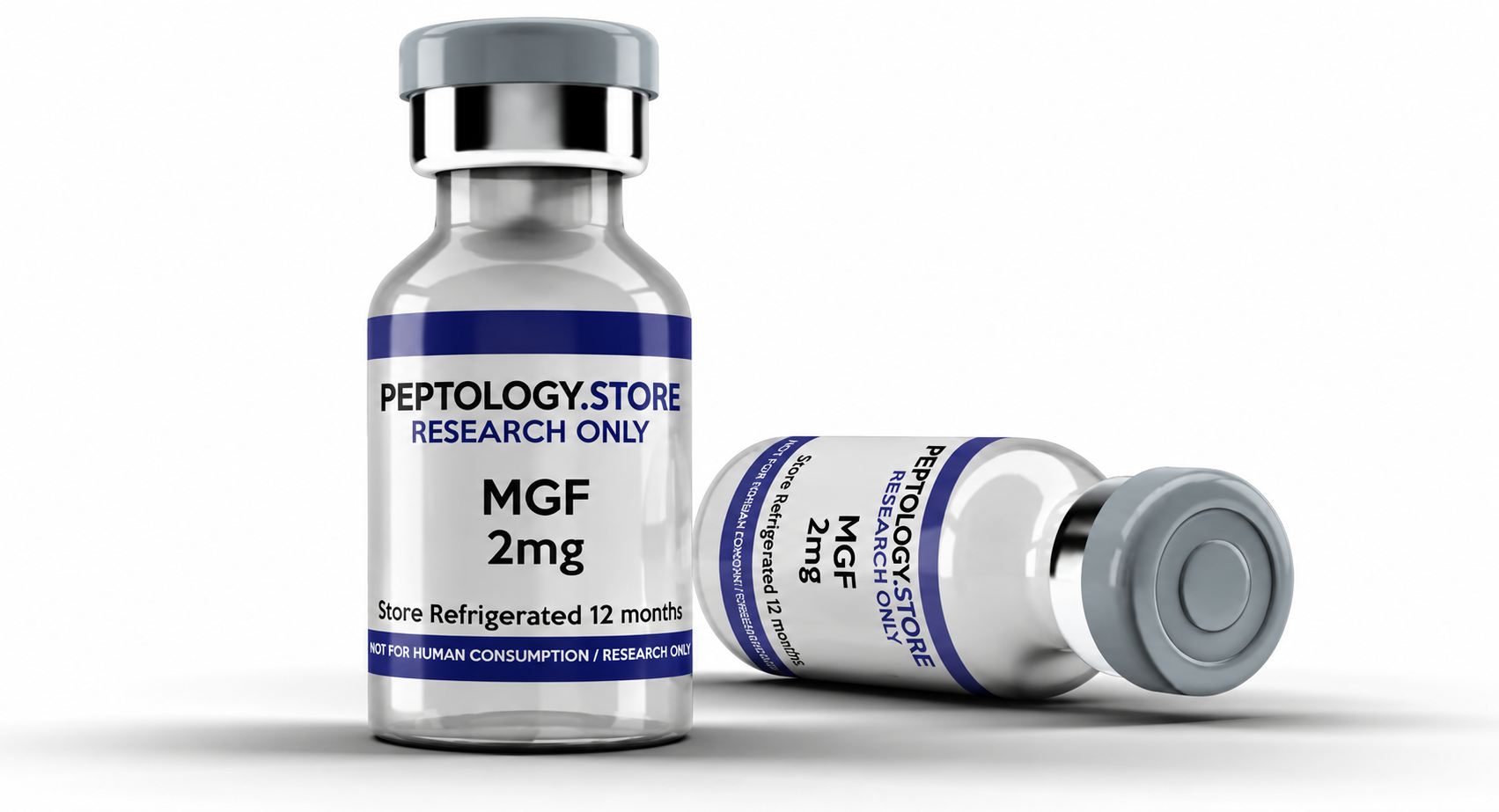
peptology.store is proud to present MGF (Mechano Growth Factor) 2mg is a research-grade peptide associated with the mechano-responsive biology of the insulin-like growth factor-1 (IGF-1) system. MGF research focuses particularly on skeletal muscle adaptation, satellite-cell activity, cellular proliferation, tissue remodeling, and regenerative signaling.
MGF is closely associated with IGF-1Ec in humans and IGF-1Eb in rodents, although the terminology surrounding MGF varies across the scientific literature. Synthetic MGF preparations used in research are generally studied as peptide mimetics corresponding to the C-terminal E-domain region associated with the IGF-1 splice variant.
For researchers seeking a dedicated MGF research compound, MGF 2mg is available through Peptology Store for laboratory and investigational research use.
For customers who regularly buy peptide online and across the European Union, our MGF 2mg provide a perfect complementary addition to your wellness routine. Whether your laboratory research involves peptide studies or you’re simply seeking high-quality nutritional products. With our guaranteed 48 hour delivery service across the EU and UK, your MGF 2mg arrive fresh and ready to enjoy.
The Scientific Foundation of MGF Research
Mechanosensitive IGF-1 Signaling
MGF emerged from research into how mechanical loading, stretching, exercise, and tissue injury influence IGF-1 gene expression.
The IGF1 gene can undergo alternative splicing to generate several isoforms. In humans, the IGF-1Ec splice variant has been associated with the term mechano-growth factor (MGF), particularly because its expression has been observed in response to mechanical stimulation and tissue stress.
This makes MGF particularly relevant to research investigating how tissues respond to mechanical stress and how local signaling may contribute to repair and remodeling.
MGF and the IGF-1 System
MGF should not simply be treated as another name for conventional mature IGF-1.
The IGF-1 system contains multiple splice variants with different C-terminal E-peptide regions. Research has investigated whether the MGF-associated E-domain has biological actions distinct from mature IGF-1. Synthetic MGF peptides have therefore been used as experimental tools to investigate these proposed mechanisms.
This distinction is important when designing experiments involving MGF because the literature uses the term “MGF” inconsistently to describe an mRNA splice variant, an IGF-1 E-domain region, or a synthetic peptide mimetic.
Satellite Cells and Muscle Research
One of the most extensively investigated areas of MGF research is skeletal muscle biology.
Studies have reported that mechanical stimulation can increase expression of the MGF-associated IGF-1 splice variant, while experimental studies using synthetic MGF-related peptides have investigated effects on muscle precursor cells and myoblast proliferation.
This has made MGF an important experimental tool for researchers studying:
- Satellite-cell biology
- Myoblast proliferation
- Muscle regeneration
- Skeletal muscle adaptation
- Tissue remodeling
- Mechanotransduction
- Exercise-associated cellular responses
Key Research Applications
Skeletal Muscle Research
MGF is particularly relevant to experimental studies examining skeletal muscle responses to mechanical loading, exercise, and cellular stress.
Researchers can investigate how MGF-related signaling interacts with pathways involved in muscle precursor-cell proliferation, remodeling, and adaptation.
Research into IGF-1 splice variants has demonstrated that MGF-associated expression changes can occur following exercise and mechanical stimulation.
Satellite Cell and Myoblast Research
Satellite cells are important muscle-resident precursor cells involved in skeletal muscle regeneration.
Synthetic MGF-related peptide research has investigated whether MGF-associated signaling can influence the proliferative behavior of muscle precursor cells. Some experimental studies have reported increased proliferation while distinguishing these effects from later differentiation processes.
MGF therefore provides a useful research model for investigating the relationship between:
Mechanical stimulus → IGF-1 alternative splicing → MGF-associated signaling → precursor-cell activity
Muscle Repair and Regeneration Research
MGF has been studied in connection with tissue repair and regeneration, particularly in skeletal muscle.
Research has investigated the possibility that MGF-associated signaling contributes to the early cellular response following mechanical stress or tissue damage. The broader IGF-1 system is involved in muscle growth, repair, differentiation, and survival, while the precise independent role of MGF remains an active research question.
Mechanotransduction Research
Mechanotransduction describes the process through which cells detect mechanical forces and convert them into biochemical signals.
Because MGF was originally associated with mechanically stimulated IGF-1 expression, it has become a useful research target for studying how mechanical stimuli influence cellular signaling.
Research applications can include:
- Mechanical loading models
- Cellular stretch studies
- Exercise-associated signaling
- Muscle stress responses
- Tissue remodeling
- Growth-factor signaling
Exercise and Muscle Adaptation Research
MGF-related IGF-1 expression has been investigated in skeletal muscle following exercise and resistance-type mechanical loading.
Human skeletal muscle research has examined changes in IGF-1 splice variants following high-resistance exercise, supporting continued investigation into the relationship between exercise-induced mechanical stress and local IGF-1/MGF biology.
MGF can therefore be incorporated into experimental research examining cellular responses to mechanical workload.
Cellular Proliferation Research
Synthetic MGF-related peptides have been studied for their potential effects on cellular proliferation, particularly in muscle-derived precursor cells.
Research has investigated signaling mechanisms including ERK-related pathways and the potential for MGF-associated peptides to influence cellular behavior independently of some canonical IGF-1 signaling mechanisms.
This makes MGF relevant to controlled laboratory investigations of:
- Cell proliferation
- Myoblast biology
- Cellular signaling
- Growth-factor responses
- Tissue regeneration models
Aging and Muscle Research
Changes in IGF-1 splice-variant expression have also been investigated in relation to aging and declining muscle regenerative capacity.
Research has reported reduced MGF-associated transcript responses in aging muscle, while experimental work has investigated whether muscle-derived cells from older subjects remain responsive to MGF-related signals.
These findings make MGF relevant to laboratory research involving:
- Age-related muscle changes
- Cellular regeneration
- Satellite-cell function
- Muscle wasting models
- Tissue repair mechanisms
Quality Assurance: Setting the Standard for Research Compounds
When selecting MGF for laboratory research, analytical documentation and batch identification are important considerations.
Researchers using MGF 2mg from Peptology Store should review the applicable batch documentation and product specifications before beginning experimental work.
Analytical Characterization
Where available, researchers should look for documentation such as:
- HPLC analysis
- Mass spectrometry confirmation
- Batch-specific Certificate of Analysis (COA)
- Peptide identity information
- Lot or batch number
- Manufacturing and handling information
Analytical documentation should be evaluated on a batch-specific basis rather than assuming that all peptide batches have identical analytical characteristics.
Physical and Chemical Properties
| Molecular Weight (g/mol) | 2867.2 g/mol |
| Appearance | White to off-white lyophilised powder |
| Melting Point | Not applicable (decomposes before melting) |
| Research Use and Safety | |
| Caution | Handle using appropriate PPE and in compliance with relevant laboratory safety standards. |
| Intended Use | For laboratory research use only. Not for human or veterinary use. |
| Hazard Classification | Not classified as hazardous under GHS for research quantities |
| Storage, Handling and Stability | |
| Storage Temperature, Opened | -20 °C, minimise freeze-thaw cycles |
| Storage Temperature, Unopened | -20 °C recommended for long-term storage |
| Shelf Life | 2 years unopened under recommended conditions |
| Reconstitution Stability | Stable for up to 28 days at 2-8 °C in aqueous solution under sterile conditions |
Stability and Handling
MGF 2mg should be handled according to the product-specific documentation and established laboratory procedures.
- Lyophilized Material: Store according to the temperature specified in the batch documentation.
- Light Protection: Protect the material from unnecessary direct light exposure.
- Moisture Protection: Keep the vial tightly sealed and protected from humidity.
- Reconstituted Material: Establish solution-storage conditions according to validated laboratory stability procedures.
- Aliquoting: Where appropriate, aliquot prepared research solutions to minimize repeated freeze-thaw exposure.
- Temperature Control: Avoid unnecessary temperature fluctuations during storage and handling.
- Documentation: Record preparation and storage conditions as part of the experimental record.
Real-World Research Applications and Investigator Studies
Mechanical-Load Studies
MGF expression has been investigated as part of the molecular response to mechanical stimulation.
In osteoblast research, mechanical stretching increased MGF expression, demonstrating a relationship between mechanical stimuli and alternative IGF-1 splicing.
Skeletal-Muscle Research
Studies of resistance exercise have measured MGF alongside changes in skeletal-muscle fiber area.
In an elderly post-operative cohort, resistance training increased type 1 and type 2 muscle-fiber area while also increasing expression of IGF-1 splice variants including MGF. These observations support investigation of MGF within the broader molecular response to resistance exercise.
Osteoblast Research
MGF peptide has been investigated directly in osteoblast models.
Experimental findings indicate that MGF promoted osteoblast proliferation and migration and influenced differentiation through an ERK1/2-associated pathway.
Bone-Cell Mechanical Signaling
Mechanical loading of osteocytes has also been associated with increased expression of MGF and other growth-related factors.
Research in MLO-Y4 osteocytes found that mechanical stimulation increased MGF mRNA expression under specific loading conditions.
Tissue-Repair Research
MGF has historically been investigated in the context of tissue repair and regeneration, particularly in relation to mechanically induced tissue responses.
However, much of the mechanistic evidence remains preclinical, and experimental findings should not be interpreted as established therapeutic efficacy in humans.
Key Research Features
- 2mg Research Presentation
- MGF / Mechano Growth Factor
- IGF-1 Splice-Variant Research
- Mechanical-Load Biology
- Skeletal-Muscle Research
- Muscle Fiber Studies
- Osteoblast Research
- Bone-Cell Signaling
- Tissue-Remodeling Research
- Cellular Proliferation Studies
- Cell Migration Research
- ERK1/2 Signaling Studies
- Alternative-Splicing Research
- Growth-Factor Signaling
- Lyophilized Research Format
- Batch-Specific Documentation
- Research-Use-Only Material
- Laboratory-Oriented Handling Guidance
- EU & UK Research Supply through Peptology Store
Frequently Asked Questions
Q: What is MGF?
A: Mechano Growth Factor (MGF) is an alternatively spliced variant of the IGF-1 gene that has been investigated in relation to mechanical stimulation, skeletal-muscle adaptation, osteoblast activity, and tissue remodeling.
Q: What is MGF 2mg used for?
A: MGF 2mg is supplied for laboratory research involving mechanical-load signaling, IGF-1 splice variants, muscle biology, osteoblast research, cellular proliferation, tissue remodeling, and ERK-associated signaling.
Q: Is MGF the same as IGF-1?
A: MGF is an IGF-1 splice variant, rather than simply being identical to the commonly studied circulating IGF-1 isoform. Alternative splicing produces distinct IGF-1 transcripts associated with different tissue contexts.
Q: What is the relationship between MGF and mechanical loading?
A: Experimental research has found that mechanical stimulation can increase MGF expression in muscle- and bone-related cellular systems.
Q: Is MGF studied in muscle research?
A: Yes. MGF has been investigated in skeletal-muscle research, including studies examining its expression following resistance exercise and its relationship with muscle-fiber adaptation.
Q: Is MGF studied in bone research?
A: Yes. Experimental studies have investigated MGF in osteoblasts and osteocytes. Research has reported effects on osteoblast proliferation and migration and increased MGF expression following mechanical stimulation.
Q: What signaling pathway has been associated with MGF?
A: Experimental osteoblast research has associated MGF’s effects with ERK1/2 signaling, including changes in osteoblast proliferation and migration.
Q: Is MGF suitable for human consumption?
A: No. MGF 2mg supplied by peptology.store is intended for research and laboratory use only and is not marketed as an approved human therapeutic.
Q: Can MGF be used in cell-based research?
A: MGF can be investigated in appropriate in-vitro experimental systems involving muscle, osteoblast, osteocyte, or other relevant cellular models. Researchers should establish concentrations, controls, exposure periods, and assay conditions according to validated laboratory protocols.
Q: How should MGF be stored?
A: Store the lyophilized material according to the product-specific storage instructions. Protect it from excessive moisture, light, and unsuitable temperatures. Reconstituted material should be handled according to an appropriate laboratory stability protocol.
Q: What documentation is provided with MGF orders?
A: Batch-specific analytical documentation may include a Certificate of Analysis (COA) and relevant analytical data. The exact documentation should be confirmed for the individual production batch.
Q: Do you offer bulk quantities of MGF?
A: Bulk research supply can be discussed for qualified laboratory and institutional requirements. Researchers can contact Peptology Store regarding current availability and documentation.
Q: Do you ship MGF 2mg to EU countries?
A: Shipping availability for MGF 2mg can be confirmed through peptology.store. Researchers should verify applicable destination-country requirements before ordering.
Q: Does research prove that MGF increases muscle mass in humans?
A: No. Human research has observed associations between MGF expression and resistance-training-related changes, but this does not establish that administration of exogenous MGF produces the same effects. Much of the direct mechanistic evidence remains preclinical.
Q: What makes MGF valuable for research?
A: MGF is valuable because it provides an experimental model for studying how alternative IGF-1 splicing responds to mechanical stimulation and how this signaling may relate to muscle, bone, and cellular adaptation.
Advance Your Research with MGF 2mg
Peptology Store provides MGF (Mechano Growth Factor) 2mg for researchers investigating mechanical-load signaling, IGF-1 splice variants, skeletal-muscle biology, osteoblast function, bone-cell responses, tissue remodeling, and cellular signaling.
Whether your work focuses on muscle adaptation, bone biology, mechanical-stress responses, alternative IGF-1 splicing, or ERK1/2-associated cellular pathways, MGF provides a defined research model for controlled laboratory investigation.
The available literature supports continued investigation of MGF in cellular and preclinical models, while human evidence concerning exogenous MGF remains limited. Research findings should therefore be interpreted within the appropriate experimental context.
-
Order today and experience the peptology.store difference – premium quality, rapid 48-hour delivery across the EU and UK, and exceptional products for your wellness journey.