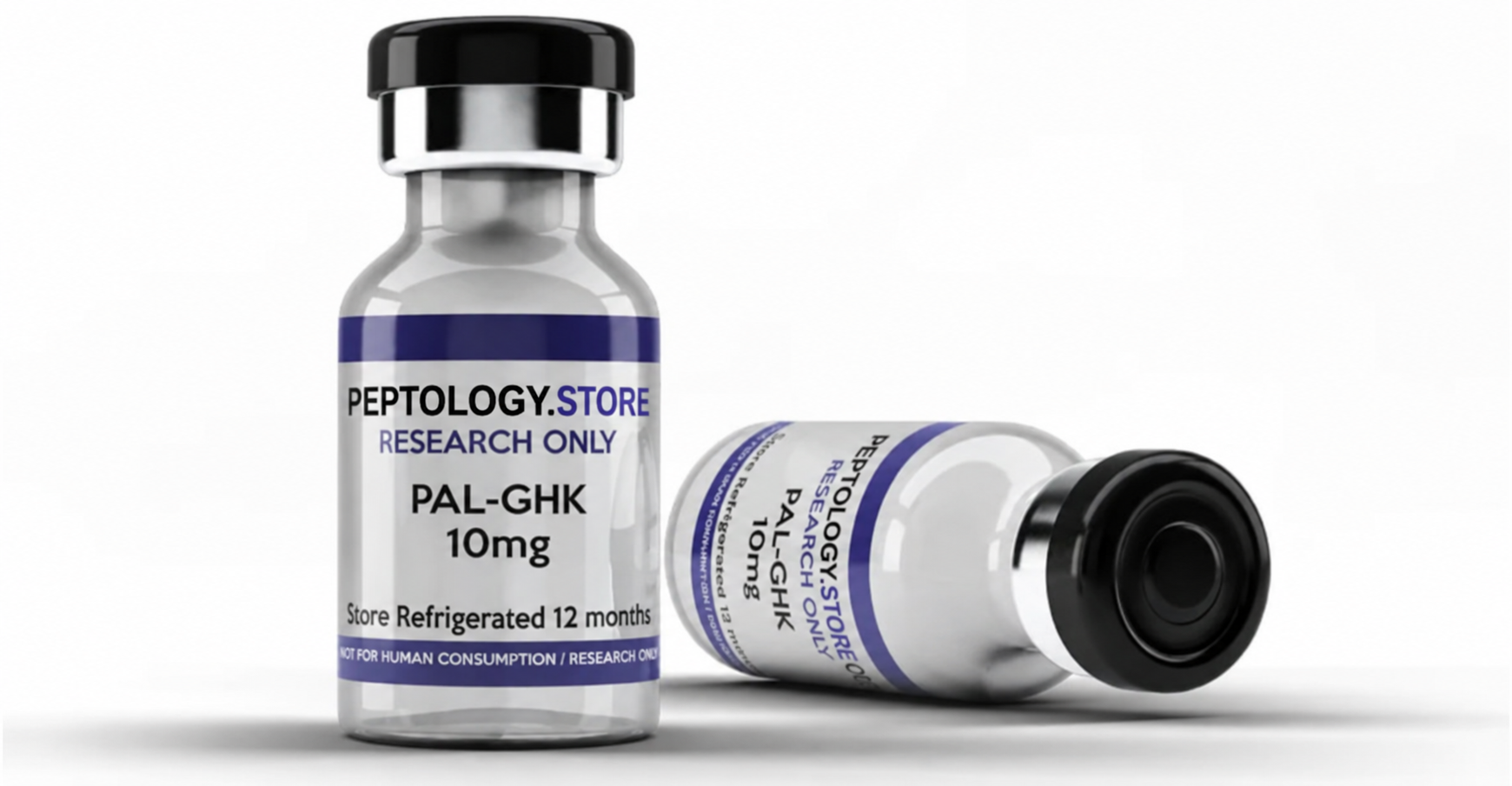
Premium PAL GHK (Palmitoyl Tripeptide-1) 10mg for Sale | ≥99% Purity | 50mg per Vial | 48-Hour Delivery Across EU & UK
PAL-GHK 10mg: Palmitoylated GHK Research Peptide for Skin Biology & Cellular Research
peptology.store presents PAL-GHK 10mg, a research-grade palmitoylated form of GHK supplied for laboratory investigations involving peptide signaling, skin biology, extracellular-matrix research, cellular communication, and tissue-remodeling pathways.
PAL-GHK refers to a lipid-modified form of GHK (glycyl-L-histidyl-L-lysine) in which a palmitoyl group is attached to the peptide. Lipid modification is an important area of peptide research because altering peptide structure can influence properties such as membrane interaction, hydrophobicity, and experimental behavior.
As a research supplier, Peptology Store provides PAL-GHK 10mg for controlled laboratory investigations where researchers require a defined palmitoylated GHK research compound.
For researchers seeking to buy peptide online for investigations into skin rejuvenation, wound healing, anti-aging mechanisms, or tissue regeneration, Peptology Store offers this premium research compound with comprehensive documentation, including Certificates of Analysis and batch-specific purity data. Whether your laboratory is based in London, Berlin, Paris, or anywhere in the European Union, our guaranteed 48 hour delivery peptide service ensures your research continues without interruption.
The Scientific Foundation of PAL-GHK Research
Understanding GHK
GHK (Gly-His-Lys) is a naturally occurring tripeptide that has been investigated extensively in cellular and skin-biology research.
GHK has been associated with research into:
- Extracellular-matrix regulation
- Collagen biology
- Fibroblast activity
- Cellular signaling
- Tissue remodeling
- Wound-healing mechanisms
- Gene-expression regulation
PAL-GHK incorporates a palmitoyl modification into the GHK structure, creating a more lipophilic peptide derivative for experimental investigation.
Palmitoylation and Peptide Research
Palmitoylation involves attaching a fatty-acid group to a molecule. In peptide research, lipid modification can alter physicochemical characteristics and interactions with biological membranes.
For PAL-GHK, researchers can investigate how the palmitoyl modification changes the experimental properties of GHK compared with the unmodified tripeptide.
Potential areas of investigation include:
- Membrane interaction
- Peptide localization
- Cellular uptake
- Molecular stability
- Lipid–peptide interactions
- Structure–activity relationships
GHK-Associated Cellular Pathways
Research involving GHK has examined cellular pathways associated with extracellular-matrix organization, collagen-related processes, fibroblast biology, and tissue remodeling.
PAL-GHK provides an opportunity to investigate whether lipid modification produces different cellular responses compared with conventional GHK.
Key Research Applications
Skin Biology Research
PAL-GHK can be investigated in laboratory models involving skin-cell biology and extracellular-matrix processes.
Potential research areas include:
- Fibroblast activity
- Collagen-related pathways
- Extracellular-matrix organization
- Cellular remodeling
- Skin-cell signaling
- Tissue regeneration mechanisms
Collagen and Extracellular-Matrix Research
GHK has been studied in relation to extracellular-matrix biology. PAL-GHK can therefore be incorporated into comparative experiments examining how lipid modification affects peptide-associated cellular responses.
Researchers may investigate:
- Collagen expression
- Matrix protein regulation
- Fibroblast signaling
- Extracellular-matrix remodeling
- Cell–matrix interactions
Cellular Signaling Research
PAL-GHK can be used as an experimental compound for investigating how a lipid-modified peptide interacts with cellular systems.
Research may examine:
- Cellular uptake
- Intracellular signaling
- Peptide localization
- Membrane interactions
- Gene-expression responses
Peptide Structure–Activity Research
One important application of PAL-GHK is comparative research between unmodified GHK and its palmitoylated derivative.
Researchers can investigate whether structural modification changes:
- Cellular activity
- Membrane association
- Stability
- Uptake
- Distribution
- Biological responses
Tissue-Remodeling Research
Because GHK has been investigated in tissue-repair and extracellular-matrix models, PAL-GHK may be incorporated into controlled laboratory studies examining tissue-remodeling mechanisms.
Quality Assurance: Supporting Reproducible Research
For PAL-GHK 10mg, researchers should review the analytical documentation associated with the specific production batch.
Relevant documentation may include:
- HPLC Analysis: Chromatographic assessment of material purity
- Mass Spectrometry: Molecular-mass confirmation
- Batch-Specific COA: Certificate of Analysis associated with the individual lot
- Identity Confirmation: Verification of the PAL-GHK material
- Physical Appearance: Documentation of the supplied research material
- Storage Information: Batch-specific handling recommendations
- Research-Use Labelling: Clear designation for laboratory research
Physical and Chemical Properties
| Molecular Weight (g/mol) | 578.799 g/mol |
| Peptide Sequence | Palmitoyl-Gly-His-Lys |
| Molecular Formula | C30H54N6O5 |
| Appearance | White to off-white lyophilised powder |
| Melting Point | Not applicable (decomposes before melting) |
| Research Use and Safety | |
| Caution | Handle using appropriate PPE and in compliance with relevant laboratory safety standards. |
| Intended Use | For laboratory research use only. Not for human or veterinary use. |
| Hazard Classification | Not classified as hazardous under GHS for research quantities |
| Storage, Handling and Stability | |
| Storage Temperature, Opened | -20 °C, minimise freeze-thaw cycles |
| Storage Temperature, Unopened | -20 °C recommended for long-term storage |
| Shelf Life | 2 years unopened under recommended conditions |
| Reconstitution Stability | Stable for up to 28 days at 2-8 °C in aqueous solution under sterile conditions |
tures
- 10mg Research Presentation
- Palmitoylated GHK
- Lipid-Modified Peptide
- GHK-Based Research Compound
- Skin Biology Research
- Fibroblast Research
- Collagen-Related Studies
- Extracellular-Matrix Research
- Cellular Signaling Studies
- Membrane Interaction Research
- Cellular Uptake Studies
- Structure–Activity Research
- Tissue-Remodeling Research
- Batch-Specific Analytical Documentation
- Research-Use-Only Material
- Laboratory-Oriented Handling Guidance
- EU & UK Research Supply through Peptology Store
Frequently Asked Questions
Q: What is PAL-GHK?
A: PAL-GHK is a palmitoylated derivative of GHK (Gly-His-Lys). The addition of a palmitoyl group creates a lipid-modified peptide that can be investigated in studies of cellular interaction, peptide localization, skin biology, and structure–activity relationships.
Q: What is PAL-GHK 10mg used for?
A: PAL-GHK 10mg is supplied for laboratory research involving peptide signaling, cellular uptake, membrane interactions, fibroblast biology, extracellular-matrix research, and comparative studies of lipid-modified peptides.
Q: What is the parent peptide of PAL-GHK?
A: The parent peptide is GHK, a tripeptide consisting of glycine, histidine, and lysine.
Q: What does the PAL modification mean?
A: PAL refers to the palmitoyl modification attached to the GHK peptide. This lipid modification changes the physicochemical characteristics of the parent peptide and provides a model for studying how structural modification affects peptide behavior.
Q: What research areas commonly investigate PAL-GHK?
A: Potential research areas include skin biology, fibroblast research, collagen and extracellular-matrix studies, cellular uptake, membrane interaction, peptide stability, and structure–activity research.
Q: How should PAL-GHK be stored?
A: Storage should follow the conditions provided with the specific research batch. Protect the material from moisture, unnecessary light exposure, temperature fluctuations, and repeated handling.
Q: Is PAL-GHK suitable for human consumption?
A: No. PAL-GHK 10mg supplied by peptology.store is intended for research and laboratory use only and is not marketed for human or veterinary consumption.
Q: Can PAL-GHK be used in cell-based research?
A: PAL-GHK can be investigated in appropriate in-vitro experimental systems where researchers are studying peptide–cell interactions, cellular uptake, membrane association, or GHK-related signaling.
Q: Can PAL-GHK be compared with GHK?
A: Yes. Comparative studies between GHK and PAL-GHK can help researchers investigate how palmitoylation affects peptide behavior, including cellular interaction, uptake, localization, and experimental activity.
Q: What documentation is available with PAL-GHK?
A: Researchers should request the batch-specific Certificate of Analysis (COA). Depending on the production batch, supporting documentation may include HPLC and mass-spectrometry information.
Q: Do you offer bulk quantities of PAL-GHK?
A: Bulk research supply can be discussed for qualified laboratory and institutional requirements. Researchers can contact Peptology Store regarding current availability, documentation, and supply requirements.
Q: Is PAL-GHK available to researchers in the UK and EU?
A: Current research-product availability and shipping options can be confirmed through peptology.store. Researchers should verify applicable destination-country requirements before ordering.
Q: Is PAL-GHK suitable for comparative peptide research?
A: Yes. PAL-GHK is particularly relevant to experimental designs comparing lipid-modified and unmodified peptides, allowing researchers to investigate differences in cellular interaction, localization, uptake, and signaling.
Advance Your Research with PAL-GHK 10mg
Peptology Store provides PAL-GHK 10mg as a research compound for investigators studying lipid-modified peptide biology, cellular signaling, fibroblast responses, extracellular-matrix pathways, and peptide structure–activity relationships.
Whether your research focuses on skin-cell biology, collagen-associated pathways, cellular uptake, membrane interactions, or comparisons between modified and unmodified peptides, PAL-GHK provides a defined experimental model for controlled laboratory investigation.
With appropriate batch documentation and research-focused handling information, PAL-GHK 10mg can be incorporated into experimental workflows where analytical traceability and reproducibility are important.
Order today and experience the Peptology Store difference – premium quality, rapid 48-hour delivery across the EU and UK, and expert support for the European research community.