FTPP Adipotide 2mg: Experimental Prohibitin-Targeting Peptidomimetic for Adipose-Vasculature Research
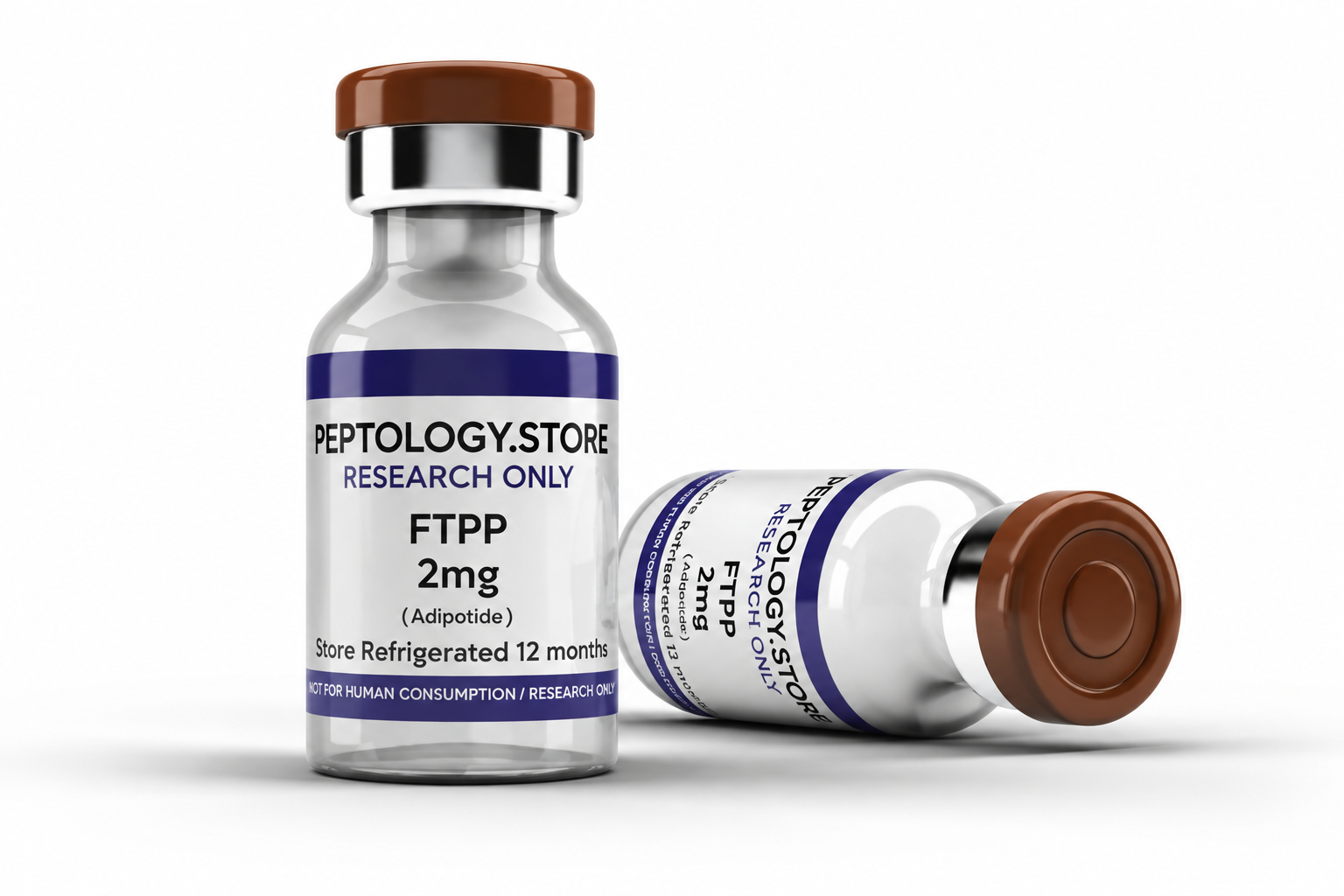
peptology.store presents FTPP Adipotide 2mg, also known as Adipotide, FTPP, or Prohibitin-Targeting Peptide 1 (PTP-1), as an experimental research compound for laboratory investigation into adipose-tissue vasculature, targeted peptide delivery, cellular apoptosis, and metabolic biology.
Adipotide is a chimeric peptidomimetic consisting of the vascular-homing sequence CKGGRAKDC, linked through a glycine-glycine spacer to the pro-apoptotic sequence D(KLAKLAK)₂. Published research has investigated this construct primarily in cellular, rodent, and non-human-primate models.
What makes FTPP Adipotide 2mg particularly valuable for research is its potential to support investigations into adipose-tissue biology, vascular targeting, and metabolic signaling. Adipotide (also known as FTPP) is an experimental peptide studied for its interaction with specific vascular targets associated with adipose tissue.
Its research profile makes it useful for investigating targeted peptide delivery, adipose-tissue vascular biology, cellular signaling, and mechanisms involved in energy metabolism.
Our collaboration with FTPP Adipotide 2mg ensures that every batch of FTPP meets rigorous quality control specifications, making peptology.store the preferred destination for researchers seeking to buy peptide online UK and across the European Union .
For researchers seeking to buy peptide online for investigations into tissue regeneration, wound healing, or musculoskeletal recovery, peptology.store offers FTPP Adipotide 2mg with comprehensive documentation, including Certificates of Analysis and batch-specific purity data. Whether your laboratory is based in London, Berlin, Paris, or anywhere in the European Union, our guaranteed 48 hour delivery peptide service ensures your research continues without interruption.
The Scientific Foundation of FTPP Adipotide Research
A Targeted Two-Component Architecture
Adipotide differs from conventional metabolic peptides because it was designed as a targeting-plus-payload construct.
Its published architecture contains:
- Targeting domain: CKGGRAKDC
- Linker: GG
- Pro-apoptotic domain: D(KLAKLAK)₂
The complete construct is commonly represented as:
CKGGRAKDC-GG-D(KLAKLAK)₂
The CKGGRAKDC portion was identified through in-vivo phage-display research and reported to associate with prohibitin on the vasculature of white adipose tissue. The D(KLAKLAK)₂ portion is a D-amino-acid pro-apoptotic sequence designed to disrupt mitochondrial membranes following cellular internalization.
Prohibitin-Associated Targeting
The original research identified CKGGRAKDC as a vascular-homing motif associated with prohibitin on blood vessels supplying white adipose tissue. This led researchers to investigate whether the targeting sequence could selectively deliver a pro-apoptotic payload to adipose-associated endothelial cells.
Pro-Apoptotic Payload
The D(KLAKLAK)₂ domain is intended to provide the cytotoxic component of the construct. Following internalization, the sequence can interact with mitochondrial membranes, providing a mechanism for studying targeted apoptosis.
This gives Adipotide its distinctive experimental architecture:
Targeting → Internalization → Mitochondrial disruption → Apoptotic signaling
Key Research Applications
Adipose-Tissue Vascular Research
The primary research interest in Adipotide concerns the blood vessels associated with white adipose tissue.
Researchers investigate:
- White-adipose-tissue microvasculature
- Endothelial-cell targeting
- Prohibitin-associated signaling
- Vascular remodeling
- Adipose-tissue vascular dependence
- Targeted endothelial apoptosis
Early animal research investigated whether disrupting adipose-associated vasculature could produce downstream changes in adipose tissue and body weight.
Targeted Apoptosis Research
Adipotide provides a model for studying how a pro-apoptotic payload can be directed toward a selected cellular population.
Research applications include:
- Cellular apoptosis
- Mitochondrial membrane disruption
- Targeted cytotoxic peptide delivery
- Endothelial-cell biology
- Peptide-mediated intracellular delivery
- Tissue-selective cell elimination
Metabolic Research
Animal studies have investigated Adipotide in models of obesity and metabolic dysfunction. Research in obese rodents and non-human primates has reported reductions in body weight and changes in metabolic parameters. These findings remain preclinical observations and should not be presented as established human therapeutic effects.
Research areas include:
- Adipose-tissue biology
- Energy metabolism
- Insulin-resistance models
- Adipose-tissue remodeling
- Metabolic signaling
- Vascular contributions to obesity
Peptide-Targeting Research
Because Adipotide combines a homing sequence with an intracellular pro-apoptotic payload, it is also useful as a model for investigating:
- Ligand-directed delivery
- Peptide targeting
- Protein-peptide interactions
- Receptor-mediated internalization
- Targeted therapeutic design
- Pro-apoptotic peptide engineering
Preclinical Research Evidence
Rodent Research
Foundational studies investigated targeted induction of apoptosis in blood vessels supplying white adipose tissue. The published work reported substantial reductions in body weight in obese mouse models following experimental treatment.
These results provided the basis for subsequent investigation in larger animal models.
Non-Human Primate Research
A later study investigated Adipotide in obese non-human primates. Researchers reported reductions in body weight and improvements in insulin-resistance measures during the experimental period.
Importantly, the same research also identified renal proximal-tubule effects, making kidney safety a major consideration in interpreting the compound’s preclinical profile.
Human Research Status
Adipotide should be regarded as a preclinical research compound, not an established human therapeutic.
A registered first-in-human Phase I study investigated Prohibitin Targeting Peptide 1 in patients with metastatic prostate cancer and obesity. The study did not establish a completed human efficacy or safety profile, and Adipotide has not become an approved therapeutic.
Therefore:
- No validated human therapeutic dose has been established.
- No established human efficacy profile exists.
- No comprehensive human safety profile exists.
- Animal findings should not be directly extrapolated to humans.
- Renal findings from animal research are an important limitation.
Quality Assurance: Research-Grade Characterization
peptology.store should provide batch-specific analytical documentation for FTPP Adipotide 2mg where available.
For research-grade material, appropriate documentation may include:
- HPLC Analysis: Chromatographic purity assessment
- Mass Spectrometry: Molecular-weight and identity confirmation
- Batch-Specific COA: Certificate corresponding to the supplied lot
- Sequence/Identity Confirmation: Verification of the intended Adipotide construct
- Research-Use-Only Labeling: Clear laboratory-use designation
- Storage Documentation: Manufacturer- or batch-specific stability information
Product Specifications
| Specification | Detail |
|---|---|
| Product Name | FTPP Adipotide 2mg |
| Alternative Names | Adipotide; FTPP; Prohibitin-Targeting Peptide 1 |
| Classification | Experimental chimeric peptidomimetic |
| Construct | CKGGRAKDC-GG-D(KLAKLAK)₂ |
| Quantity | 2mg |
| Targeting Domain | CKGGRAKDC |
| Linker | Gly-Gly (GG) |
| Pro-Apoptotic Domain | D(KLAKLAK)₂ |
| Primary Research Area | Adipose vasculature and targeted apoptosis |
| Research Areas | Metabolic biology, endothelial research, peptide targeting |
| Form | Lyophilized material, where supplied in lyophilized form |
| Intended Use | Research and laboratory use only |
| Therapeutic Status | Not an approved human therapeutic |
| Documentation | Batch-specific COA recommended |
The published research identifies the construct as CKGGRAKDC-GG-D(KLAKLAK)₂.
Stability and Handling Guidelines
Lyophilized Material
For FTPP Adipotide 2mg supplied as lyophilized research material:
- Follow the storage conditions supplied with the specific batch.
- Protect the material from direct light.
- Keep the container tightly sealed.
- Protect against moisture.
- Avoid unnecessary temperature fluctuations.
- Maintain batch-specific storage records where required.
Reconstituted Material
There is no universally validated commercial post-reconstitution stability period that should be applied to every Adipotide preparation.
For laboratory research:
- Follow the supplier’s batch-specific reconstitution documentation.
- Use a solvent system validated for the intended experiment.
- Avoid repeated freeze-thaw cycles where applicable.
- Aliquoting may reduce repeated handling.
- Label reconstituted material with the preparation date.
- Use validated stability data rather than assuming a fixed storage period.
Key Research Features
- Experimental Targeted Peptidomimetic: Combines a vascular-homing domain with a pro-apoptotic payload.
- Adipose-Vasculature Research: Investigated in models involving blood vessels supplying white adipose tissue.
- Prohibitin-Associated Targeting: CKGGRAKDC was identified as a vascular-homing motif associated with prohibitin.
- Pro-Apoptotic Domain: D(KLAKLAK)₂ provides the mitochondrial-disruption component.
- Targeted Delivery Research: Useful for investigating ligand-directed peptide delivery.
- Apoptosis Research: Supports experimental investigation of targeted endothelial-cell apoptosis.
- Metabolic Research: Studied in animal models involving obesity and insulin resistance.
- Preclinical Evidence: Evidence is primarily derived from cellular and animal research.
- Human Translation: No established human therapeutic efficacy or safety profile.
- Renal Safety Consideration: Renal proximal-tubule effects were reported in non-human-primate research.
- Batch Characterization: Research material should be accompanied by appropriate analytical documentation.
- RUO Positioning: Appropriate presentation is as an experimental laboratory compound.
Frequently Asked Questions
Q: What is FTPP Adipotide 2mg?
A: FTPP Adipotide is an experimental chimeric peptidomimetic also known as Adipotide or Prohibitin-Targeting Peptide 1. Its published construct combines CKGGRAKDC with D(KLAKLAK)₂ and has primarily been investigated in adipose-vascular and metabolic research.
Q: What is the sequence of Adipotide?
A: The commonly reported construct is CKGGRAKDC-GG-D(KLAKLAK)₂. It consists of a vascular-homing sequence, a glycine-glycine linker, and a D-amino-acid pro-apoptotic domain.
Q: What research areas commonly use Adipotide?
A: Research has focused on adipose-tissue vasculature, targeted apoptosis, peptide delivery, endothelial-cell biology, obesity models, insulin resistance, and metabolic research.
Q: Has Adipotide been studied in animals?
A: Yes. Research has included rodent models and non-human primates. Studies reported changes in body weight and metabolic parameters, while primate research also identified renal effects.
Q: Has Adipotide been established as a human treatment?
A: No. Adipotide remains an experimental research compound and does not have an established approved therapeutic indication. Human development did not produce an established clinical efficacy or safety profile.
Q: What are the major research limitations of Adipotide?
A: The evidence base is predominantly preclinical, and renal effects were reported in non-human-primate research. Consequently, animal findings should not be interpreted as evidence of established human safety or efficacy.
Q: What documentation should accompany FTPP Adipotide from peptology.store?
A: Research-grade material should ideally be accompanied by a batch-specific Certificate of Analysis, with identity and purity information. HPLC and mass-spectrometry documentation can provide additional analytical characterization.
Q: Do you offer bulk quantities of FTPP Adipotide for institutional research?
A: Bulk availability depends on current supplier inventory and applicable research-compound requirements. Institutional purchasers should request batch-specific analytical documentation and applicable compliance information from peptology.store before procurement.
Q: Do you ship FTPP Adipotide to EU and UK research facilities?
A: Shipping availability depends on the destination, applicable regulations, and current supplier fulfillment options. Researchers should verify the current shipping terms directly with peptology.store and ensure that procurement complies with local requirements.
Q: Can FTPP Adipotide be used in laboratory research?
A: Adipotide has been investigated in experimental cellular and animal models involving targeted apoptosis, adipose vasculature, and metabolic biology. Laboratory work should be conducted under appropriate institutional procedures and with validated experimental protocols.
Q: Is there an established human dosing protocol for Adipotide?
A: No validated human dosing protocol should be presented for this compound. The available evidence does not establish a clinically validated human dose, and preclinical animal dosing should not be converted into human-use instructions.
Q: What is the main mechanism investigated with Adipotide?
A: The research model proposes that CKGGRAKDC targets prohibitin-associated structures on adipose-tissue vasculature, allowing the attached D(KLAKLAK)₂ pro-apoptotic domain to be internalized and disrupt mitochondrial membranes.
Advance Your Research with FTPP Adipotide 2mg
peptology.store can position FTPP Adipotide 2mg as an experimental research compound for laboratories investigating targeted peptide delivery, adipose-tissue vasculature, endothelial apoptosis, metabolic biology, and prohibitin-associated signaling.
The scientific literature makes Adipotide particularly interesting because of its unusual targeting-plus-payload architecture. At the same time, the preclinical evidence includes important renal safety findings, and the compound has not established a validated human therapeutic profile.
Order today and experience the peptology.store difference – premium Thoroughbred Labs quality, rapid 48-hour delivery across the EU and UK, and expert support for the European research community.