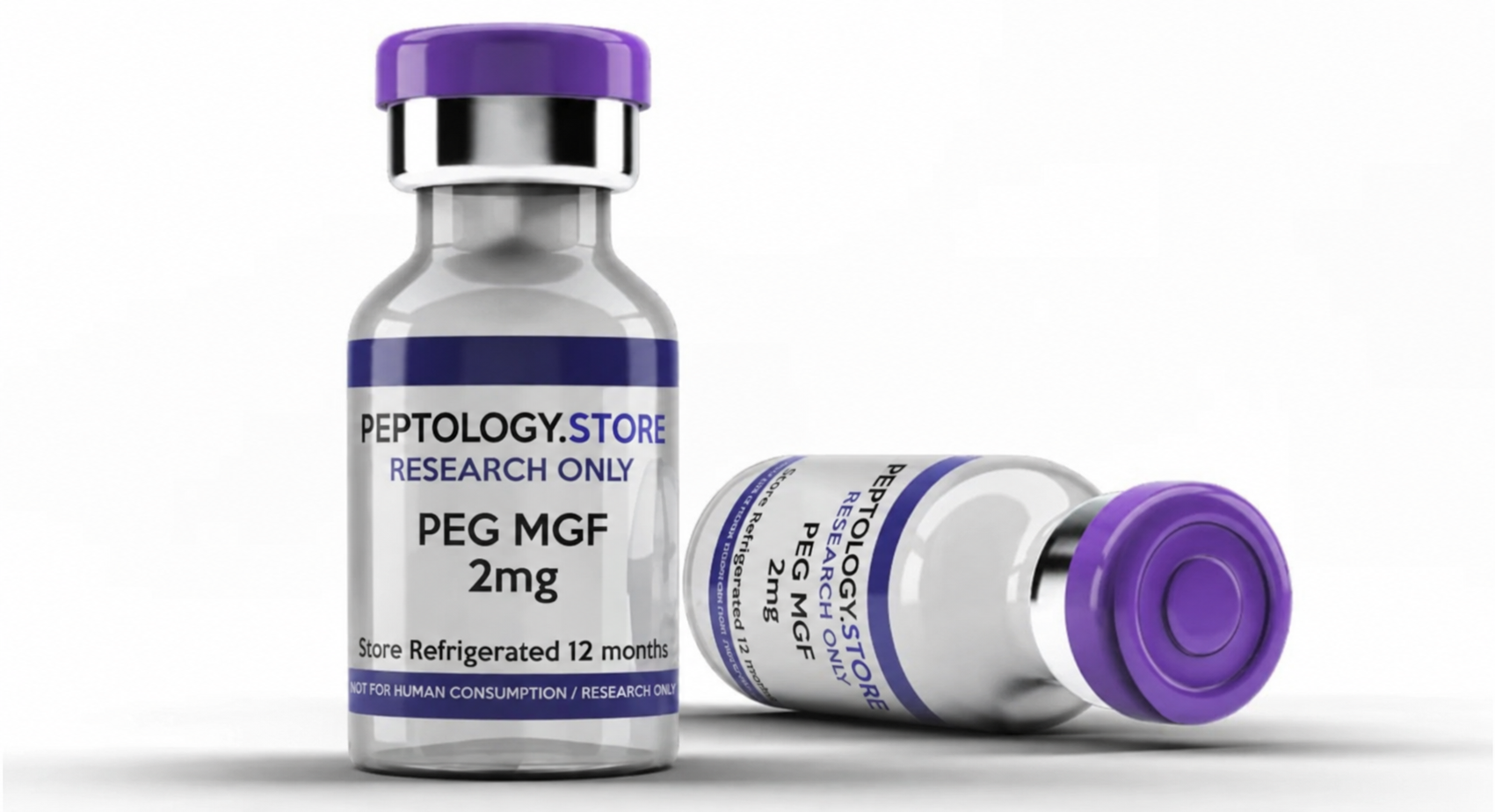
Premium PEG-MGF 2mg (Pegylated Mechano Growth Factor) for Sale | Lyophilized Powder | Research Grade | EU & UK Delivery
PEG-MGF 2mg: Advanced Pegylated Mechano Growth Factor for Muscle Regeneration & Cellular Signaling Research
peptology.store is proud to present PEG-MGF 2mg (Pegylated Mechano Growth Factor), a premium research-grade peptide designed for advanced laboratory investigations into muscle regeneration, cellular growth, satellite cell activity, tissue repair, and IGF-1-associated signaling pathways.
As a trusted peptide vendor UK and dedicated EU peptide supplier, we provide researchers across Europe with PEG-MGF 2mg for sale, with an emphasis on analytical quality, consistency, and documented product specifications.
PEG-MGF is a chemically modified form of Mechano Growth Factor (MGF), a peptide associated with alternative splicing of the insulin-like growth factor-1 (IGF-1) gene. MGF has attracted scientific interest because of its relationship with mechanical loading, skeletal muscle adaptation, satellite cell activity, and tissue regeneration.
The addition of polyethylene glycol (PEG) to the peptide structure is intended to modify its physicochemical characteristics, including its susceptibility to enzymatic degradation and persistence under experimental conditions.
What makes PEG-MGF 2mg particularly interesting for research is its combination of MGF-associated biological mechanisms and PEGylation technology, providing investigators with a modified peptide for studying muscle-cell responses, growth-factor signaling, cellular proliferation, and tissue remodeling.
Our collaboration with qualified manufacturing facilities aims to ensure that every batch of PEG-MGF 2mg meets defined analytical specifications, making peptology.store a destination for researchers seeking to buy research peptides online UK and across the European Union.
The Scientific Foundation of PEG-MGF Research
Discovery and Biological Background
Mechano Growth Factor (MGF) is associated with alternative splicing of the IGF-1 gene and has been investigated for its expression following mechanical loading and tissue injury.
Researchers have examined MGF-related signaling in skeletal muscle because of its proposed involvement in early cellular responses to mechanical stress and muscle damage.
The development of PEGylated MGF represents an attempt to modify the peptide’s physicochemical properties through the attachment of polyethylene glycol.
PEGylation is a widely investigated pharmaceutical and biochemical modification technique that can influence peptide stability, molecular size, solubility, and pharmacokinetic behavior.
However, the precise properties of an individual PEG-MGF preparation depend on its molecular structure, PEG attachment, and manufacturing specifications.
Structure and Classification
PEG-MGF (Pegylated Mechano Growth Factor) is a chemically modified research peptide based on an MGF-associated peptide sequence.
Its molecular structure incorporates polyethylene glycol, distinguishing it from unmodified MGF.
PEG-MGF research commonly focuses on:
-
Skeletal muscle biology
-
Satellite cell activity
-
Growth-factor signaling
-
Cellular proliferation
-
Tissue regeneration
-
IGF-1-associated pathways
-
Peptide stability and modification
-
Muscle adaptation mechanisms
Understanding PEGylation Technology
PEGylation involves the covalent attachment of polyethylene glycol to a peptide or protein.
Depending on the molecular design, this modification can influence:
-
Molecular size
-
Enzymatic degradation
-
Solubility
-
Molecular stability
-
Biological distribution
-
Interaction with cellular targets
These characteristics make PEG-MGF useful for comparative laboratory investigations involving modified and unmodified peptide structures.
MGF and IGF-1-Associated Signaling
MGF is associated with alternative IGF-1 gene splicing and has been investigated in relation to skeletal muscle adaptation.
Experimental research has examined MGF-related activity in pathways associated with:
-
Muscle-cell responses to mechanical stress
-
Satellite cell activation
-
Cellular proliferation
-
Muscle regeneration
-
Tissue remodeling
-
Growth-factor-associated signaling
It is important to distinguish the biological properties of naturally expressed MGF-related isoforms from those of commercially synthesized PEG-MGF preparations.
Key Research Applications
Muscle Regeneration Research
PEG-MGF is investigated in laboratory studies exploring mechanisms associated with skeletal muscle regeneration and cellular adaptation.
Research applications include:
-
Muscle Repair Models: Investigating cellular responses associated with muscle injury.
-
Satellite Cell Biology: Examining the activity of muscle-resident stem cells.
-
Cellular Proliferation: Studying pathways involved in muscle-cell growth.
-
Muscle Adaptation: Investigating responses to mechanical stimulation.
-
Tissue Remodeling: Exploring cellular processes associated with structural tissue changes.
Satellite Cell Research
Satellite cells are specialized muscle-resident stem cells involved in skeletal muscle maintenance and regeneration.
MGF-related research has examined the relationship between mechanical stimulation, IGF-1 gene expression, and satellite cell activity.
PEG-MGF may be incorporated into controlled experimental models investigating:
-
Satellite cell activation
-
Myogenic cell proliferation
-
Muscle precursor-cell behavior
-
Cellular differentiation
-
Muscle regeneration signaling
IGF-1 Pathway Research
The IGF-1 system is involved in several biological processes associated with cellular growth and tissue regulation.
PEG-MGF provides an experimental peptide for studying the relationship between MGF-associated sequences and growth-factor biology.
Potential research areas include:
-
IGF-1-associated signaling
-
Cellular growth pathways
-
Muscle-cell responses
-
Growth-factor regulation
-
Molecular interactions involving modified peptides
Tissue Repair and Regeneration Studies
PEG-MGF can also be investigated in experimental systems examining cellular responses associated with tissue damage and regeneration.
Research endpoints may include:
-
Cell viability
-
Cellular proliferation
-
Tissue-remodeling markers
-
Growth-factor expression
-
Cellular stress responses
-
Regenerative signaling
Aging and Sarcopenia Research
Age-associated changes in skeletal muscle include reductions in muscle mass, regenerative capacity, and satellite cell function.
MGF-related mechanisms are therefore relevant to research investigating muscle aging.
PEG-MGF may be evaluated in laboratory models examining:
-
Age-associated muscle changes
-
Satellite cell responses
-
Muscle-cell proliferation
-
Growth-factor signaling
-
Cellular regeneration
-
Skeletal muscle maintenance
These applications remain investigational and should not be interpreted as evidence of established clinical efficacy.
Comparative Peptide Research
PEG-MGF is particularly relevant to comparative studies involving peptide modification.
Researchers may compare modified and unmodified MGF-related sequences to investigate:
-
Molecular stability
-
Peptide degradation
-
Solubility
-
Biological activity
-
Cellular interactions
-
Experimental response profiles
Quality Assurance: Setting the Standard for Research Compounds
Manufacturing Excellence
peptology.store supplies PEG-MGF 2mg with an emphasis on analytical quality, research consistency, and batch traceability.
Quality-control documentation may include:
-
HPLC Purity Analysis: Chromatographic assessment of peptide purity.
-
Mass Spectrometry Verification: Confirmation of molecular identity and relevant mass characteristics.
-
Batch-Specific Certificates of Analysis: Analytical documentation associated with individual production lots.
-
PEGylation Verification: Assessment of the modified peptide according to the applicable analytical specification.
-
Lyophilized Formulation: Supplied as a dry research compound for appropriate laboratory storage.
-
Research-Use Only (RUO) Labelling: Intended exclusively for research and laboratory applications.
Physical and Chemical Properties
| Molecular Weight (g/mol) | 2888.16 g/mol |
| Peptide Sequence | H-Tyr-Gln-Pro-Pro-Ser-Thr-Asn-Lys-Asn-Thr-Lys-Ser-Gln-Arg-Arg-Lys-Gly-Ser-Thr-Phe-Glu-Glu-His-Lys-NH2 |
| Physical and Chemical Properties | |
| Molecular Formula | C121H200N42O39 |
| Physical Appearance | White lyophilised solid |
| Form | Sterile filtered white lyophilized (freeze-dried) |
| Solubility | Aqueous soluble |
| Appearance | White to off-white lyophilised powder |
| Melting Point | Not applicable (decomposes before melting) |
| Analytical and Quality Control | |
| Mass Spectrum | Consistent with structure. |
| Purity % | >98% |
| Research Use and Safety | |
| Caution | Research use only / Not for human or veterinary use |
| Intended Use | For laboratory research use only. Not for human or veterinary use. |
| Hazard Classification | Not classified as hazardous under GHS for research quantities |
| Storage, Handling and Stability | |
| Storage Temperature, Opened | Lyophilized peptides although stable at room temperature for 3 months, should be stored desiccated below -18°C. Upon reconstitution of the peptide it should be stored at 4°C between 2-21 days and for future use below -18°C. |
| Storage Temperature, Unopened | -20 °C recommended for long-term storage |
| Shelf Life | 2 years unopened under recommended conditions |
| Reconstitution Stability | Stable for up to 28 days at 2-8 °C in aqueous solution under sterile conditions |
Stability and Handling
PEG-MGF 2mg should be handled according to the product-specific documentation and established laboratory procedures.
-
Lyophilized Powder Storage: Store under the temperature conditions specified by the manufacturer.
-
Light Sensitivity: Protect the compound from unnecessary direct light exposure.
-
Moisture Protection: Keep the original container tightly sealed.
-
Temperature Control: Avoid unnecessary temperature fluctuations during storage.
-
Reconstituted Solutions: Establish appropriate storage conditions according to validated laboratory protocols.
-
Aliquoting: Where suitable, divide prepared research solutions into single-use aliquots to minimize repeated freeze-thaw exposure.
-
Handling Guidance: Avoid unnecessary agitation and prolonged exposure to unsuitable environmental conditions.
-
Transportation: Use appropriate protective packaging to preserve product integrity during transit.
Real-World Research Applications and Investigator Experiences
Mechanical Loading and MGF Expression Studies
Research investigating skeletal muscle adaptation has identified relationships between mechanical stimulation and alternative IGF-1 gene expression.
MGF-associated sequences have therefore attracted interest as experimental tools for understanding the molecular responses of skeletal muscle to mechanical stress.
Researchers may investigate:
-
Mechanical loading responses
-
IGF-1 gene expression
-
Muscle adaptation
-
Cellular proliferation
-
Growth-factor signaling
Satellite Cell Activation Studies
Satellite cells are important for skeletal muscle regeneration.
MGF-related experimental research has investigated how growth-factor-associated mechanisms influence satellite cell responses during muscle adaptation and repair.
PEG-MGF may be evaluated in controlled experimental systems to investigate whether PEGylation alters the activity of an MGF-derived sequence.
Muscle Regeneration Models
Muscle regeneration involves coordinated cellular processes, including inflammatory signaling, satellite cell activity, myogenic differentiation, and tissue remodeling.
PEG-MGF provides a modified peptide for experimental investigation into selected aspects of these processes.
Potential measurements include:
-
Cell proliferation
-
Myogenic markers
-
Cellular viability
-
Growth-factor-associated responses
-
Regenerative signaling
PEGylation and Peptide Stability Research
One of the distinguishing features of PEG-MGF is its chemically modified structure.
PEGylation research can examine how polymer attachment influences peptide stability, degradation, molecular behavior, and biological interactions.
These characteristics make PEG-MGF relevant to laboratory investigations involving peptide engineering and modified growth-factor-associated compounds.
Safety and Translational Research Considerations
Published research on MGF-related biology should not automatically be interpreted as evidence of the safety or effectiveness of PEG-MGF in humans.
PEG-MGF remains an investigational compound, and its biological behavior may differ from naturally occurring IGF-1 isoforms or unmodified MGF-derived peptides.
All research should be conducted under appropriate institutional procedures.
Key Benefits
-
Premium Research-Grade Material: Supplied for controlled laboratory investigations.
-
2mg Per Vial: Defined research quantity.
-
PEGylated Peptide Structure: Modified MGF-associated peptide.
-
Muscle Regeneration Research: Relevant to experimental muscle-repair models.
-
Satellite Cell Studies: Supports investigations into muscle-resident stem-cell biology.
-
IGF-1-Associated Research: Useful for examining growth-factor-related mechanisms.
-
Cellular Proliferation Studies: Suitable for appropriately designed cellular research.
-
Tissue Remodeling Research: Investigate regenerative cellular pathways.
-
Skeletal Muscle Biology: Explore muscle adaptation and mechanical-stress responses.
-
Peptide Modification Research: Examine the influence of PEGylation.
-
Molecular Stability Studies: Compare modified and unmodified peptide characteristics.
-
Aging Research: Relevant to experimental models of age-associated muscle changes.
-
Lyophilized Formulation: Suitable for controlled laboratory storage.
-
Analytical Documentation: Batch-specific COA according to product specifications.
-
Research-Use Only: Intended exclusively for laboratory research.
-
Batch Traceability: Documentation supports reproducible experimental workflows.
-
EU & UK Research Supply: Available through Peptology Store.
-
Protective Packaging: Designed to preserve product integrity during transit.
Frequently Asked Questions
Q: What is PEG-MGF 2mg?
A: PEG-MGF 2mg is a PEGylated derivative of Mechano Growth Factor (MGF), supplied as a synthetic research peptide. It is investigated in laboratory models involving muscle biology, cellular proliferation, satellite cell activity, peptide modification, and tissue-regeneration mechanisms.
Q: What does PEG-MGF stand for?
A: PEG-MGF stands for Pegylated Mechano Growth Factor. The term refers to an MGF-derived peptide that has undergone chemical modification through the attachment of polyethylene glycol.
Q: What makes PEG-MGF different from regular MGF?
A: PEG-MGF contains a polyethylene glycol modification that distinguishes it structurally from unmodified MGF-derived peptides. PEGylation can influence molecular stability, degradation, solubility, and other physicochemical characteristics, depending on the specific formulation.
Q: What research areas commonly use PEG-MGF?
A: PEG-MGF is relevant to laboratory investigations involving skeletal muscle biology, satellite cell activity, tissue regeneration, IGF-1-associated signaling, peptide modification, and cellular proliferation.
Q: What purity level can I expect when I buy PEG-MGF from peptology.store?
A: Product purity should be verified using the batch-specific Certificate of Analysis associated with the supplied material. Analytical documentation provides the appropriate reference for evaluating individual production batches.
Q: What is the molecular weight of PEG-MGF?
A: The molecular weight of PEG-MGF depends on the specific peptide structure, PEG attachment, and degree of modification. Researchers should consult the applicable batch-specific analytical documentation for the molecular-weight specification.
Q: How should PEG-MGF be stored?
A: Store lyophilized PEG-MGF according to the manufacturer’s storage recommendations, protected from light and moisture. Reconstituted material should be handled according to validated laboratory stability procedures.
Q: Is PEG-MGF suitable for human consumption?
A: No. PEG-MGF 2mg supplied by peptology.store is strictly intended for research and laboratory use only. It is not marketed as an approved human or veterinary therapeutic product.
Q: Can PEG-MGF be used in cell culture research?
A: PEG-MGF may be evaluated in appropriately designed in-vitro experimental systems. Researchers should establish suitable concentrations, controls, solvents, and exposure conditions according to validated laboratory protocols.
Q: What is the relationship between MGF and IGF-1?
A: MGF is associated with alternative splicing of the IGF-1 gene and has been investigated in relation to mechanical loading, skeletal muscle adaptation, and cellular regeneration.
Q: Is PEG-MGF studied for muscle regeneration?
A: PEG-MGF is investigated in relation to MGF-associated mechanisms and skeletal muscle biology. However, findings involving naturally expressed MGF or unmodified peptide sequences should not automatically be assumed to apply equally to PEG-MGF.
Q: Does PEGylation improve peptide stability?
A: PEGylation can modify the physicochemical properties of peptides and proteins, potentially influencing stability and degradation. The extent of these effects depends on the specific PEGylated molecule and must be established through appropriate analytical testing.
Q: Does PEG-MGF have established clinical benefits in humans?
A: No established human therapeutic benefits should be inferred from preclinical MGF-related research. PEG-MGF remains an investigational compound, and its safety and effectiveness for human use have not been established.
Q: What documentation is provided with PEG-MGF orders?
A: Batch-specific analytical documentation may include a Certificate of Analysis, chromatographic purity information, and relevant molecular-identity testing, depending on the product specification.
Q: Do you offer bulk quantities of PEG-MGF for institutional research?
A: Bulk research supply may be available for qualified laboratories and research institutions. Contact Peptology Store for current availability, documentation, quantity options, and institutional requirements.
Q: Do you ship PEG-MGF to EU countries?
A: peptology.store provides research-compound supply options for customers across the EU and UK, subject to applicable destination-country requirements and shipping availability.
Q: What makes PEG-MGF valuable for scientific research?
A: PEG-MGF combines an MGF-associated peptide structure with polyethylene glycol modification, making it a useful experimental subject for investigating skeletal muscle biology, satellite cell responses, growth-factor-associated pathways, and the influence of PEGylation on peptide properties.
Advance Your Research with PEG-MGF 2mg
peptology.store is your source for PEG-MGF 2mg (Pegylated Mechano Growth Factor), a specialized research peptide for investigators exploring skeletal muscle biology, cellular regeneration, satellite cell activity, IGF-1-associated signaling, and peptide modification.
Whether you are investigating muscle-cell responses, designing satellite cell studies, examining tissue-regeneration mechanisms, or researching the physicochemical effects of PEGylation, PEG-MGF 2mg provides a modified peptide structure for controlled laboratory investigations.
With research-focused product specifications, analytical documentation, and appropriate handling guidance, PEG-MGF offers a foundation for experimental workflows requiring consistency and traceability.
Order today and experience the peptology.store difference – premium quality, rapid 48-hour delivery across the EU and UK, and expert support for the European research community.