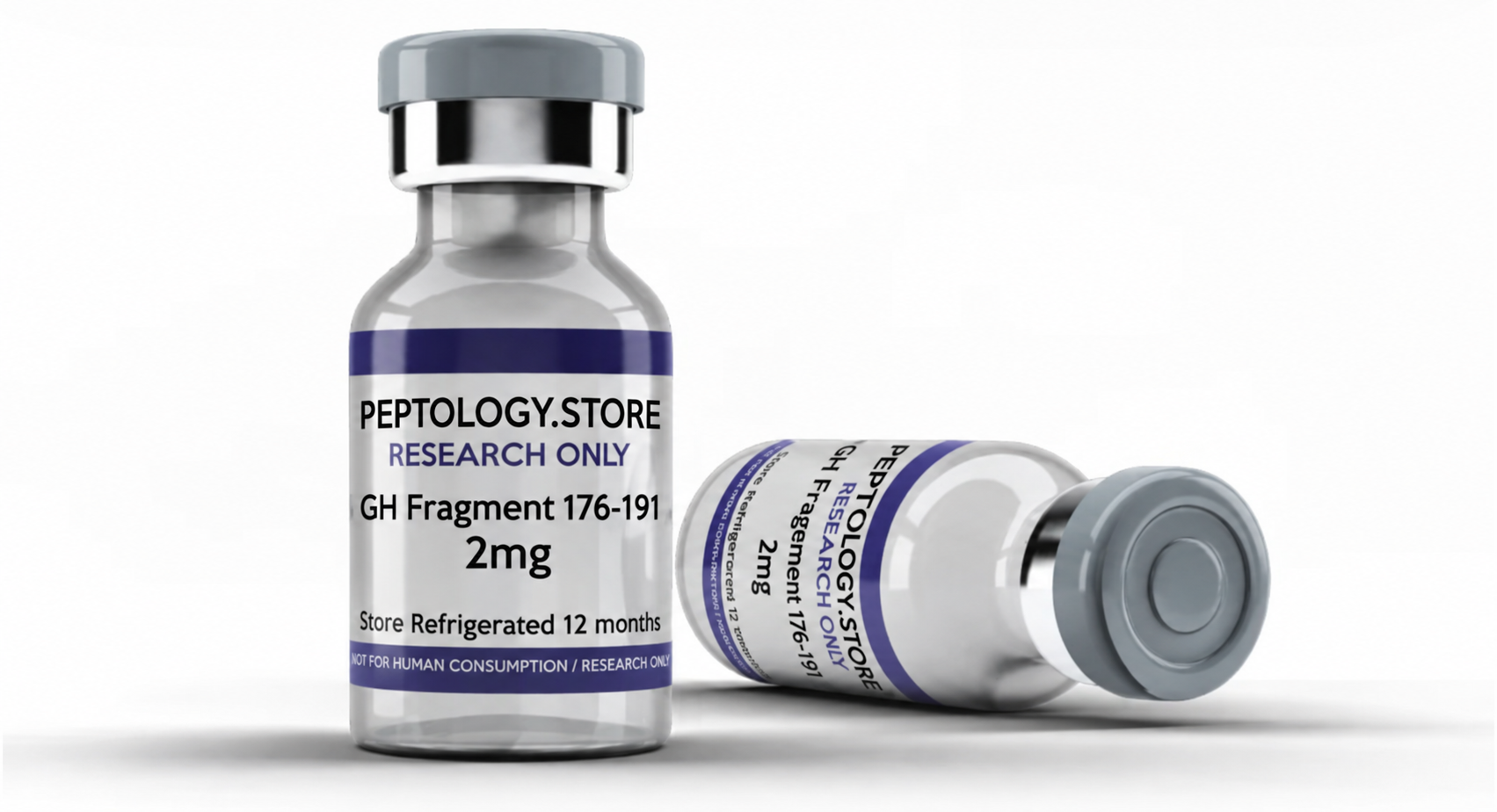
HGH Fragment 176–191 2mg: Research Peptide for Metabolic & Adipose-Tissue Studies For Sale UK & EU
HGH Fragment 176–191 2mg: Research Peptide for Metabolic & Adipose-Tissue Studies
peptology.store is proud to present HGH Fragment 176–191 2mg, a research-grade synthetic peptide fragment corresponding to residues 176–191 of human growth hormone (hGH). As a research peptide supplier, we provide HGH Fragment 176–191 for laboratory investigations involving adipose-tissue biology, lipid metabolism, metabolic signaling, and growth-hormone structure–function relationships.
HGH Fragment 176–191 represents the C-terminal region of human growth hormone and has been investigated as a distinct peptide fragment for studying biological mechanisms associated with lipid metabolism and adipose-tissue activity. Unlike full-length hGH, this compound consists only of the defined 176–191 sequence, providing researchers with a focused model for examining the contribution of this region to metabolic processes.
The peptide is supplied as a 2mg lyophilized research compound, allowing investigators to study a defined hGH fragment under controlled laboratory conditions. Research involving HGH Fragment 176–191 has examined pathways associated with fatty-acid mobilization, adipocyte activity, lipid utilization, and metabolic regulation.
For researchers seeking to buy peptide online for investigations into muscle physiology, bone health, or androgen receptor signaling, peptology.store offers HGH Fragment 176–191 with comprehensive documentation, including Certificates of Analysis and batch-specific purity data. Whether your laboratory is based in London, Berlin, Paris, or anywhere in the European Union, our guaranteed 48 hour delivery peptide service ensures your research continues without interruption.
The Scientific Foundation of HGH Fragment 176–191 Research
Structure and Classification
HGH Fragment 176–191 is a synthetic 16-amino-acid fragment corresponding to residues 176–191 of human growth hormone.
The fragment has attracted research interest because studies have investigated whether specific regions of hGH may contribute to metabolic activity independently of the complete hormone.
This makes HGH Fragment 176–191 particularly relevant to structure–activity relationship research, where investigators examine how defined peptide sequences contribute to biological responses.
Metabolic Research
Research involving HGH Fragment 176–191 has primarily focused on mechanisms associated with lipid metabolism and adipose-tissue biology.
Experimental studies have investigated areas including:
- Lipid mobilization
- Fatty-acid metabolism
- Adipocyte activity
- Energy-substrate utilization
- Metabolic signaling
- Growth-hormone-related pathways
The fragment therefore provides a focused research model for examining metabolic effects associated with a specific region of hGH.
Adipose-Tissue Research
HGH Fragment 176–191 has been investigated in experimental models involving adipose tissue and fat-cell metabolism.
Researchers can use the peptide to explore how defined peptide fragments may influence cellular processes associated with lipid storage, mobilization, and energy metabolism.
These investigations may help clarify the relationship between peptide structure and metabolic signaling.
Key Research Applications
Lipid Metabolism Studies
HGH Fragment 176–191 provides a research tool for investigating:
- Lipid mobilization
- Fatty-acid utilization
- Adipocyte metabolism
- Lipid-storage pathways
- Metabolic signaling mechanisms
Adipocyte Biology
The peptide can be investigated in laboratory models examining cellular activity within adipose tissue.
Research may focus on how adipocytes respond to defined peptide fragments and how these responses relate to lipid metabolism.
Growth Hormone Structure–Function Research
Because HGH Fragment 176–191 represents a specific region of hGH, it can be used in studies examining the relationship between peptide structure and biological activity.
Researchers can investigate whether individual regions of the larger hormone contribute independently to particular metabolic processes.
Metabolic Signaling Research
HGH Fragment 176–191 can also be incorporated into controlled laboratory investigations examining cellular signaling associated with metabolism and energy balance.
| Molecular Weight (g/mol) | 1817.1 g/mol |
| Peptide Sequence | H-Tyr -Leu-Arg-lle-Va1-GIn-Cys-Arg-Ser-Va1-GIu-Gly-Ser-Cys-Gly-Phe-OH |
| Physical and Chemical Properties | |
| Molecular Formula | C78H125N23O23S2 |
| Physical Appearance | White lyophilised solid |
| Form | Sterile filtered white lyophilized (freeze-dried) |
| Solubility | Aqueous soluble |
| Appearance | White to off-white lyophilised powder |
| Melting Point | Not applicable (decomposes before melting) |
| Analytical and Quality Control | |
| Mass Spectrum | Consistent with structure. |
| Purity % | >98% |
| Research Use and Safety | |
| Caution | Research use only / Not for human or veterinary use |
| Intended Use | For laboratory research use only. Not for human or veterinary use. |
| Hazard Classification | Not classified as hazardous under GHS for research quantities |
| Storage, Handling and Stability | |
| Storage Temperature, Opened | Lyophilized peptides although stable at room temperature for 3 months, should be stored desiccated below -18°C. Upon reconstitution of the peptide it should be stored at 4°C between 2-21 days and for future use below -18°C. |
| Storage Temperature, Unopened | -20 °C recommended for long-term storage |
| Shelf Life | 2 years unopened under recommended conditions |
| Reconstitution Stability | Stable for up to 28 days at 2-8 °C in aqueous solution under sterile conditions |
Stability and Handling
HGH Fragment 176–191 should be handled and stored under conditions appropriate for a research peptide:
- Storage Conditions: Store the lyophilized peptide at approximately -20°C, protected from direct light and moisture.
- Shelf Life: Stability should be determined according to the manufacturer’s batch-specific documentation and Certificate of Analysis.
- Moisture Protection: Keep the original container tightly sealed and protected from humidity.
- Reconstituted Solutions: For research applications requiring reconstitution, use an appropriate laboratory-grade solvent according to the validated experimental protocol. Aliquoting can help minimize repeated freeze-thaw cycles.
- Freeze-Thaw Protection: Avoid unnecessary repeated freezing and thawing, as repeated temperature cycling may affect peptide integrity.
- Transportation: Maintain appropriate temperature control and protective secondary packaging during shipment to minimize exposure to heat, light, and moisture.
Real-World Research Applications and Investigator Experiences
Lipid Metabolism Research
HGH Fragment 176–191 is a modified fragment corresponding to residues 176–191 of human growth hormone and has attracted research interest because of its association with mechanisms involved in lipid metabolism.
Researchers have investigated the fragment in experimental models examining:
- Lipolytic signaling
- Fatty-acid metabolism
- Adipocyte biology
- Energy metabolism
- Hormone-related metabolic pathways
Unlike intact growth hormone, HGH Fragment 176–191 is studied primarily for biological activity associated with the C-terminal region of the hormone rather than as a replacement for full-length growth hormone.
Adipose Tissue Studies
Experimental research has investigated HGH Fragment 176–191 in models of adipocyte function and fat metabolism. Studies have explored whether the fragment can influence pathways associated with the breakdown and utilization of stored lipids.
Research areas include:
- Adipocyte differentiation
- Lipid mobilization
- Fatty-acid utilization
- Regulation of adipose tissue metabolism
- Cellular responses to metabolic signaling
These studies provide researchers with a model for examining the biological activity of the C-terminal region of growth hormone independently from the complete hormone molecule.
Growth Hormone Fragment Research
HGH Fragment 176–191 provides researchers with an opportunity to study a specific region of the human growth hormone molecule.
The fragment corresponds to amino acids 176–191 of human growth hormone and has been investigated to determine whether this region contributes to metabolic activity independently of the hormone’s complete structure.
This makes the peptide useful for comparative studies involving:
- Full-length human growth hormone
- Growth hormone fragments
- Hormonal signaling
- Metabolic regulation
- Structure–activity relationships
Cellular and Molecular Research
Researchers can use HGH Fragment 176–191 in experimental systems designed to investigate molecular responses associated with lipid metabolism and cellular energy regulation.
Potential research areas include:
- Intracellular metabolic signaling
- Adipocyte biology
- Lipid oxidation
- Cellular energy homeostasis
- Hormone-derived peptide activity
- Structure–function relationships
Metabolic Disease Research
HGH Fragment 176–191 has also been investigated in experimental models relevant to metabolic disorders and altered lipid metabolism.
Research may examine how the fragment interacts with pathways involved in:
- Obesity-related metabolic changes
- Adipose tissue dysfunction
- Fat accumulation
- Lipid homeostasis
- Metabolic signaling
Findings from experimental models should not be interpreted as evidence of established therapeutic efficacy in humans.
Key Research Features
- Research-Grade HGH Fragment: Fragment corresponding to residues 176–191 of human growth hormone
- 2mg Quantity: Supplied as a 2mg research-peptide preparation
- Lipid Metabolism Research: Investigated in experimental models involving lipid mobilization and fatty-acid metabolism
- Adipose Tissue Studies: Used to investigate biological processes involving adipocytes and lipid storage
- Growth Hormone Fragment Research: Enables investigation of a defined C-terminal region of human growth hormone
- Structure–Activity Studies: Useful for examining relationships between peptide structure and biological activity
- Metabolic Research: Investigated in experimental models of energy and lipid regulation
- Cellular Research: Suitable for laboratory investigations involving peptide-mediated cellular pathways
- Batch Documentation: Research materials should be accompanied by appropriate batch-specific analytical documentation where available
- Controlled Storage: Store according to the manufacturer’s recommended temperature and handling conditions
- Research Use Only: Intended for laboratory and research applications, not human or veterinary use
Frequently Asked Questions
Q: What is HGH Fragment 176–191?
A: HGH Fragment 176–191 is a peptide corresponding to amino acids 176–191 of human growth hormone. It has been investigated primarily in experimental research involving lipid metabolism, adipose tissue biology, and metabolic signaling.
Q: What makes HGH Fragment 176–191 useful for research?
A: Its value comes from allowing researchers to investigate the biological properties of a defined region of human growth hormone independently from the complete hormone. This makes it useful for studies involving lipid metabolism, adipocyte biology, metabolic pathways, and structure–activity relationships.
Q: What research areas commonly use HGH Fragment 176–191?
A: Research involving HGH Fragment 176–191 includes lipid metabolism, adipose tissue biology, fatty-acid metabolism, metabolic signaling, energy homeostasis, and growth-hormone fragment research.
Q: How should HGH Fragment 176–191 be stored?
A: The lyophilized material should generally be stored at approximately -20°C, protected from light and moisture. Researchers should follow the storage requirements supplied with the specific batch and its analytical documentation.
Q: How should HGH Fragment 176–191 be handled after reconstitution?
A: Reconstituted material should be handled according to the validated laboratory protocol and the manufacturer’s documentation. Aliquoting can reduce repeated freeze-thaw exposure, and unnecessary temperature cycling should be avoided.
Q: Is HGH Fragment 176–191 the same as full-length human growth hormone?
A: No. HGH Fragment 176–191 represents a specific 16-amino-acid region of human growth hormone rather than the complete 191-amino-acid hormone. Its research profile therefore differs from that of full-length HGH.
Q: Does HGH Fragment 176–191 stimulate growth hormone secretion?
A: HGH Fragment 176–191 is primarily investigated as a defined growth-hormone fragment rather than as a conventional growth-hormone secretagogue. Researchers should distinguish studies involving the fragment from studies involving full-length HGH or GHRH analogues.
Q: Can HGH Fragment 176–191 be used in cell-based research?
A: It can be investigated in appropriate laboratory and cell-based experimental systems. Solvent selection, concentration, controls, and final solvent levels should be established according to the specific validated research protocol.
Q: What documentation should accompany HGH Fragment 176–191?
A: Research-grade material should ideally be accompanied by batch-specific analytical documentation such as a Certificate of Analysis (COA), purity information, and analytical data where available.
Q: Is HGH Fragment 176–191 intended for human consumption?
A: No. Research-grade HGH Fragment 176–191 should be clearly labeled and handled as Research Use Only (RUO) material and is not intended for human or veterinary consumption.
Q: Do you offer bulk HGH Fragment 176–191 for institutional research?
A: Yes. We accommodate bulk orders for research institutions. Contact our team now for volume pricing, custom requirements, and supply agreements for ongoing research programs.
Q: Do you ship HGH Fragment 176–191 to EU and UK research facilities?
A: Yes. As a dedicated peptide supplier, we ship HGH Fragment 176–191 to all European Union member states with our guaranteed 48 hour delivery peptide service. Our peptology.store fulfilment centre ensures rapid delivery without customs delays. Each unit ships in protective secondary packaging with labeling designed to remain legible during transit
Advance Your Research with HGH Fragment 176–191 2mg
peptology.store is your trusted source for HGH Fragment 176–191 2mg, a research-grade peptide designed for investigators studying growth-hormone fragment biology, lipid metabolism, adipose tissue pathways, and metabolic regulation. Corresponding to residues 176–191 of human growth hormone, HGH Fragment 176–191 provides researchers with a defined peptide sequence for investigating the biological properties of this specific region of the hormone.
Whether you are exploring adipocyte biology, lipid mobilization, fatty-acid metabolism, metabolic signaling, or structure–activity relationships involving growth-hormone-derived peptides, HGH Fragment 176–191 2mg provides a focused research material for laboratory investigations. Appropriate batch documentation, analytical verification, and controlled storage practices can help support consistent and reproducible experimental work.
Order today and experience the peptology.store difference – premium HGH Fragment 176–191 2mg quality, rapid 48-hour delivery across the EU and UK, and expert support for the European research community.