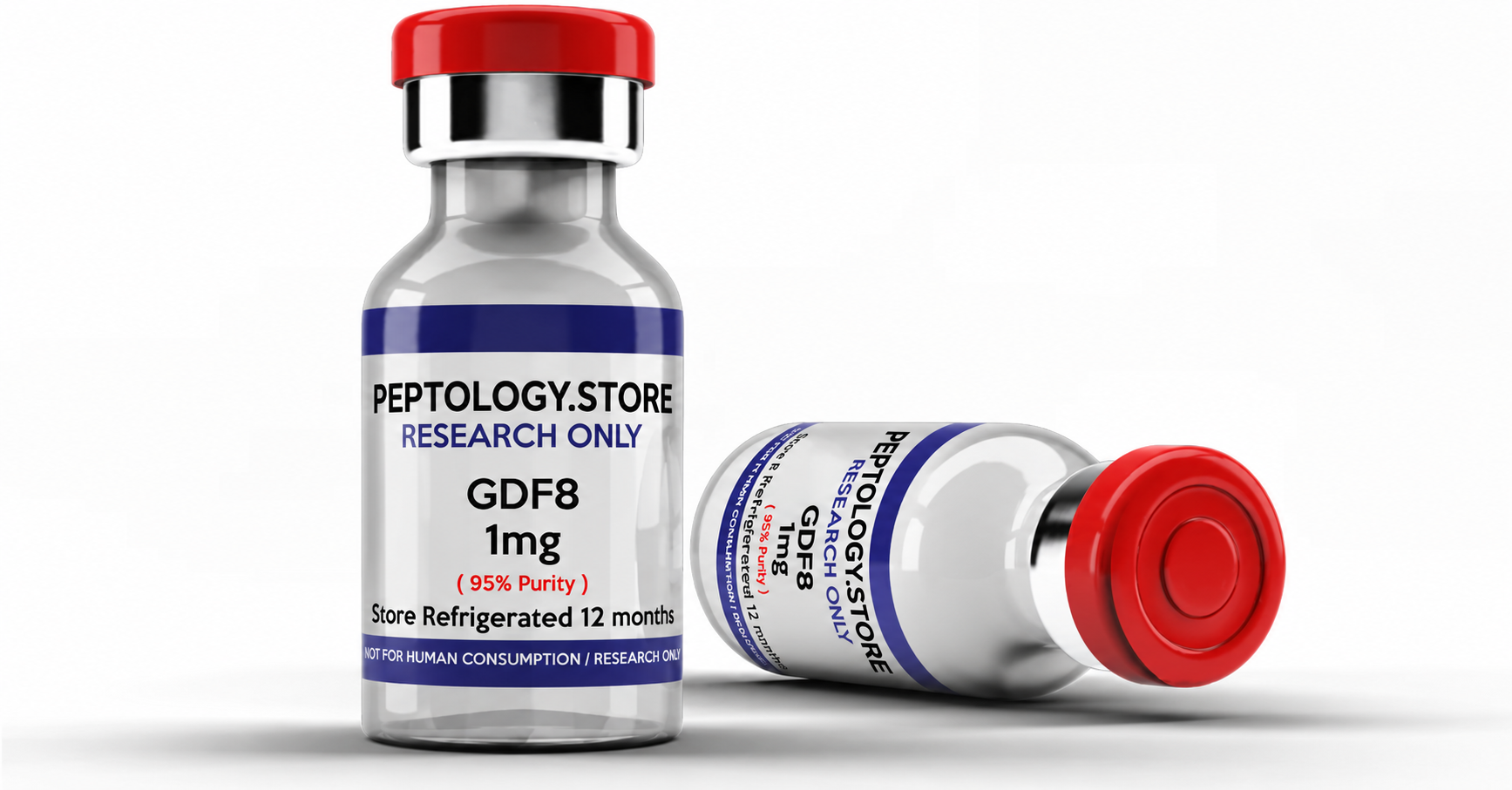
GDF-8 (Myostatin) 1mg – High-Quality Research Protein | 48-Hour Delivery Across EU & UK
GDF-8 (Myostatin) 95%: A Key Regulatory Protein for Muscle Biology & Growth Research
peptology.store presents GDF-8 (Myostatin) 95%, a research-grade material for laboratory investigations into skeletal muscle development, muscle-cell differentiation, tissue growth, and transforming growth factor-beta (TGF-β) superfamily signaling.
GDF-8, commonly known as myostatin, is a member of the TGF-β superfamily and functions as an important negative regulator of skeletal muscle growth. It has become a widely studied molecular target in research examining muscle development, regeneration, metabolism, and related signaling pathways.
The mechanism of action of GDF-8 (Myostatin) has been extensively investigated in preclinical models of skeletal muscle biology. As a member of the transforming growth factor-beta (TGF-β) superfamily, GDF-8 regulates muscle-cell growth and differentiation through interactions with activin type II receptors, particularly ActRIIB. Receptor activation subsequently engages type I receptors and downstream SMAD2/3 signaling, influencing transcriptional pathways involved in muscle development, myoblast differentiation, and muscle homeostasis.
By activating this signaling pathway, GDF-8 functions as an important negative regulator of skeletal muscle growth. Experimental studies have demonstrated that disruption or inhibition of myostatin signaling can produce substantial increases in skeletal muscle mass, making the GDF-8 pathway an important model for investigating muscle hypertrophy, regeneration, atrophy, and tissue remodeling.
Research into GDF-8 also examines its interactions with extracellular regulatory proteins such as follistatin, which can bind myostatin and influence its availability to activin receptors. These ligand–binding interactions provide additional opportunities for studying the regulation of TGF-β superfamily signaling.
Our GDF-8 (Myostatin) 95% research material is intended for laboratory investigations involving myostatin signaling, activin receptor biology, SMAD2/3 pathways, skeletal muscle development, myoblast differentiation, and muscle-regulation mechanisms. For current product information, batch documentation, and research specifications, visit peptology.store.
For researchers seeking to buy peptide online for investigations into metabolic disorders, obesity, diabetes, or mitochondrial function, peptology.store offers GDF-8 (Myostatin) 95% with comprehensive documentation, including Certificates of Analysis and batch-specific purity data. Whether your laboratory is based in London, Berlin, Paris, or anywhere in the European Union, our guaranteed 48 hour delivery peptide service ensures your research continues without interruption.
The Scientific Foundation of GDF-8 (Myostatin) Research
Discovery and Biological Significance
GDF-8 was identified as a growth and differentiation factor belonging to the TGF-β superfamily and was subsequently characterized as myostatin, a regulator of skeletal muscle mass.
Genetic disruption of the myostatin gene produces a pronounced increase in skeletal muscle mass in several animal models, establishing GDF-8 as an important biological regulator of muscle development.
The protein is synthesized as a precursor that undergoes proteolytic processing to generate the mature signaling form. Its activity is regulated through interactions with extracellular binding proteins and other components of the TGF-β signaling system.
GDF-8 Signaling
Myostatin signaling involves binding to activin type II receptors, particularly ActRIIB and related type II receptors. Receptor activation can recruit type I receptors and stimulate intracellular SMAD2/3 signaling.
The resulting signaling cascade can influence transcriptional programs involved in:
- Myoblast differentiation
- Muscle-cell growth
- Protein metabolism
- Satellite-cell activity
- Skeletal muscle development
- Tissue remodeling
Relationship with Follistatin and Activin Signaling
GDF-8 activity is regulated by several extracellular proteins, including follistatin, which can bind members of the TGF-β/activin family and influence receptor availability.
The interaction between myostatin, follistatin, activin receptors, and related ligands provides an important research model for understanding how extracellular protein networks regulate muscle growth.
Key Research Applications
Skeletal Muscle Biology
GDF-8 is extensively studied as a molecular regulator of skeletal muscle mass.
Research applications include:
- Muscle growth regulation
- Muscle-cell differentiation
- Myoblast proliferation
- Muscle regeneration
- Skeletal muscle development
- Muscle atrophy pathways
Myoblast Differentiation Research
Researchers use GDF-8 to investigate how myogenic precursor cells transition through proliferation and differentiation.
Experimental studies can examine:
- Myogenic gene expression
- Myotube formation
- Cellular differentiation
- Muscle-specific transcription factors
- SMAD2/3 signaling
Muscle Regeneration and Satellite-Cell Research
Satellite cells are important for skeletal muscle regeneration. Myostatin signaling has been investigated for its role in regulating satellite-cell activity and the balance between muscle repair and growth.
This makes GDF-8 relevant to research involving:
- Muscle injury models
- Regenerative biology
- Satellite-cell activation
- Muscle remodeling
- Tissue recovery pathways
TGF-β Superfamily Research
Because GDF-8 belongs to the TGF-β superfamily, it provides a useful experimental ligand for investigating broader signaling mechanisms.
Researchers can study:
- Activin receptor signaling
- SMAD2/3 phosphorylation
- Ligand–receptor interactions
- TGF-β family cross-talk
- Extracellular ligand regulation
Metabolic and Tissue Research
Myostatin signaling has also been investigated in relation to adipose tissue, glucose metabolism, and broader metabolic regulation.
These studies help researchers examine relationships between skeletal muscle signaling and systemic metabolic pathways.
Quality Assurance: Supporting Reproducible Research
For GDF-8 (Myostatin) 95%, researchers should review the analytical documentation associated with the individual batch.
Important quality information may include:
- Purity: 95% specification for the supplied research material
- HPLC Analysis: Chromatographic assessment of peptide/protein purity
- Mass Spectrometry: Molecular-mass confirmation where applicable
- Batch-Specific COA: Certificate of Analysis associated with the production lot
- Identity Confirmation: Analytical confirmation of GDF-8 identity
- Physical Appearance: Documentation of the supplied material
- Storage Information: Manufacturer-provided stability recommendations
- Research-Use Labeling: Clear designation for laboratory research
| Physical and Chemical Properties | |
| Appearance | White to off-white lyophilised powder |
| Melting Point | Not applicable (decomposes before melting) |
| Research Use and Safety | |
| Caution | Handle using appropriate PPE and in compliance with relevant laboratory safety standards. |
| Intended Use | For laboratory research use only. Not for human or veterinary use. |
| Hazard Classification | Not classified as hazardous under GHS for research quantities |
| Storage, Handling and Stability | |
| Storage Temperature, Opened | -20 °C, minimise freeze-thaw cycles |
| Storage Temperature, Unopened | -20 °C recommended for long-term storage |
| Shelf Life | 2 years unopened under recommended conditions |
| Reconstitution Stability | Stable for up to 28 days at 2-8 °C in aqueous solution under sterile conditions |
Stability and Handling
GDF-8 (Myostatin) 95% should be stored and handled according to the supplier’s batch-specific documentation.
- Storage: Maintain the material under the recommended temperature conditions supplied with the batch.
- Light Protection: Protect from unnecessary direct light exposure.
- Moisture Protection: Keep the container tightly sealed and protected from humidity.
- Reconstituted Material: Follow validated laboratory procedures and supplier instructions when preparing experimental solutions.
- Freeze-Thaw Exposure: Avoid unnecessary repeated freeze-thaw cycles.
- Aliquoting: Where appropriate for the research protocol, aliquot prepared material to minimize repeated handling.
- Documentation: Record storage, preparation, and experimental conditions to support reproducibility.
Real-World Research Applications and Investigator Experiences
Myostatin Loss-of-Function Research
One of the strongest foundations for myostatin research comes from genetic studies demonstrating that disruption of GDF-8 signaling can produce substantial increases in skeletal muscle mass in experimental animals.
These models provide researchers with important evidence for investigating the molecular mechanisms controlling muscle growth.
SMAD Signaling Studies
Researchers can use GDF-8 to investigate activation of the SMAD2/3 pathway, including downstream changes in transcription and cellular differentiation.
Muscle Atrophy Research
Because myostatin acts as a negative regulator of muscle growth, researchers investigate its signaling in models involving muscle loss, disuse, aging, and other conditions associated with altered muscle homeostasis.
Follistatin Interaction Studies
GDF-8 can be investigated alongside follistatin and related proteins to understand how extracellular ligand-binding interactions influence signaling through activin receptors.
Comparative TGF-β Research
GDF-8 can also be compared with other TGF-β superfamily ligands to investigate differences in receptor utilization, downstream signaling, and cellular responses.
Key Research Features
- GDF-8 / Myostatin
- 95% Purity Specification
- TGF-β Superfamily Member
- Skeletal Muscle Research
- Myoblast Differentiation Studies
- Muscle Regeneration Research
- Satellite-Cell Biology
- SMAD2/3 Signaling Research
- Activin Receptor Research
- Follistatin Interaction Studies
- Muscle Atrophy Research
- Muscle Development Studies
- Metabolic Research Applications
- Comparative TGF-β Signaling
- Batch-Specific Analytical Documentation
- Research-Use Material
- Laboratory Use Only
Frequently Asked Questions
Q: What is GDF-8?
A: GDF-8, commonly called myostatin, is a member of the TGF-β superfamily that functions as an important regulator of skeletal muscle growth and development.
Q: What is another name for GDF-8?
A: GDF-8 is commonly known as myostatin. The terms GDF-8 and myostatin generally refer to the same biological protein.
Q: What receptor does GDF-8 interact with?
A: GDF-8 can interact with activin type II receptors, particularly ActRIIB, initiating signaling involving type I receptors and downstream SMAD2/3 pathways.
Q: What is the role of myostatin in muscle research?
A: Myostatin is widely investigated as a negative regulator of skeletal muscle growth. Researchers study its role in muscle development, myoblast differentiation, regeneration, and muscle homeostasis.
Q: What research areas commonly use GDF-8?
A: GDF-8 is investigated in skeletal muscle biology, muscle regeneration, myoblast differentiation, satellite-cell research, muscle atrophy, TGF-β signaling, activin receptor biology, and metabolic research.
Q: What is the relationship between GDF-8 and follistatin?
A: Follistatin is an extracellular binding protein that can interact with myostatin and other members of the activin/TGF-β family. This interaction is an important subject of research into the regulation of myostatin signaling.
Q: Does GDF-8 activate SMAD signaling?
A: Yes. GDF-8 signaling is associated with activation of the SMAD2/3 pathway through activin receptor signaling. Researchers frequently examine SMAD phosphorylation and downstream transcriptional responses when studying myostatin biology.
Q: How should GDF-8 95% be stored?
A: Follow the storage conditions provided with the specific research batch. Protect the material from unnecessary light, moisture, temperature fluctuations, and repeated freeze-thaw exposure.
Q: What documentation should accompany GDF-8?
A: Researchers should request a batch-specific Certificate of Analysis (COA) and, where available, analytical information such as HPLC purity results, mass-spectrometry data, lot identification, and storage recommendations.
Q: Can GDF-8 be used in cell-based research?
A: GDF-8 can be investigated in appropriate experimental cell systems. Researchers should establish suitable concentrations, controls, exposure conditions, and assay procedures according to their validated laboratory protocols.
Q: Do you offer bulk quantities of GDF-8?
A: Institutional and laboratory researchers requiring larger quantities should contact peptology.store to confirm current availability, batch documentation, pricing, and research-supply requirements.
Q: Do you ship GDF-8 to EU and UK research facilities?
A: Shipping availability, delivery times, and import requirements should be confirmed directly with peptology.store, as these can vary according to destination and applicable regulations.
Q: Where can I find GDF-8 95% product information?
A: Current product information, availability, and applicable documentation can be reviewed through peptology.store.
Advance Your Research with GDF-8 (Myostatin) 95%
peptology.store provides GDF-8 (Myostatin) 95% as a research material for investigators studying skeletal muscle biology, myogenic differentiation, muscle regeneration, activin receptor signaling, and TGF-β superfamily pathways.
With its established role as a regulator of skeletal muscle growth, GDF-8 provides a well-defined experimental target for investigating the molecular mechanisms governing muscle development, tissue remodeling, and cellular signaling.
Whether you are exploring obesity mechanisms, designing diabetes studies, investigating cancer metabolism, or studying mitochondrial bioenergetics, our rigorously tested compound provides the quality and consistency your work demands.
Order today and experience the peptology.store difference – premium GDF-8 (Myostatin) 95% quality, rapid 48-hour delivery across the EU and UK, and expert support for the European research community.