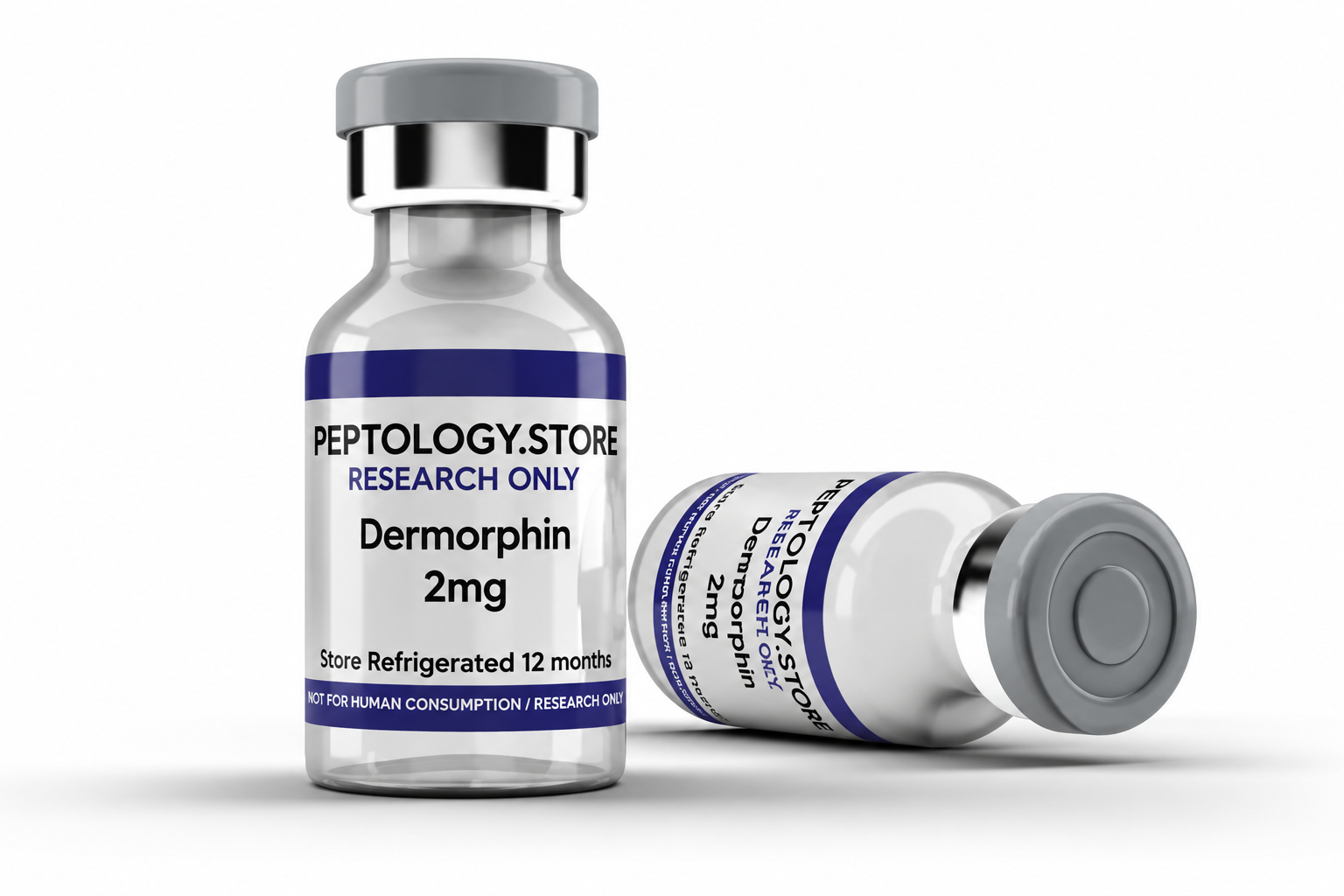
Premium Dermorphin Peptide for Sale | 2mg Lyophilized Powder | High-Purity Research Peptide | EU & UK Delivery
Dermorphin Peptide: A Potent Opioid Peptide at the Forefront of Receptor Pharmacology Research
Buy Dermorphin Peptide EU & UK, peptology.store is proud to present Dermorphin 2mg, a research-grade opioid peptide supplied for controlled laboratory investigation. As a trusted peptide vendor uk and leading EU peptide supplier, we provide researchers across Europe with Dermorphin peptide for sale for advanced studies in opioid receptor pharmacology, peptide-receptor interactions, analgesic signaling, and related neuroscience research. Buy Dermorphin Peptide EU & UK
Dermorphin: is a peptide originally isolated from South American Phyllomedusa frogs. Its unique properties make it an area of interest in scientific studies related to receptor interactions. This product is designed for use in laboratory research where high precision is required.
- Product Name: Dermorphin 2mg
- Catalogue Number: DER2-024
- Molecular Formula: C40H50N8O10
- Molecular Weight: 802.88 g/mol
- Purity: 98%
- Sequence: Tyr-D-Ala-Phe-Gly-Tyr-Pro-Ser-NH2
- CAS Number: 77614-16-5
- Form: Lyophilised Solid
Storage and Handling:
Dermorphin is supplied as a lyophilised solid to ensure maximum stability and ease of use in research environments. Store the sealed vial at -20°C, protected from light and moisture. All handling and laboratory procedures are determined by the receiving laboratory under its own protocols.
Synthesis and Quality Assurance:
Dermorphin is meticulously synthesised through a controlled process that ensures high purity and stability, suitable for laboratory research. Our commitment to excellence guarantees that each batch undergoes stringent quality control.
Legal and Safety Information:
Peptology Store provides Dermorphin strictly for scientific and research use. Our products meet stringent quality standards and comply with legal requirements. Note that our peptides, including Dermorphin, are intended for research purposes only and are not for human consumption or clinical application.
To acquire high-quality Dermorphin for your research, explore our range of peptides designed for scientific innovation.
For researchers seeking to buy peptide online for investigations into neuroimmune interactions, inflammatory pathways, gastrointestinal physiology, or neuroprotection, peptology.store offers this premium research compound with comprehensive documentation, including Certificates of Analysis and batch-specific purity data. Whether your laboratory is based in London, Berlin, Paris, or anywhere in the European Union, our guaranteed 48 hour delivery peptide service ensures your research continues without interruption.
The Scientific Foundation of Dermorphin Peptide Research
Discovery and Historical Significance
Dermorphin is a naturally occurring opioid heptapeptide originally isolated from the skin secretions of South American frogs of the Phyllomedusa genus. It attracted significant scientific interest because of its unusually high affinity and selectivity for μ-opioid receptors (MORs) compared with many endogenous opioid peptides.
Since its discovery, Dermorphin has been investigated extensively in experimental pharmacology and neuroscience research, particularly in studies examining opioid receptor activation, peptide-receptor interactions, analgesic signaling, and mechanisms underlying opioid-mediated cellular responses.
Structure and Classification
Dermorphin is a seven-amino-acid peptide with the sequence Tyr-D-Ala-Phe-Gly-Tyr-Pro-Ser. A notable structural feature is the presence of D-alanine at the second position, distinguishing Dermorphin from many naturally occurring opioid peptides and contributing to its receptor-binding characteristics.
Dermorphin belongs to the broader family of opioid peptides and is primarily characterized by its interaction with μ-opioid receptors. Its defined peptide sequence makes it a useful research compound for investigating structure–activity relationships and receptor-selective opioid signaling.
Dermorphin and μ-Opioid Receptors
Dermorphin produces its principal pharmacological effects through interaction with the μ-opioid receptor (MOR), a G protein-coupled receptor involved in opioid signaling. Receptor activation can influence intracellular signaling pathways associated with neuronal excitability, neurotransmitter release, and analgesic responses.
Research involving Dermorphin therefore provides an experimental model for examining:
- μ-Opioid Receptor Binding: Investigating the interaction between Dermorphin and MORs
- Receptor Selectivity: Studying the preferential activity of Dermorphin at μ-opioid receptors
- G-Protein Signaling: Examining intracellular signaling following opioid-receptor activation
- Neuronal Signaling: Investigating opioid-mediated changes in neuronal activity and neurotransmission
- Structure–Activity Relationships: Exploring how individual amino-acid residues influence opioid peptide activity
| Receptor | Distribution | Primary Functions |
|---|
| μ-Opioid Receptor (MOR / OPRM1) | Widely expressed throughout the central and peripheral nervous systems, including brain regions, spinal cord, and peripheral sensory neurons | Opioid-mediated analgesia, modulation of neuronal excitability, regulation of neurotransmitter release, and other opioid-related signaling processes |
| δ-Opioid Receptor (DOR / OPRD1) | Expressed primarily in the central and peripheral nervous systems, with distribution across multiple neuronal populations | Modulation of nociception, neuronal signaling, and opioid-related cellular responses |
| κ-Opioid Receptor (KOR / OPRK1) | Distributed throughout the central and peripheral nervous systems | Modulation of nociception, neurotransmission, and other opioid-mediated physiological responses |
Dermorphin’s primary pharmacological target is the μ-opioid receptor (MOR/OPRM1), which is widely distributed throughout the central and peripheral nervous systems. MOR activation is associated with modulation of neuronal excitability, neurotransmitter release, and opioid-mediated signaling. Dermorphin’s high affinity for MOR makes it a useful research tool for investigating receptor-selective opioid activity and downstream cellular responses.
Biosynthesis and Processing
Unlike VIP, Dermorphin is not produced from a well-characterized mammalian preprohormone precursor. It is a naturally occurring heptapeptide identified in the skin secretions of Phyllomedusa frogs, with the sequence Tyr-D-Ala-Phe-Gly-Tyr-Pro-Ser.
A defining structural feature is the D-alanine residue at position 2, which contributes to Dermorphin’s resistance to enzymatic degradation and its strong interaction with μ-opioid receptors. In laboratory research, synthetic Dermorphin can therefore be studied as a defined peptide sequence without relying on the complex precursor-processing pathway characteristic of neuropeptides such as VIP.
Research into Dermorphin processing and activity can include:
- Peptide Stability: Investigation of resistance to enzymatic degradation
- Receptor Binding: Characterization of interaction with μ-opioid receptors
- Structure–Activity Relationships: Examination of how individual residues influence receptor affinity and activity
- Opioid Signaling: Study of downstream cellular responses following MOR activation
- Peptide Metabolism: Investigation of enzymatic degradation and peptide metabolites in experimental systems
Key Research Applications
Opioid Receptor Pharmacology Research
Dermorphin is a valuable experimental peptide for investigating opioid receptor pharmacology, particularly because of its strong interaction with the μ-opioid receptor (MOR). Its defined heptapeptide structure provides a useful model for studying receptor binding and opioid-mediated signaling.
Mechanism: Dermorphin interacts primarily with μ-opioid receptors, which are G protein-coupled receptors expressed throughout the central and peripheral nervous systems. MOR activation can modulate neuronal excitability and neurotransmitter release through downstream intracellular signaling pathways.
Research Applications: Dermorphin may be investigated in studies involving:
- μ-Opioid Receptor Binding: Characterizing peptide-receptor interactions and receptor affinity
- Opioid Pharmacology: Investigating mechanisms associated with μ-opioid receptor activation
- Structure–Activity Studies: Examining how peptide sequence and stereochemistry influence receptor activity
- Receptor Signaling: Studying downstream cellular responses following MOR activation
Analgesia and Nociception Research
Dermorphin has attracted considerable experimental interest because of its potent opioid activity and has been used in research investigating mechanisms of nociception and analgesic signaling.
Mechanism: Activation of μ-opioid receptors can alter neuronal signaling involved in the transmission and modulation of nociceptive information.
Key Research Areas:
- Investigation of opioid-mediated analgesic mechanisms
- Study of neuronal pathways involved in nociceptive processing
- Evaluation of μ-opioid receptor signaling in experimental models
- Comparative analysis of opioid peptides and receptor-selective compounds
Neuropharmacology Research
Because μ-opioid receptors are widely distributed within the nervous system, Dermorphin can serve as an experimental compound for investigating opioid-related neuronal processes.
Research Applications:
- Neuronal Signaling: Studying changes in neuronal activity following MOR stimulation
- Neurotransmitter Regulation: Investigating opioid-mediated modulation of neurotransmitter release
- Receptor Internalization: Examining cellular responses following prolonged receptor activation
- Opioid Receptor Biology: Characterizing receptor distribution, activation, and downstream signaling
Peptide Structure–Activity Research
Dermorphin’s unusual sequence provides a useful model for investigating relationships between peptide structure and opioid-receptor activity.
Key Research Areas:
- D-Amino Acid Research: Investigating the contribution of the D-alanine residue to peptide activity and stability
- Sequence Optimization: Comparing structural modifications and their effects on receptor interaction
- Binding Studies: Examining how peptide structure influences μ-opioid receptor affinity
- Peptide Stability: Investigating enzymatic degradation and stability in experimental systems
Cellular Signaling Research
Dermorphin can be incorporated into controlled laboratory studies examining the intracellular mechanisms associated with μ-opioid receptor activation.
Research Applications:
- G-Protein Signaling: Investigating MOR-associated G-protein pathways
- Second-Messenger Systems: Examining downstream intracellular signaling responses
- Neuronal Excitability: Studying opioid-mediated changes in cellular electrical activity
- Receptor Regulation: Investigating mechanisms of receptor desensitization and internalization
Comparative Opioid Research
Dermorphin may also be used alongside other opioid peptides or receptor ligands in controlled comparative experiments.
Key Research Areas:
- Comparing receptor affinity among opioid peptides
- Investigating differences in receptor selectivity
- Studying structure–activity relationships across related compounds
- Evaluating distinct cellular responses produced by different opioid receptor ligands
Quality Assurance: Setting the Standard for Research Compounds
Manufacturing Excellence
peptology.store sources Dermorphin 2mg with quality-control procedures intended to support consistent laboratory research:
- HPLC Purity Analysis: Chromatographic analysis may be used to assess peptide purity
- Mass Spectrometry Verification: Molecular identity and molecular weight can be confirmed using appropriate analytical methods
- Batch-Specific Certificates of Analysis: Documentation for the applicable production batch where available
- Quality-Controlled Manufacturing: Lyophilized Dermorphin supplied in a defined research-compound format
- Research-Use Only (RUO) Labelling: Supplied for laboratory research and experimental use only
Chemical and Product Specifications
| Specification | Detail |
|---|
| Product Name | Dermorphin 2mg |
| CAS Number | 7768-30-7 |
| Molecular Formula | C₃₅H₅₆N₁₀O₁₀ |
| Molecular Weight | ~776.9 Da |
| Amino Acid Sequence | Tyr-D-Ala-Phe-Gly-Tyr-Pro-Ser |
| Purity | Batch-specific; verify current COA |
| Appearance | White to off-white lyophilised powder |
| Form | Lyophilised powder |
| Solubility | Solubility depends on the selected solvent and experimental conditions; follow applicable laboratory protocols |
| Target Receptor | μ-Opioid receptor (MOR / OPRM1) |
| Storage (Lyophilised) | Approximately -20°C; protect from light and moisture |
| Storage (Reconstituted) | Follow manufacturer/batch-specific storage instructions |
| Shelf Life | Determined by the applicable batch documentation |
| Intended Use | Research and laboratory use only |
| Documentation | Certificate of Analysis provided where applicable for the specific batch |
Stability and Handling Guidelines
Lyophilised Powder Storage: Store lyophilised Dermorphin 2mg according to the manufacturer’s current storage specifications, in a dry, dark environment protected from light and moisture. Use the applicable batch documentation for the recommended storage period.
Reconstitution Protocol:
- Allow the vial and selected solvent to reach appropriate handling temperature before preparation.
- Reconstitute using an appropriate research-grade solvent according to the manufacturer’s instructions and the desired experimental concentration.
- Introduce solvent slowly down the inside wall of the vial to minimise foaming.
- Gently swirl or roll the vial until the material is fully dissolved—do not shake vigorously.
- Label the vial with the date of reconstitution and resulting concentration.
- Store the reconstituted preparation according to the applicable manufacturer or laboratory protocol.
Reconstituted Solution Storage: Store reconstituted Dermorphin according to the manufacturer’s current storage recommendations. Protect the preparation from light and avoid unnecessary temperature fluctuations and repeated freeze-thaw cycles.
Protection from Light and Moisture:
- Store in original packaging protected from light.
- Keep vials tightly sealed when not being handled.
- Minimise exposure to humidity and elevated temperatures.
- Follow the applicable batch-specific storage and handling documentation.
Key Benefits
- Premium Research Format: Supplied as a defined 2mg lyophilised peptide for laboratory research.
- Well-Characterised Peptide: Dermorphin is a naturally occurring opioid heptapeptide identified in Phyllomedusa frog skin secretions.
- Defined Molecular Structure: Contains the sequence Tyr-D-Ala-Phe-Gly-Tyr-Pro-Ser.
- μ-Opioid Receptor Research: Provides a research model for investigating μ-opioid receptor (MOR/OPRM1) interactions.
- Opioid Pharmacology Research: Used in experimental studies of opioid receptor activation and signalling.
- Analgesic Mechanism Research: Investigated in laboratory models examining opioid-mediated nociceptive pathways.
- Neuropharmacology Studies: Supports research into opioid-related neuronal signalling and neurotransmitter regulation.
- Structure–Activity Research: The presence of D-alanine makes Dermorphin useful for investigating peptide structure and receptor activity.
- Peptide Stability Research: Can be studied in experimental systems examining enzymatic degradation and peptide stability.
- Receptor Binding Studies: Suitable for controlled investigations of peptide-receptor affinity and selectivity.
- Cellular Signalling Research: Enables examination of intracellular responses associated with MOR activation.
- Comparative Opioid Research: Can be compared with other opioid peptides and receptor ligands in controlled experimental models.
- Single-Vial Format: Convenient 2mg lyophilised presentation for laboratory research.
- Comprehensive Documentation: Batch-specific analytical documentation should be used to verify identity and purity where available.
- Research-Use Only: Intended for laboratory research and experimental use only.
Frequently Asked Questions
Q: What is Dermorphin Peptide and how does it work?
A: Dermorphin is a naturally occurring opioid heptapeptide with the sequence Tyr-D-Ala-Phe-Gly-Tyr-Pro-Ser. It is primarily studied for its interaction with the μ-opioid receptor (MOR), making it a useful experimental compound for opioid receptor and neuropharmacology research.
Q: What purity level can I expect when I buy Dermorphin 2mg from peptology.store?
A: Purity should be verified using the batch-specific Certificate of Analysis associated with the Dermorphin 2mg product. Exact purity specifications should not be assumed independently of the applicable analytical documentation.
Q: What is the amino acid sequence and molecular weight of Dermorphin?
A: Dermorphin is a heptapeptide with the sequence Tyr-D-Ala-Phe-Gly-Tyr-Pro-Ser. Its molecular specifications should be confirmed against the analytical documentation for the particular product form and batch.
Q: What research areas commonly use Dermorphin Peptide?
A: Dermorphin is primarily investigated in opioid receptor pharmacology, analgesia and nociception research, neuropharmacology, receptor-binding studies, peptide structure–activity research, and cellular signalling studies.
Q: How should I store Dermorphin 2mg for long-term stability?
A: Store lyophilised Dermorphin according to the manufacturer’s current specifications, protected from light, moisture, and excessive temperature fluctuations. For reconstituted material, follow the applicable batch-specific storage instructions and avoid repeated freeze-thaw cycles.
Q: What is the recommended reconstitution protocol for Dermorphin Peptide?
A: Reconstitution should follow the manufacturer’s current instructions and the requirements of the particular research application. The solvent volume should be selected according to the desired experimental concentration rather than assuming a universal volume.
Q: What is the primary receptor for Dermorphin?
A: Dermorphin is primarily associated with the μ-opioid receptor (MOR/OPRM1). Research involving this interaction can examine receptor binding, opioid signalling, neuronal responses, and related cellular mechanisms.
Q: Is Dermorphin used in analgesia research?
A: Yes. Dermorphin has been investigated in experimental models of opioid-mediated analgesia and nociception because of its strong interaction with μ-opioid receptors. These findings are research observations and should not be interpreted as an established human treatment protocol.
Q: What makes Dermorphin structurally distinctive?
A: Dermorphin contains D-alanine at position 2, an unusual feature among naturally occurring peptides. This structural characteristic is of particular interest in research examining peptide stability, receptor affinity, and structure–activity relationships.
Q: Is Dermorphin approved for human use?
A: Dermorphin is a research compound and should not be presented as an approved therapeutic medicine. It is intended for controlled laboratory research and experimental applications only.
Q: Do you ship Dermorphin Peptide to EU countries?
A: Dermorphin 2mg is available for research use through peptology.store. Shipping availability, destinations, and delivery times should be confirmed at the time of order. All applicable shipping and import requirements should be observed.
Q: What documentation do you provide with Dermorphin Peptide orders?
A: Documentation for Dermorphin 2mg should include the applicable Certificate of Analysis (COA) where available, providing batch-specific information such as identity and purity. Additional analytical documentation may be available depending on the specific batch.
Q: Is Dermorphin Peptide stable in solution?
A: The stability of reconstituted Dermorphin depends on factors including solvent, concentration, temperature, and storage conditions. Reconstituted material should be handled according to the manufacturer’s current specifications and applicable laboratory protocols. Avoid unnecessary temperature fluctuations and repeated freeze-thaw cycles.
Q: What is the biological activity of Dermorphin?
A: Dermorphin is primarily investigated for its interaction with the μ-opioid receptor (MOR/OPRM1). Research examines its effects on opioid receptor binding, neuronal signaling, nociceptive pathways, and downstream cellular responses. These experimental findings should not be interpreted as an established human therapeutic application.
Q: Do you offer bulk quantities of Dermorphin Peptide for institutional research?
A: Bulk quantities of Dermorphin 2mg is available for institutional research depending on current supply. Research institutions can contact peptology.store supplier regarding available quantities, documentation, and applicable supply arrangements.
Advance Your Research with Dermorphin 2mg
peptology.store is your trusted source for Dermorphin 2mg Peptide, the premium choice for researchers investigating immunomodulation, neuroprotection, gastrointestinal physiology, and cardiovascular signalling. With over five decades of published research establishing VIP as a master regulator of neuroimmune interactions, this 28-amino acid neuropeptide represents an essential tool for exploring the complex biology of the VPAC receptor system .
Whether you are exploring inflammatory pathways, designing neuroprotection studies, investigating gastrointestinal function, or researching circadian rhythms, our rigorously tested compound provides the quality and consistency your work demands.
Order today and experience the peptology.store difference – premium quality, rapid 48-hour delivery across the EU and UK, and expert support for the European research community.