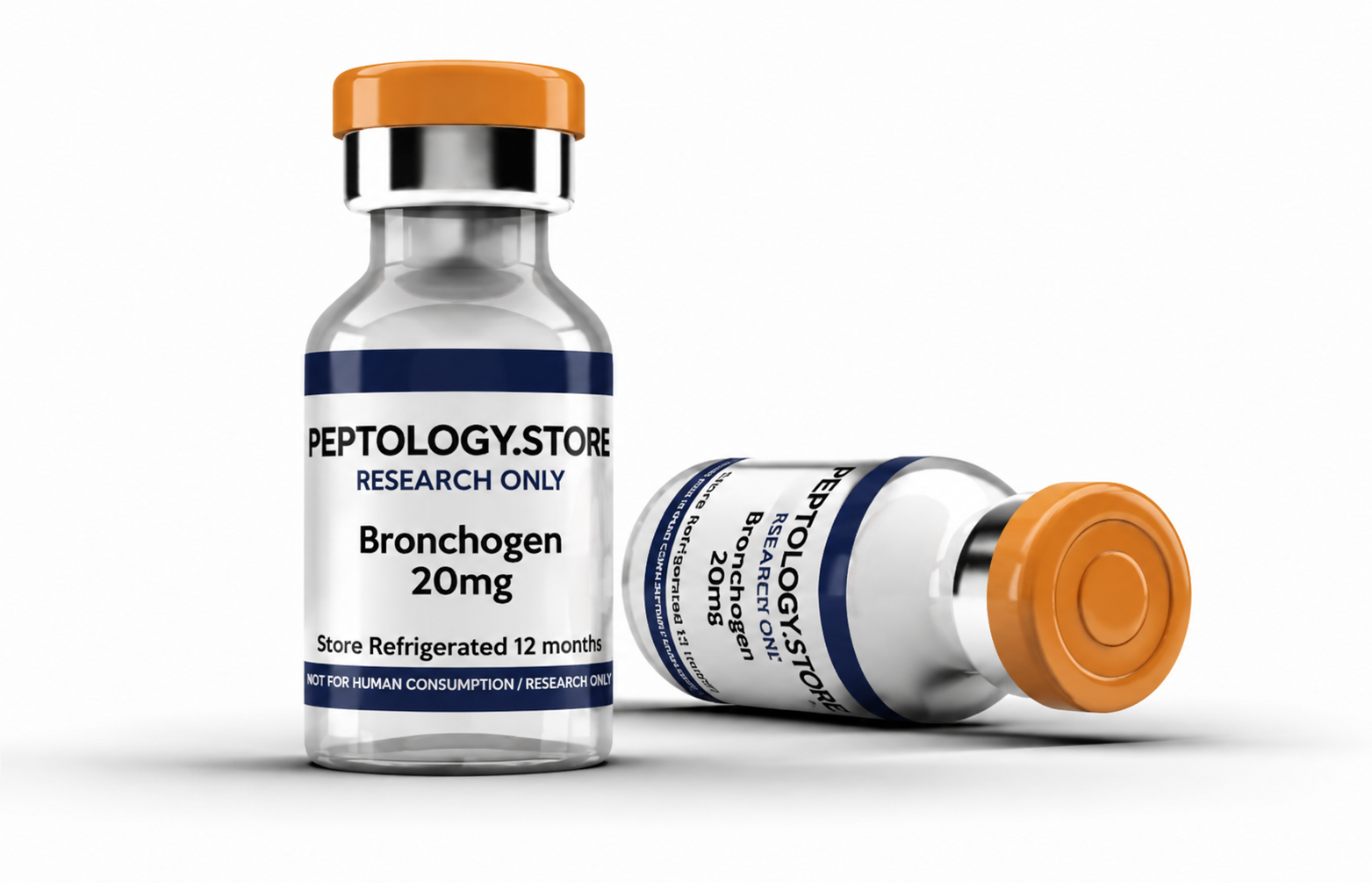
Premium Bronchogen 20mg for Sale | 20mg Lyophilized Powder | ≥99% Purity | 48-Hour Delivery Across EU & UK
Bronchogen 20mg – Research Peptide
Bronchogen, offered at 20mg, is a synthetic research peptide with the sequence Ala-Glu-Asp-Leu (AEDL). It has been studied for its interaction with pulmonary cell models and related signalling pathways, making it of interest to researchers focused on inflammation, tissue biology, and DNA stability.
- Product Name: Bronchogen 20mg
- Catalogue Number: BRCHG-020
- Molecular Formula: C18H30N4O9
- Molecular Weight: 446.45 g/mol
- Purity: 99%
- Sequence: H-Ala-Glu-Asp-Leu-OH (AEDL)
- Form: Lyophilised Solid
Storage and Handling:
Bronchogen is supplied as a lyophilised solid to maintain stability and integrity during storage and handling. For optimal use in research settings, please refer to our storage and reconstitution guidance available on the Peptology website.
Synthesis and Quality Assurance:
Each batch of Bronchogen is synthesised under rigorous standards to ensure exceptional purity and consistency. All products undergo extensive quality control to meet the exacting requirements of scientific research.
Why Choose Peptology for Bronchogen?
With over 14 years of experience, Peptology has become a trusted source for high-quality research peptides. Our direct relationship with our manufacturing facility allows us to offer products with guaranteed quality and transparency — no third-party resellers, just consistent and reliable peptides for researchers across the UK, EU and beyond.
Legal and Safety Information:
Peptology supplies Bronchogen strictly for scientific and research use only. It is not intended for human consumption or clinical application. All products are for laboratory-based research purposes and should be handled by qualified professionals only.
Explore Bronchogen 20mg today and discover the quality and reliability trusted by researchers worldwide.
Bronchogen has been investigated as a short synthetic peptide within the broader field of peptide bioregulator research. Experimental studies have examined its interactions with DNA, changes in DNA thermostability, and effects on gene and protein expression in cellular models, including bronchial epithelial systems. Research has also explored its potential biological effects in experimental models of respiratory and bronchial tissue function. However, Bronchogen’s precise molecular targets, receptor interactions, blood-brain barrier permeability, and clinical effects in humans have not been definitively established.
For researchers seeking to buy peptide online for investigations into sleep architecture, circadian rhythms, stress responses, or neuroendocrine regulation, peptology.store offers this premium research compound with comprehensive documentation, including Certificates of Analysis and batch-specific purity data. Whether your laboratory is based in London, Berlin, Paris, or anywhere in the European Union, our guaranteed 48 hour delivery peptide service ensures your research continues without interruption.
The Scientific Foundation of Bronchogen Research
Understanding Bronchogen
Bronchogen is a short synthetic tetrapeptide associated with the Khavinson family of peptide bioregulators. It is most commonly identified as Ala-Glu-Asp-Leu (AEDL), although one primary publication reports the middle residues in the opposite order as Ala-Asp-Glu-Leu (ADEL). The commonly used AEDL designation is supported by multiple later sources.
Bronchogen has been investigated primarily in experimental research involving DNA interaction, gene-expression regulation, bronchial epithelial cell models, and animal models of respiratory pathology. These findings remain preclinical and should not be interpreted as evidence of established human therapeutic effects.
Molecular and Cellular Research
Reported research involving Bronchogen includes:
- DNA Interaction: Experimental work has investigated interactions between Bronchogen and DNA and changes in DNA thermostability.
- Gene-Expression Research: Studies have examined changes in gene and protein expression in experimental cellular systems.
- Bronchial Epithelial Research: Bronchogen has been investigated using bronchial epithelial cell models.
- Respiratory-Tissue Research: Animal studies have explored its effects in experimental models of obstructive lung pathology.
- Cellular Differentiation: Research has examined potential relationships between short-peptide exposure and cellular differentiation-related processes.
Proposed Research Mechanisms
Bronchogen does not have a validated receptor or established pharmacological mechanism comparable to conventional receptor-targeting drugs. Current research instead focuses on several proposed molecular effects.
DNA Interaction
Biophysical research has examined the ability of Bronchogen to interact with DNA and alter DNA melting characteristics under experimental conditions. This represents a laboratory observation rather than evidence of a therapeutic mechanism in humans.
Gene-Expression Modulation
Experimental studies have investigated whether Bronchogen can influence gene and protein expression in cellular models. The broader peptide-bioregulator hypothesis proposes that short peptides may influence cellular regulatory processes, but the precise molecular mechanism remains unresolved.
Bronchial Epithelial Research
Bronchogen has been studied in experimental bronchial epithelial systems, with research examining cellular morphology, gene expression, and other biological markers. These findings are limited to experimental models and do not establish clinical efficacy.
Key Research Applications
Respiratory and Bronchial Biology Research
Bronchogen is primarily associated with experimental respiratory-tissue research:
- Bronchial Epithelial Studies: Investigate cellular responses in bronchial epithelial models.
- Respiratory Gene Expression: Examine changes in genes and proteins associated with bronchial cellular function.
- Airway Biology: Study experimental molecular mechanisms associated with respiratory tissue.
- Pulmonary Research Models: Investigate biological responses in laboratory models of respiratory pathology.
Peptide-DNA Interaction Research
- DNA Thermostability: Study changes in DNA melting characteristics following peptide interaction.
- Peptide-DNA Binding: Investigate physical interactions between short peptides and DNA.
- Molecular Biophysics: Explore the properties of short peptide–nucleic acid interactions.
Cellular Aging and Gene-Expression Research
- Gene Regulation: Investigate peptide-associated changes in experimental gene-expression profiles.
- Cellular Differentiation: Study changes in differentiation-related markers.
- Cellular Biology: Examine short-peptide effects in controlled laboratory models.
Comparative Peptide Research
Bronchogen can also be investigated alongside other short peptide bioregulators to examine differences in molecular composition, cellular responses, and proposed tissue associations.
Quality Assurance: Research Compound Standards
Analytical Characterization
For research applications, appropriate analytical documentation may include:
- HPLC Purity Analysis: Batch-specific purity determination.
- Mass Spectrometry: Molecular-mass confirmation and compound identification.
- Batch-Specific COA: Documentation of the analytical results for the specific production lot.
- Identity Verification: Confirmation of peptide composition and molecular characteristics.
- Research-Use Labeling: Clear designation for laboratory research purposes only.
Chemical and Product Specifications
| Specification | Detail |
|---|---|
| Product Name | Bronchogen Peptide |
| Quantity | 20 mg per vial |
| Purity | ≥99% HPLC, subject to batch-specific COA |
| Form | Lyophilized powder |
| Appearance | White to off-white lyophilized powder |
| Molecular Weight | Approximately 446.45 Da |
| Molecular Formula | C₁₈H₃₀N₄O₉ |
| Amino Acid Sequence | Commonly reported as Ala-Glu-Asp-Leu (AEDL) |
| Sequence Note | Some primary literature reports Ala-Asp-Glu-Leu (ADEL); sequence order should be verified against batch documentation |
| Structure | Linear synthetic tetrapeptide |
| CAS Number | Not assigned / not conclusively established |
| Target Receptor | No specific validated receptor established |
| Key Research Areas | Bronchial epithelial biology, respiratory research, DNA interaction, gene-expression studies, and peptide bioregulator research |
| Storage (Lyophilized) | Follow manufacturer-validated conditions; commonly stored cold and protected from moisture and light |
| Storage (Reconstituted) | Follow validated laboratory stability data |
| Shelf Life | Batch-specific; refer to manufacturer’s documented expiry |
| Intended Use | Research and laboratory use only |
| Documentation | Certificate of Analysis and applicable analytical data |
The molecular formula and approximately 446.45 Da molecular weight are consistently reported across available sources.
Stability and Handling Guidelines
Lyophilized Powder Storage:
Store lyophilized Bronchogen according to the manufacturer’s validated storage conditions. Available research-product documentation commonly specifies cold, dry storage with protection from light and moisture.
Laboratory Handling:
- Handle the vial using appropriate laboratory procedures.
- Protect the material from unnecessary exposure to heat, moisture, and excessive light.
- Use an appropriate research-grade solvent or buffer where laboratory reconstitution is required.
- Mix gently according to the applicable laboratory protocol.
- Clearly label prepared research material with compound identity, concentration, batch number, and preparation date.
- Follow the applicable SDS and batch-specific stability information.
Reconstituted Material:
There is insufficient independent evidence to assign a universal stability period to reconstituted Bronchogen. Storage conditions should therefore follow validated laboratory data and the manufacturer’s documentation.
Protection From Light and Moisture:
- Keep the container tightly closed.
- Maintain the material in its original packaging where practical.
- Protect from excessive moisture and light.
- Follow the batch-specific SDS and COA.
Key Research Characteristics
- Synthetic Tetrapeptide: Bronchogen is commonly identified as Ala-Glu-Asp-Leu (AEDL).
- 20mg Research Presentation: Supplied as a lyophilized research material.
- High-Purity Research Material: ≥99% purity when supported by the applicable batch COA.
- DNA Research: Investigated in experimental peptide-DNA interaction studies.
- Bronchial Research: Studied in experimental bronchial epithelial models.
- Gene-Expression Research: Investigated for changes in gene and protein expression.
- Respiratory Models: Examined in preclinical respiratory-tissue models.
- Analytical Documentation: Research batches may be accompanied by COA, HPLC, and mass-spectrometry documentation.
- Research-Only Classification: Not established as an approved medicine and not supported by human clinical trials.
Frequently Asked Questions
Q: What is Bronchogen?
A: Bronchogen is a synthetic short tetrapeptide associated with the Khavinson peptide-bioregulator research program. It is most commonly identified as Ala-Glu-Asp-Leu (AEDL) and has been investigated in experimental DNA, cellular, and respiratory research.
Q: What is the molecular weight of Bronchogen?
A: The commonly reported molecular weight is approximately 446.45 Da, with molecular formula C₁₈H₃₀N₄O₉.
Q: What is the amino acid sequence?
A: Most current sources identify the sequence as Ala-Glu-Asp-Leu (AEDL). However, one primary publication gives the sequence as Ala-Asp-Glu-Leu (ADEL), so this discrepancy should be acknowledged when comparing scientific sources.
Q: Does Bronchogen have a specific receptor?
A: No specific validated receptor has been established for Bronchogen. Research has instead focused on DNA interaction, gene-expression changes, and cellular responses.
Q: What research areas commonly use Bronchogen?
A: Research has focused on bronchial epithelial biology, respiratory-tissue models, peptide-DNA interactions, DNA thermostability, gene-expression research, and broader short-peptide bioregulator studies.
Q: What is the half-life of Bronchogen?
A: A definitive plasma half-life for Bronchogen has not been reliably established in humans. Available research does not provide sufficient pharmacokinetic evidence to assign a validated human half-life. Therefore, specific half-life values should not be presented as established facts without supporting pharmacokinetic data.
Q: Do you ship Bronchogen to EU countries?
A: Yes. As a dedicated peptology peptide supplier, we ship Bronchogen Peptide to all European Union member states with our guaranteed 48 hour delivery peptide service. Our EU fulfilment centre ensures rapid delivery without customs delays. All shipments use protective packaging to maintain compound integrity during transit.
Q: What documentation do you provide with Bronchogen orders?
A: Each research batch should be accompanied by the applicable Certificate of Analysis (COA) containing batch-specific analytical information. Additional HPLC chromatograms, mass-spectrometry data, and safety documentation may be provided where available.
Q: Do you offer bulk quantities of Bronchogen for institutional research?
A: Yes. We accommodate bulk orders for research institutions. Contact our team now for volume pricing, custom requirements, and supply agreements for ongoing research programs.
Advance Your Research with Bronchogen Peptide
peptology.store is your trusted source for Bronchogen Peptide, a research-stage synthetic tetrapeptide investigated in experimental studies involving bronchial epithelial biology, respiratory-tissue models, DNA interactions, and gene-expression regulation.
Whether you are exploring bronchial cellular mechanisms, studying peptide–DNA interactions, designing gene-expression experiments, or investigating short-peptide bioregulator activity, Bronchogen provides a defined research compound for controlled laboratory investigations.
Order today and experience the peptology.store difference – premium quality, rapid 48-hour delivery across the EU and UK, and expert support for the European research community.