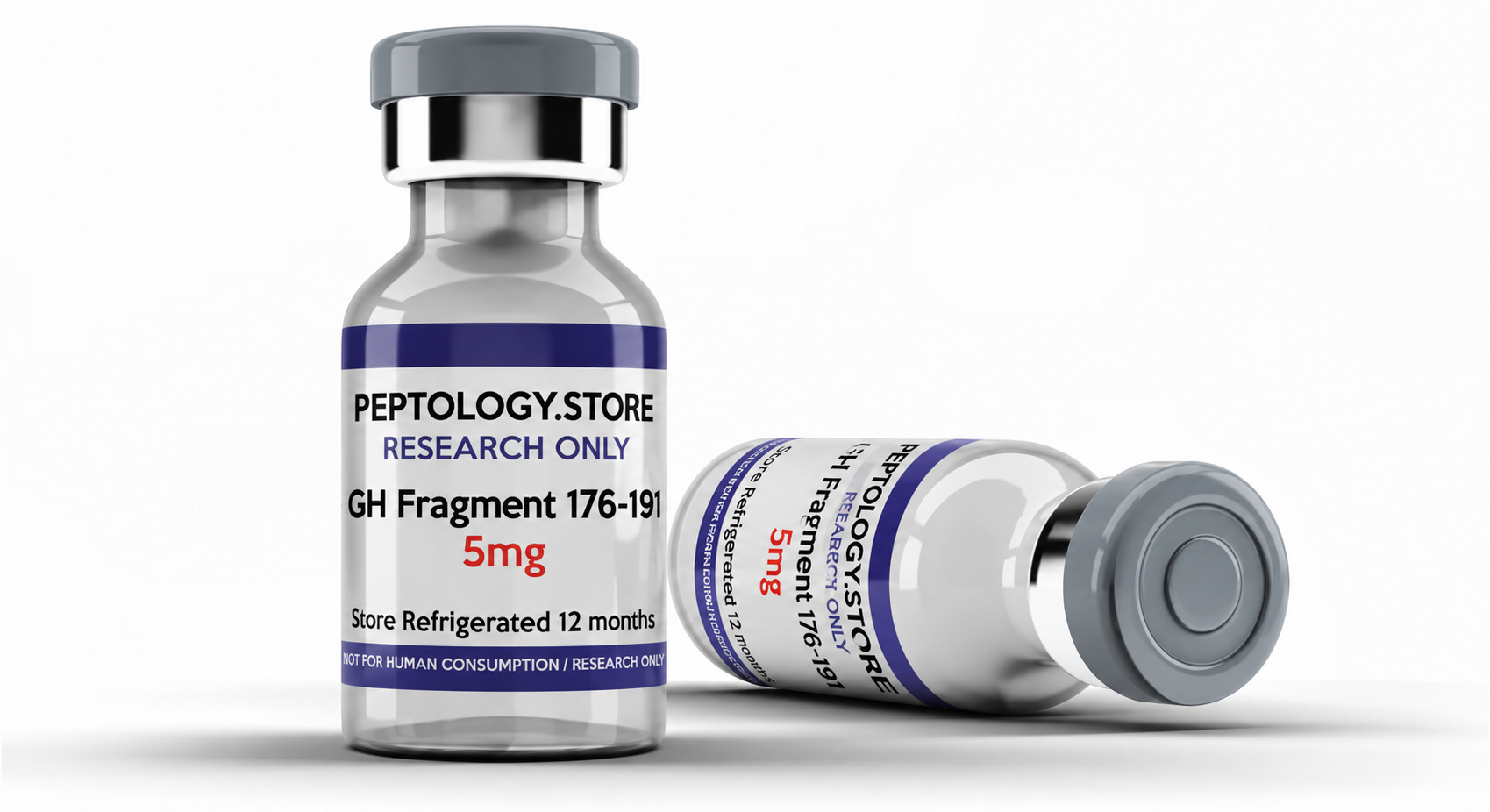
HGH Fragment 176-191 5mg: C-Terminal Growth Hormone Fragment for Lipid-Metabolism & Adipose-Tissue Research
peptology.store presents HGH Fragment 176-191 5mg as an experimental research peptide based on the C-terminal region of human growth hormone (hGH). This fragment is investigated primarily in laboratory studies of lipid metabolism, adipose-tissue biology, lipolytic signaling, and the metabolic actions associated with the C-terminal region of growth hormone.
Research on related C-terminal hGH fragments has reported effects on lipogenesis and lipolysis in cellular and animal models, although findings depend on the exact sequence, peptide structure, and experimental system.
What makes HGH Fragment 176–191 particularly valuable for research is its structural relationship to the C-terminal region of human growth hormone (hGH) and its use in studies investigating mechanisms associated with lipid metabolism. This 16-amino-acid peptide fragment corresponds to residues 176–191 of hGH and has been investigated for biological activity distinct from the growth-promoting effects associated with full-length growth hormone. Its research potential includes studies of adipocyte metabolism, fatty-acid mobilization, and pathways involved in energy balance and metabolic regulation.
The peptide’s relatively small structure makes it a useful research tool for investigating how specific regions of growth hormone may contribute to metabolic signaling. Research models have examined HGH Fragment 176–191 in relation to adipose-tissue pathways, lipid utilization, and metabolic processes, providing a focused approach for studying the relationship between peptide structure and metabolic activity.
For researchers seeking to buy peptide online for investigations into mitochondrial bioenergetics, neuroprotection, or cognitive enhancement, peptology.store offers HGH Fragment 176–191 with comprehensive documentation, including Certificates of Analysis and batch-specific purity data. Whether your laboratory is based in London, Berlin, Paris, or anywhere in the European Union, our guaranteed 48 hour delivery peptide service ensures your research continues without interruption.
The Scientific Foundation of HGH Fragment 176-191 Research
The C-Terminal Region of Human Growth Hormone
Human growth hormone is a multifunctional peptide hormone involved in growth, metabolism, and tissue regulation. Research into its C-terminal region has investigated whether portions of the molecule retain distinct metabolic activities independent of the complete hormone.
Synthetic C-terminal hGH fragments have demonstrated biological activity in experimental models of lipid metabolism. Early research identified anti-lipogenic activity within the C-terminal region of hGH, while subsequent studies investigated related fragments for their effects on adipose-tissue metabolism.
Lipid-Metabolism Signaling
The principal research interest surrounding HGH Fragment 176-191 and related C-terminal fragments is their potential influence on fatty-acid metabolism and adipose-tissue lipid handling.
Experimental studies of related hGH C-terminal fragments have investigated:
- Lipolysis
- Lipogenesis
- Fatty-acid metabolism
- Adipocyte function
- Energy expenditure
- Adipose-tissue remodeling
A study of AOD-9401, a synthetic hGH-derived fragment, reported increased lipolytic activity and reduced lipogenic activity in adipose tissue from obese rodents and humans in experimental settings.
Key Research Applications
Adipose-Tissue and Lipid-Metabolism Research
C-terminal hGH fragments are particularly relevant to research examining how growth-hormone-related signaling influences adipose tissue.
Research applications include:
- Adipocyte lipid metabolism
- Fatty-acid mobilization
- Lipolytic signaling
- Lipogenesis
- Adipose-tissue physiology
- Energy-substrate utilization
- Metabolic signaling pathways
Experimental work has demonstrated that related C-terminal hGH fragments can influence lipid metabolism in adipose tissue.
Lipolysis Research
Lipolysis—the breakdown of stored triglycerides into fatty acids and glycerol—is an important area of investigation surrounding hGH and its C-terminal fragments.
Research has examined whether C-terminal fragments can reproduce selected metabolic effects of intact growth hormone without reproducing all of its biological activities.
Studies involving related hGH fragments have reported increased lipolytic activity in adipose-tissue models, although the magnitude and mechanism depend on the specific fragment being investigated.
Anti-Lipogenic Research
Another major area of interest is inhibition of lipogenesis, the process through which fatty acids are synthesized and stored.
Early research reported that synthetic C-terminal hGH sequences could inhibit fatty-acid synthesis through effects involving acetyl-CoA carboxylase.
Related research subsequently investigated whether C-terminal hGH fragments could reduce lipogenic activity in adipose tissue while increasing lipid mobilization.
Obesity-Model Research
Several experimental studies have examined hGH-derived C-terminal fragments in animal models of obesity.
In obese mice, chronic treatment with a synthetic hGH 177-191 fragment was associated with reduced cumulative body-weight gain and reduced adipose-tissue mass.
A separate study of AOD-9401 reported reduced weight gain, increased fat oxidation, and increased lipolysis in obese mice.
These results are preclinical findings and should not be interpreted as evidence of established clinical efficacy in humans.
Adipocyte Biology
HGH-derived fragments provide experimental tools for investigating how peptide signals influence adipocytes.
Research areas include:
- Triglyceride storage
- Fatty-acid release
- Lipid oxidation
- Adipocyte signaling
- Lipogenic enzyme activity
- Hormonal regulation of adipose tissue
Studies using related C-terminal fragments have demonstrated activity in rodent and human adipose-tissue preparations.
Relationship to Growth Hormone
HGH Fragment 176-191 represents only a portion of the full growth hormone molecule. Therefore, research involving the fragment should not automatically be interpreted as equivalent to research involving intact recombinant human growth hormone.
This distinction is important because experimental studies have suggested that some C-terminal hGH fragments can influence lipid metabolism through mechanisms that differ from classical full-length hGH receptor signaling.
For example, AOD-9604 was reported in an animal study to increase fat oxidation and lipolysis without competing for the hGH receptor.
Consequently, researchers should identify the exact peptide sequence and molecular form being tested when comparing different hGH-derived fragments.
Preclinical Research Evidence
Early C-Terminal Fragment Studies
Early studies of synthetic C-terminal hGH sequences investigated their effects on adipose-tissue lipid metabolism.
Research involving hGH 177-191 reported anti-lipogenic activity comparable to intact hGH in experimental models, although that particular study did not find a significant lipolytic effect under its experimental conditions.
This illustrates why results should be interpreted according to the exact fragment, model, and experimental protocol rather than generalized across all hGH-derived peptides.
Animal Obesity Models
Research in obese mice has provided evidence that certain C-terminal hGH fragments can affect adipose-tissue metabolism.
A study of synthetic hGH 177-191 reported reductions in cumulative body-weight gain and adipose-tissue mass following chronic treatment in obese mice.
Another study using AOD-9401 reported increased fat oxidation and lipolysis together with reduced body-weight gain in obese mice.
Human Adipose-Tissue Research
Related hGH-derived peptide research has also examined isolated human adipose tissue.
A study of AOD-9401 reported increased lipolytic and reduced lipogenic activity in isolated adipose tissue obtained from obese humans and rodents.
These experiments provide mechanistic research evidence but do not establish that HGH Fragment 176-191 itself produces a clinically meaningful weight-loss effect in humans.
Quality Assurance: Research-Grade Characterization
peptology.store should provide batch-specific analytical documentation for HGH Fragment 176-191 5mg where available.
Appropriate research-grade documentation may include:
- HPLC Analysis: Chromatographic purity assessment
- Mass Spectrometry: Molecular-weight and identity confirmation
- Batch-Specific COA: Certificate corresponding to the supplied production lot
- Sequence Confirmation: Verification of the intended HGH fragment
- Research-Use-Only Labeling: Clear laboratory-use designation
- Storage Documentation: Manufacturer- or batch-specific stability information
| Molecular Weight (g/mol) | 1817.1 g/mol |
| Peptide Sequence | H-Tyr -Leu-Arg-lle-Va1-GIn-Cys-Arg-Ser-Va1-GIu-Gly-Ser-Cys-Gly-Phe-OH |
| Physical and Chemical Properties | |
| Molecular Formula | C78H125N23O23S2 |
| Physical Appearance | White lyophilised solid |
| Form | Sterile filtered white lyophilized (freeze-dried) |
| Solubility | Aqueous soluble |
| Appearance | White to off-white lyophilised powder |
| Melting Point | Not applicable (decomposes before melting) |
| Analytical and Quality Control | |
| Mass Spectrum | Consistent with structure. |
| Purity % | >98% |
| Research Use and Safety | |
| Caution | Research use only / Not for human or veterinary use |
| Intended Use | For laboratory research use only. Not for human or veterinary use. |
| Hazard Classification | Not classified as hazardous under GHS for research quantities |
| Storage, Handling and Stability | |
| Storage Temperature, Opened | Lyophilized peptides although stable at room temperature for 3 months, should be stored desiccated below -18°C. Upon reconstitution of the peptide it should be stored at 4°C between 2-21 days and for future use below -18°C. |
| Storage Temperature, Unopened | -20 °C recommended for long-term storage |
| Shelf Life | 2 years unopened under recommended conditions |
| Reconstitution Stability | Stable for up to 28 days at 2-8 °C in aqueous solution under sterile conditions |
Stability and Handling Guidelines
Lyophilized Material
For HGH Fragment 176-191 5mg supplied as lyophilized research material:
- Follow the storage conditions specified by the supplier or batch documentation.
- Protect the material from direct light.
- Keep the container tightly sealed.
- Protect against moisture.
- Minimize unnecessary temperature fluctuations.
- Maintain appropriate batch and storage records for laboratory use.
Reconstituted Material
There is no single universally validated post-reconstitution stability period that should be applied to every HGH Fragment 176-191 preparation.
For laboratory research:
- Follow the supplier’s batch-specific documentation.
- Use a solvent system validated for the intended experimental application.
- Minimize repeated freeze-thaw cycles.
- Aliquoting may reduce repeated handling.
- Label prepared material with the preparation date.
- Use validated stability data rather than assuming a fixed storage period.
Key Research Features
- C-Terminal hGH Research: Based on the C-terminal region of human growth hormone.
- Lipid-Metabolism Research: Investigated for effects on adipose-tissue lipid handling.
- Lipolysis Studies: Related C-terminal fragments have demonstrated lipolytic activity in experimental models.
- Anti-Lipogenic Research: C-terminal hGH sequences have been investigated for effects on fatty-acid synthesis.
- Adipocyte Research: Useful for investigating cellular lipid storage and mobilization.
- Obesity-Model Research: Related fragments have been evaluated in experimental obesity models.
- Energy-Metabolism Research: Investigated in relation to fat oxidation and substrate utilization.
- Preclinical Evidence: Much of the evidence comes from cellular and animal studies.
- Sequence-Specific Interpretation: Results from one hGH fragment should not automatically be applied to another.
- Research-Grade Characterization: Batch-specific identity and purity testing are important for reproducibility.
- RUO Positioning: Appropriate presentation is as an experimental laboratory compound.
Frequently Asked Questions
Q: What is HGH Fragment 176-191 5mg?
A: HGH Fragment 176-191 is an experimental peptide corresponding to a portion of the C-terminal region of human growth hormone. It is primarily of research interest in lipid metabolism, adipose-tissue biology, lipolysis, and metabolic signaling.
Q: What is HGH Fragment 176-191 studied for?
A: Research involving hGH-derived C-terminal fragments has focused on lipid metabolism, lipolysis, inhibition of lipogenesis, adipocyte biology, fat oxidation, and experimental obesity models.
Q: Does HGH Fragment 176-191 work the same way as full-length HGH?
A: Not necessarily. C-terminal hGH fragments may exhibit biological activities that differ from those of the complete hormone. Research on related fragments has identified metabolic effects that may occur independently of classical full-length hGH activity.
Q: Has hGH 177-191 been studied in animals?
A: Yes. Experimental studies have investigated synthetic hGH 177-191 in obese mice, with reported reductions in cumulative body-weight gain and adipose-tissue mass.
Q: Has a related hGH-derived fragment been studied in human adipose tissue?
A: Yes. AOD-9401, a related synthetic hGH-derived fragment, was studied in isolated adipose tissue from obese humans and rodents. The study reported increased lipolytic and reduced lipogenic activity in the experimental tissue models.
Q: Is HGH Fragment 176-191 an approved weight-loss treatment?
A: It should not be presented as an approved weight-loss treatment. Research involving hGH-derived fragments is predominantly experimental, and findings from related fragments cannot automatically be attributed to a specific 176-191 preparation.
Q: What documentation should accompany HGH Fragment 176-191 from peptology.store?
A: Research-grade material should ideally include a batch-specific Certificate of Analysis documenting identity and purity. HPLC and mass-spectrometry results can provide additional analytical verification.
Q: Do you offer bulk quantities of HGH Fragment 176-191 for institutional research?
A: Bulk availability depends on current supplier inventory and applicable research-compound requirements. Institutional researchers should request current availability, batch documentation, and applicable compliance information directly from peptology.store.
Q: Do you ship HGH Fragment 176-191 to EU and UK research facilities?
A: Shipping availability depends on destination, applicable regulations, and current supplier fulfillment options. Researchers should verify current shipping terms directly with peptology.store and ensure procurement complies with local requirements.
Q: How should HGH Fragment 176-191 be handled in laboratory research?
A: Handling should follow the supplier’s batch-specific documentation and the laboratory’s validated protocols. Storage, preparation, and stability conditions should be established according to the exact peptide formulation being studied.
Q: Is HGH Fragment 176-191 the same as AOD-9604 or AOD-9401?
A: No. These are related hGH-derived peptides, but they are not automatically chemically identical. AOD-9604/AOD-9401 research should not be used as direct evidence for a product labeled HGH Fragment 176-191 without confirming the exact sequence and molecular structure.
Q: What is the main research interest in HGH Fragment 176-191?
A: The principal interest is its relationship to the metabolic activity of the C-terminal region of human growth hormone, particularly research involving adipose-tissue lipid metabolism, lipolysis, and lipogenesis.
Advance Your Research with HGH Fragment 176-191 5mg
peptology.store can position HGH Fragment 176-191 5mg as an experimental research compound for laboratories investigating adipocyte biology, lipid metabolism, lipolytic signaling, fatty-acid metabolism, and the metabolic functions of the C-terminal region of human growth hormone.
The scientific literature provides evidence that several related C-terminal hGH fragments can influence lipid metabolism in experimental systems
Whether you are exploring mitochondrial bioenergetics, designing neuroprotection studies, investigating memory mechanisms, or studying antimicrobial photodynamic therapy, our rigorously tested compound provides the quality and consistency your work demands.
Order today and experience the peptology.store difference – premium quality, rapid 48-hour delivery across the EU and UK, and expert support for the European research community.