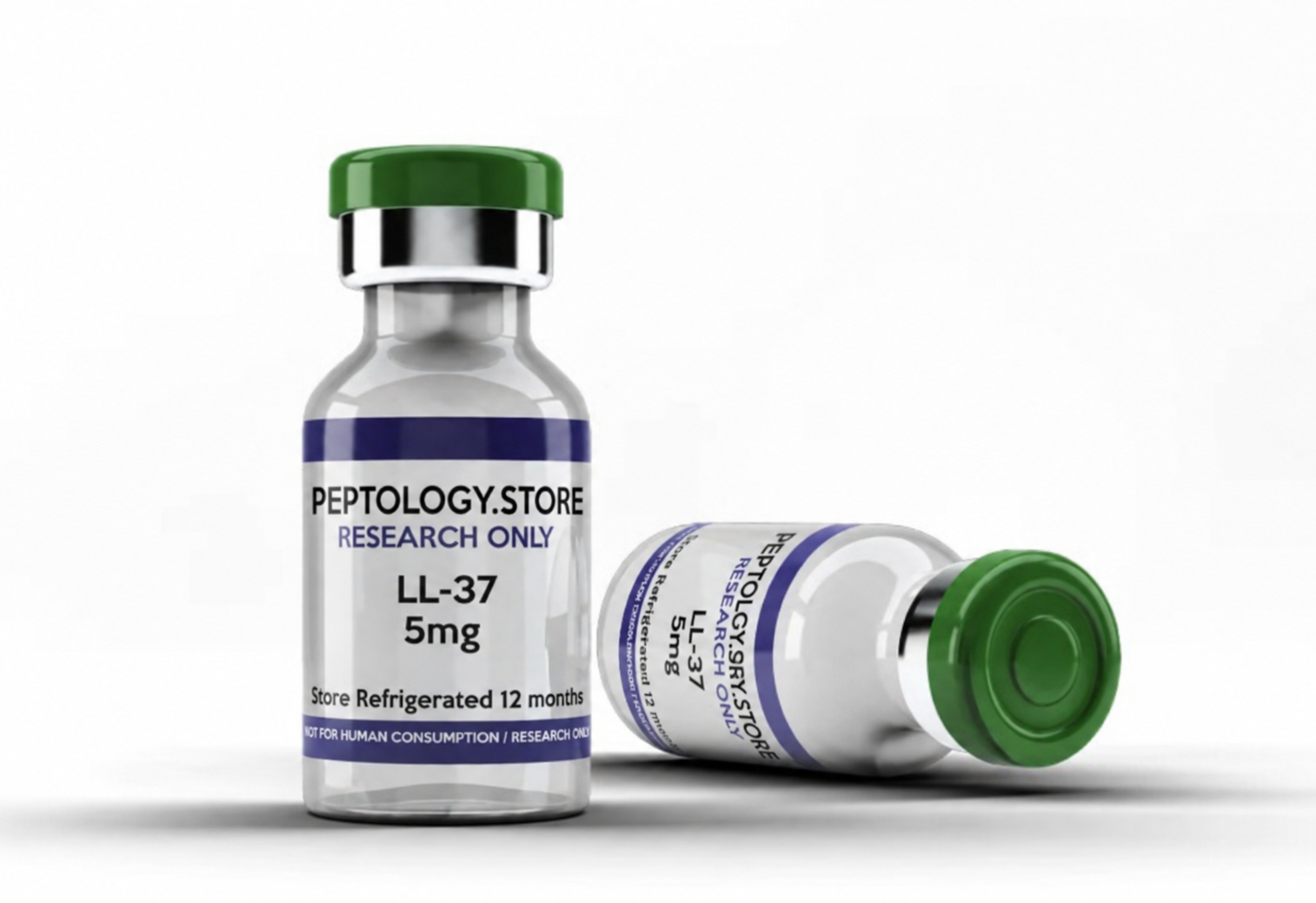
LL-37 5mg – High-Quality Research Peptide | 48-Hour Delivery Across EU & UK
LL-37 5mg: Advanced Human Cathelicidin Research Peptide for Antimicrobial, Immunomodulation & Wound-Healing Studies
peptology.store is proud to present LL-37 5mg, a research-grade human cathelicidin peptide supplied for laboratory investigations into innate immunity, antimicrobial activity, inflammatory signaling, wound healing, epithelial biology, angiogenesis, and host-defense mechanisms.
LL-37 is the mature 37-amino-acid C-terminal peptide derived from the human cathelicidin precursor hCAP-18/CAMP. It is the only human cathelicidin identified to date and has been extensively investigated for its direct antimicrobial effects as well as its ability to modulate immune-cell behavior, inflammation, chemotaxis, epithelial responses, and tissue repair.
As a dedicated EU peptide supplier and peptide vendor UK, Peptology Store provides research compounds with documented specifications intended to support controlled laboratory workflows.
For researchers who regularly buy peptide online UK and across the European Union, the LL-37 5mg provides an elegant solution for vial storage and organization. Whether your laboratory is based in London, Berlin, Paris, or anywhere in the European Union, our guaranteed 48 hour delivery peptide service ensures your essential laboratory accessories arrive when you need them.
The Scientific Foundation of LL-37 Research
Discovery and Biological Background
LL-37 is generated from the human cathelicidin precursor hCAP-18, which is encoded by the CAMP gene. Proteolytic processing releases the mature LL-37 peptide extracellularly. It is expressed by several cell types involved in host defense, including neutrophils, macrophages, and epithelial cells.
LL-37 is considered a multifunctional host-defense peptide because its activity extends beyond direct antimicrobial effects.
Research has investigated LL-37 in relation to:
- Antimicrobial defense
- Innate immune signaling
- Chemotaxis
- Inflammatory regulation
- Epithelial-cell migration
- Wound healing
- Angiogenesis
- Biofilm biology
- Endotoxin neutralization
Molecular Structure and Classification
Human LL-37 consists of 37 amino acids and has a molecular weight of approximately 4.49 kDa in its unmodified form. PubChem lists the molecular formula as C205H340N60O53 and the sequence as:
LLGDFFRKSKEKIGKEFKRIVQRIKDFLRNLVPRTES.
The peptide is cationic and amphipathic, properties that contribute to its ability to interact with microbial membranes and biological surfaces.
Antimicrobial Mechanisms
LL-37 has been extensively studied for direct activity against microorganisms.
Research has investigated its interaction with:
- Bacterial membranes
- Gram-positive bacteria
- Gram-negative bacteria
- Bacterial biofilms
- Microbial endotoxins
- Selected viral pathogens
- Fungal organisms
Its amphipathic structure facilitates interaction with negatively charged microbial membranes, and experimental studies describe membrane permeabilization as an important antimicrobial mechanism.
Immunomodulatory Activity
LL-37 is not simply an antimicrobial molecule. It also acts as a regulator of innate immune responses.
Research has demonstrated effects involving:
- Chemokine production
- Cytokine regulation
- Leukocyte recruitment
- Monocyte activation
- Neutrophil activity
- Dendritic-cell responses
- TLR-associated signaling
- Inflammatory pathway modulation
Importantly, LL-37 can have both pro-inflammatory and anti-inflammatory effects depending on concentration, cell type, and biological context.
Key Research Applications
Antimicrobial and Host-Defense Research
LL-37 is extensively studied as a model antimicrobial peptide for investigating innate host defense.
Research applications include:
- Bacterial Research: Study activity against Gram-positive and Gram-negative organisms
- Biofilm Research: Investigate disruption of microbial biofilms
- Antiviral Research: Examine activity against selected viral systems
- Antifungal Research: Investigate host-defense activity against fungal organisms
- Endotoxin Research: Examine interactions with bacterial lipopolysaccharide and related inflammatory mediators
LL-37 has demonstrated broad antimicrobial activity in experimental systems, although activity varies substantially with organism, peptide concentration, and experimental conditions.
Innate Immunity Research
LL-37 provides a useful experimental model for investigating how antimicrobial peptides communicate with immune cells.
Research areas include:
- Innate immune activation
- Leukocyte recruitment
- Chemokine signaling
- Monocyte biology
- Neutrophil responses
- Dendritic-cell function
- Pattern-recognition receptor signaling
Inflammation Research
LL-37 has complex effects on inflammatory pathways.
Researchers may investigate:
- Pro-inflammatory cytokines
- Anti-inflammatory responses
- NF-κB signaling
- MAPK pathways
- TLR signaling
- Chemokine production
- Inflammatory-cell recruitment
Because LL-37 can promote or suppress inflammatory responses depending on the biological environment, it provides a useful model for studying context-dependent immune regulation.
Wound-Healing Research
LL-37 has attracted substantial research interest in tissue repair and wound biology.
Experimental research has investigated effects involving:
- Keratinocyte migration
- Epithelial repair
- Cell proliferation
- Growth-factor signaling
- Inflammatory regulation
- Antimicrobial protection
- Wound closure
Studies have reported LL-37-associated signaling in keratinocytes involving pathways connected to cell migration and wound healing.
Angiogenesis Research
LL-37 has also been studied for its ability to influence vascular biology.
Research applications include:
- Endothelial-cell migration
- Vascular signaling
- Angiogenic responses
- Wound-associated vascularization
- FPRL1-associated signaling
Experimental literature has reported LL-37-mediated angiogenic effects involving vascular endothelial signaling.
Epithelial Biology Research
LL-37 is expressed in epithelial tissues and has been investigated as part of the interface between epithelial barriers and innate immunity.
Research may examine:
- Epithelial-cell migration
- Barrier responses
- Keratinocyte signaling
- Airway epithelial responses
- Gastrointestinal epithelial defense
- Host-microbe interactions
Biofilm Research
Biofilms represent an important area of antimicrobial research because microbial communities embedded within biofilms can display altered susceptibility to antimicrobial agents.
LL-37 has been investigated for its ability to interact with and disrupt microbial biofilms, providing a model for studying host-defense peptides against organized microbial communities.
Quality Assurance: Setting the Standard for Research Compounds
Manufacturing Excellence
peptology.store supplies LL-37 5mg with an emphasis on analytical quality and batch traceability.
Quality documentation may include:
- HPLC Purity Analysis: Chromatographic assessment of peptide purity
- Mass Spectrometry Verification: Molecular identity and mass confirmation
- Batch-Specific Certificates of Analysis: Documentation associated with individual production lots
- Lyophilized Research Format: Dry presentation intended for appropriate laboratory storage
- Research-Use-Only Labelling: Clearly designated for laboratory research
- Batch Traceability: Lot-specific documentation to support reproducibility.
Physical and Chemical Properties
| Molecular Weight (g/mol) | 4493.37 g/mol |
| Peptide Sequence | LLGDFFRKSKEKIGKEFKRIVQRIKDFLRNLVPRTES |
| CAS Number | 154947-66-7 |
| Molecular Formula | C205H340N60O53 |
| Appearance | White to off-white lyophilised powder |
| Melting Point | Not applicable (decomposes before melting) |
| Research Use and Safety | |
| Caution | Handle using appropriate PPE and in compliance with relevant laboratory safety standards. |
| Intended Use | For laboratory research use only. Not for human or veterinary use. |
| Hazard Classification | Not classified as hazardous under GHS for research quantities |
| Storage, Handling and Stability | |
| Storage Temperature, Opened | -20 °C, minimise freeze-thaw cycles |
| Storage Temperature, Unopened | -20 °C recommended for long-term storage |
| Shelf Life | 2 years unopened under recommended conditions |
| Reconstitution Stability | Stable for up to 28 days at 2-8 °C in aqueous solution under sterile conditions |
Stability and Handling
LL-37 5mg should be handled according to the supplier’s batch-specific documentation and established laboratory procedures.
- Lyophilized Material: Store according to the temperature specified in the product documentation.
- Light Protection: Protect the material from unnecessary direct light exposure.
- Moisture Protection: Keep the vial tightly sealed and protected from humidity.
- Reconstituted Material: Establish solution-storage conditions using validated laboratory procedures and available stability information.
- Aliquoting: Where appropriate, aliquot prepared research solutions to minimize repeated freeze-thaw exposure.
- Handling: Avoid unnecessary agitation and prolonged exposure to unsuitable temperatures.
- Documentation: Record preparation dates and storage conditions as part of the experimental record.
Real-World Research Applications and Investigator Studies
Antimicrobial Activity Studies
LL-37 has been extensively evaluated in laboratory models of microbial infection.
Studies have demonstrated activity against multiple Gram-positive and Gram-negative bacteria and have also investigated its interactions with biofilms and bacterial endotoxins.
These studies provide a foundation for investigating:
- Membrane permeabilization
- Microbial viability
- Biofilm disruption
- Endotoxin binding
- Host-microbe interactions
Immune-Cell Signaling Studies
LL-37 can influence immune-cell behavior through several signaling mechanisms.
Research has reported effects on monocytes, neutrophils, dendritic cells, macrophages, and other immune-cell populations. These effects provide opportunities to investigate chemotaxis, cytokine production, and innate immune activation.
Wound-Healing Models
LL-37 has been investigated in wound-healing models because of its combined antimicrobial, immunomodulatory, and cell-migration properties.
Research has examined:
- Keratinocyte migration
- Epithelial repair
- Cell proliferation
- Inflammatory regulation
- Angiogenesis
- Microbial control
These combined properties have made LL-37 an important model for studying host-defense mechanisms during tissue repair.
Angiogenesis Studies
Experimental studies have reported that LL-37 can influence angiogenic signaling and endothelial-cell behavior.
This provides a research framework for examining relationships between innate immunity, vascular development, and tissue repair.
Host-Microbe Interaction Studies
Because LL-37 combines antimicrobial activity with immune modulation, it is particularly valuable for studying the interaction between microbial organisms and host immune systems.
Researchers may examine how antimicrobial peptide activity affects:
- Microbial survival
- Host-cell signaling
- Inflammatory responses
- Leukocyte recruitment
- Tissue-barrier integrity
Key Research Features
- 5mg Research Presentation
- Human Cathelicidin LL-37
- 37-Amino-Acid Host-Defense Peptide
- Antimicrobial Research
- Gram-Positive and Gram-Negative Bacterial Studies
- Biofilm Research
- Innate Immunity Studies
- Immune-Cell Signaling
- Inflammatory-Pathway Research
- Chemotaxis Studies
- Wound-Healing Research
- Keratinocyte Biology
- Angiogenesis Research
- Epithelial Biology
- Host-Microbe Interaction Studies
- Lyophilized Research Format
- Batch-Specific Documentation
- Research-Use-Only Material
- Laboratory-Oriented Handling Guidance
- EU & UK Research Supply through Peptology Store
Frequently Asked Questions
Q: What is LL-37?
A: LL-37 is a 37-amino-acid human cathelicidin and host-defense peptide derived from the precursor hCAP-18. It is extensively studied for antimicrobial, immunomodulatory, chemotactic, wound-healing, and angiogenic activities.
Q: What is LL-37 5mg used for?
A: LL-37 5mg is supplied for laboratory research involving antimicrobial activity, innate immunity, inflammatory signaling, wound healing, epithelial biology, angiogenesis, biofilm research, and host-microbe interactions.
Q: What is the sequence of human LL-37?
A: The human LL-37 sequence is LLGDFFRKSKEKIGKEFKRIVQRIKDFLRNLVPRTES. PubChem lists the unmodified peptide at approximately 4,493 Da.
Q: What is the biological role of LL-37?
A: LL-37 is part of the human innate immune system. It can directly interact with microbial membranes while also influencing immune-cell recruitment, inflammatory signaling, epithelial responses, and tissue repair.
Q: Does LL-37 have antimicrobial activity?
A: Yes. LL-37 has demonstrated antimicrobial activity against multiple Gram-positive and Gram-negative organisms in experimental systems and has also been investigated for antiviral, antifungal, anti-biofilm, and endotoxin-binding effects.
Q: Is LL-37 involved in inflammation?
A: Yes. LL-37 has complex immunomodulatory activity and can produce both pro-inflammatory and anti-inflammatory effects depending on the cellular and biological context.
Q: Is LL-37 studied for wound healing?
A: Yes. Research has investigated LL-37 in wound healing through mechanisms involving antimicrobial protection, keratinocyte migration, epithelial responses, inflammatory signaling, and angiogenesis.
Q: Is LL-37 studied for angiogenesis?
A: Yes. Experimental research has reported effects of LL-37 on endothelial-cell signaling and angiogenic processes, particularly in the context of tissue repair.
Q: Is LL-37 suitable for human consumption?
A: No. LL-37 5mg supplied by peptology.store is intended for research and laboratory use only and is not marketed as an approved human therapeutic product.
Q: Can LL-37 be used in cell-culture research?
A: LL-37 is widely investigated in experimental cellular systems. Researchers should establish appropriate concentrations, exposure times, controls, and assay conditions according to validated laboratory protocols because LL-37 activity and cytotoxicity can vary substantially with concentration and cell type.
Q: What documentation is available with LL-37 orders?
A: A batch-specific Certificate of Analysis (COA) may provide analytical information about the supplied material. Additional analytical information should be confirmed for the specific production batch.
Q: How should LL-37 be stored?
A: Store the lyophilized research material according to the product-specific documentation. Protect it from moisture, excessive light, and unsuitable temperatures. Reconstituted material should be handled according to an appropriate laboratory stability protocol.
Q: What research areas commonly use LL-37?
A: LL-37 is investigated in antimicrobial research, innate immunity, inflammation, wound healing, epithelial biology, angiogenesis, biofilm research, and host-microbe interaction studies.
Q: Do you offer bulk quantities of LL-37 5mg?
A: Bulk research supply can be discussed for qualified laboratory and institutional requirements. Researchers can contact Peptology Store regarding current availability, documentation, and research quantities.
Q: Do you ship LL-37 to EU countries?
A: Research-product availability and shipping options for LL-37 5mg can be confirmed through peptology.store. Researchers should verify applicable destination-country requirements before ordering.
Q: Does LL-37 always suppress inflammation?
A: No. LL-37 has context-dependent immunomodulatory effects and can promote or suppress inflammatory responses depending on concentration, cell type, tissue environment, and other experimental conditions.
Advance Your Research with LL-37 5mg
Peptology Store provides LL-37 5mg for researchers investigating human host-defense mechanisms, antimicrobial peptide biology, innate immunity, inflammatory signaling, wound healing, epithelial responses, angiogenesis, and host-microbe interactions.
Whether your research focuses on microbial membrane interactions, biofilm biology, immune-cell signaling, epithelial repair, or the relationship between antimicrobial peptides and tissue regeneration, LL-37 provides a well-characterized experimental model for controlled laboratory investigation.
The extensive research literature surrounding LL-37 supports continued investigation of its multifunctional biological activity, while its concentration-dependent and context-dependent effects should be carefully considered when designing and interpreting experimental studies.
Order today and experience the peptology.store difference – premium quality, rapid 48-hour delivery across the EU and UK, and expert support for the European research community.