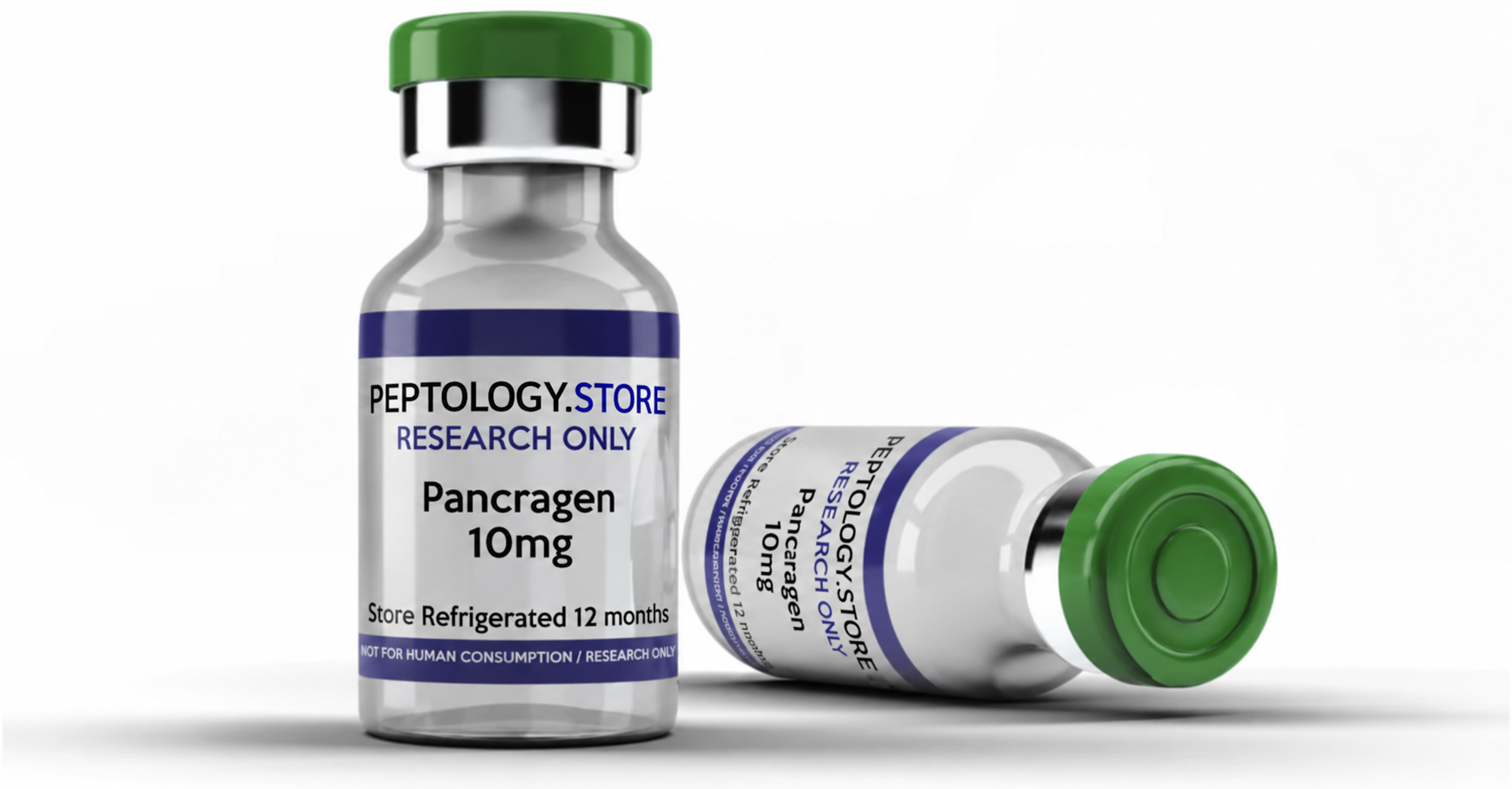
Pancragen 10mg – Research Peptide (Bioregulator) | ≥99% Purity | 48-Hour Delivery Across EU & UK
Pancragen 10mg: Research-Grade Tetrapeptide for Pancreatic & Metabolic Biology Studies
peptology.store is proud to present Pancragen 10mg, a research-grade short peptide supplied for laboratory investigations involving pancreatic biology, glucose-insulin signaling, cellular differentiation, aging-associated metabolic changes, and pancreatic tissue research.
Pancragen, also known as KEDW or Lys-Glu-Asp-Trp, is a synthetic tetrapeptide associated with the Khavinson family of short peptide bioregulators. Research has investigated Pancragen in pancreatic-cell models, diabetic animal models, aging-related metabolic studies, and limited human research. The available evidence remains limited and has not established Pancragen as an approved treatment for diabetes or pancreatic disease.
As a dedicated EU peptide supplier and peptide vendor UK, Peptology Store provides research compounds with documented specifications intended to support controlled laboratory workflows.
For researchers seeking to buy peptide online for investigations into topical peptide delivery, dermatological research, or hair growth studies, Peptology Store offers this premium research kit with comprehensive documentation, including Certificates of Analysis and batch-specific purity data. Whether your laboratory is based in London, Berlin, Paris, or anywhere in the European Union, our guaranteed 48 hour delivery peptide service ensures your research supplies arrive when you need them.
The Scientific Foundation of Pancragen Research
Structure and Classification
Pancragen is generally identified as the synthetic tetrapeptide Lys-Glu-Asp-Trp (KEDW).
Some literature and reference sources identify the C-terminally amidated form as Lys-Glu-Asp-Trp-NH₂ (KEDW-NH₂), while some commercial documentation describes the free-acid form. Researchers should therefore verify the exact chemical form against the batch-specific analytical documentation before beginning an experiment.
Its research relevance includes:
- Pancreatic-cell biology
- Glucose-insulin signaling
- Cellular differentiation
- Gene-expression studies
- Aging-associated metabolic research
- Short-peptide structure-function studies
Pancreatic Biology Research
Pancragen has been investigated as a pancreas-associated short peptide bioregulator.
Experimental research has examined potential relationships with:
- Pancreatic-cell differentiation
- Pancreatic gene expression
- Insulin-related pathways
- Glucose tolerance
- Endocrine pancreatic function
- Age-associated pancreatic changes
Most of the available evidence is derived from animal and cellular research rather than large, independently replicated clinical trials.
Glucose and Insulin Research
Pancragen has attracted research interest because experimental studies have examined its relationship with glucose metabolism and insulin-associated responses.
Research areas include:
- Glucose tolerance
- Insulin production
- Insulin sensitivity
- Glucose-homeostasis markers
- Pancreatic endocrine function
- Metabolic aging
These findings remain investigational and should not be interpreted as evidence of an established diabetes treatment.
Aging-Associated Metabolic Research
Pancragen belongs to a family of short peptides investigated in connection with aging-associated tissue and cellular changes.
Research models have examined:
- Age-related metabolic changes
- Pancreatic function during aging
- Cellular differentiation
- Gene-expression changes
- Glucose regulation in aging models
Key Research Applications
Pancreatic Cell Research
Pancragen provides an experimental model for investigating pancreatic-cell biology.
Potential research applications include:
- Cell Differentiation: Study pancreatic-cell differentiation markers
- Gene Expression: Investigate pancreatic gene-expression pathways
- Cell Signaling: Examine peptide-associated signaling responses
- Endocrine Function: Investigate insulin-related cellular processes
- Cellular Aging: Study age-associated changes in pancreatic cells
Glucose-Insulin Research
Pancragen has been investigated in experimental models involving glucose and insulin regulation.
Researchers may examine:
- Glucose tolerance
- Insulin-related biomarkers
- Glucose homeostasis
- Pancreatic endocrine responses
- Metabolic changes associated with aging
Metabolic Aging Research
Experimental studies have examined Pancragen in relation to metabolic changes associated with aging.
Research areas include:
- Age-associated glucose intolerance
- Insulin signaling
- Pancreatic endocrine function
- Metabolic syndrome models
- Cellular aging
Pancreatic Tissue Research
Pancragen can be incorporated into experimental studies investigating pancreatic tissue and its relationship with systemic metabolic regulation.
Potential areas include:
- Pancreatic-cell function
- Tissue-specific peptide signaling
- Pancreatic gene expression
- Cellular differentiation
- Tissue aging
Short-Peptide Structure-Function Research
Because Pancragen is a very short tetrapeptide, it can also serve as a model for investigating relationships between peptide sequence, terminal modification, molecular stability, and biological activity.
Quality Assurance: Setting the Standard for Research Compounds
Manufacturing Excellence
peptology.store supplies Pancragen 10mg with an emphasis on analytical quality and batch traceability.
Quality documentation may include:
- HPLC Purity Analysis: Analytical assessment of peptide purity
- Mass Spectrometry Verification: Molecular identity and molecular-weight confirmation
- Batch-Specific Certificate of Analysis: Documentation associated with the individual production lot
- Lyophilized Research Format: Dry presentation for appropriate laboratory storage
-
Research-Use-Only Labelling: Clearly designated for laboratory research
Physical and Chemical Properties
| Molecular Weight (g/mol) | 576.25 g/mol |
| Peptide Sequence | Lys-Glu-Asp-Trp (KEDW) |
| Molecular Formula | C26H36N6O9 |
| Appearance | White to off-white lyophilised powder |
| Melting Point | Not applicable (decomposes before melting) |
| Research Use and Safety | |
| Caution | Handle using appropriate PPE and in compliance with relevant laboratory safety standards. |
| Intended Use | For laboratory research use only. Not for human or veterinary use. |
| Hazard Classification | Not classified as hazardous under GHS for research quantities |
| Storage, Handling and Stability | |
| Storage Temperature, Opened | -20 °C, minimise freeze-thaw cycles |
| Storage Temperature, Unopened | -20 °C recommended for long-term storage |
| Shelf Life | 2 years unopened under recommended conditions |
| Reconstitution Stability | Stable for up to 28 days at 2-8 °C in aqueous solution under sterile conditions |
Stability and Handling
Pancragen 10mg should be handled according to the supplier’s batch-specific documentation and established laboratory procedures.
- Lyophilized Material: Store according to the temperature specified in the product documentation.
- Light Protection: Protect the material from unnecessary direct light exposure.
- Moisture Protection: Keep the vial tightly sealed and protected from humidity.
- Reconstituted Material: Establish solution-storage conditions according to validated laboratory procedures and available stability information.
- Aliquoting: Where appropriate, aliquot prepared research solutions to minimize repeated freeze-thaw exposure.
- Temperature Control: Avoid unnecessary temperature fluctuations.
- Documentation: Record preparation and storage conditions as part of the experimental record.
Real-World Research Applications and Investigator Studies
Pancreatic Differentiation Studies
Pancragen has been investigated in experimental pancreatic-cell systems examining differentiation and gene-expression markers.
These studies provide a framework for investigating whether short peptide bioregulators influence pancreatic-cell phenotype and function.
Glucose-Tolerance Research
Animal research has examined Pancragen in relation to glucose tolerance and metabolic regulation.
Reported research areas include:
- Glucose tolerance
- Insulin-related responses
- Pancreatic endocrine function
- Age-associated metabolic changes
These findings remain preclinical and have not established an approved therapeutic application.
Aging and Metabolic Studies
Research involving aged animal models has investigated Pancragen in relation to metabolic changes associated with aging.
This provides opportunities to study:
- Age-associated glucose regulation
- Pancreatic function
- Cellular differentiation
- Metabolic biomarkers
- Endocrine responses
Cell-Signaling and Gene-Expression Studies
Pancragen can also be investigated in cellular systems examining gene-expression changes and signaling pathways associated with pancreatic biology.
Key Research Features
- 10mg Research Presentation
- Pancragen / KEDW
- Lys-Glu-Asp-Trp Tetrapeptide
- Pancreatic Biology Research
- Pancreatic Cell Differentiation Studies
- Glucose-Insulin Research
- Metabolic Aging Research
- Glucose-Tolerance Models
- Gene-Expression Research
- Cell-Signaling Studies
- Endocrine Pancreatic Research
- Short-Peptide Structure-Function Studies
- Lyophilized Research Format
- Batch-Specific Documentation
- Research-Use-Only Material
- Laboratory-Oriented Handling Guidance
- EU & UK Research Supply through Peptology Store
Frequently Asked Questions
Q: What is Pancragen?
A: Pancragen is a synthetic short peptide generally identified as Lys-Glu-Asp-Trp (KEDW). It belongs to the family of short peptide bioregulators associated with pancreatic and aging-related research.
Q: What is Pancragen 10mg used for?
A: Pancragen 10mg is supplied for laboratory research involving pancreatic-cell biology, glucose-insulin signaling, cellular differentiation, metabolic aging, and related molecular pathways.
Q: What is the sequence of Pancragen?
A: The commonly reported sequence is Lys-Glu-Asp-Trp (KEDW). Some research sources specify the C-terminally amidated form KEDW-NH₂, so researchers should confirm the exact chemical form against the batch documentation.
Q: What research areas commonly investigate Pancragen?
A: Research areas include pancreatic-cell differentiation, glucose tolerance, insulin-related signaling, metabolic aging, pancreatic gene expression, endocrine pancreatic function, and short-peptide structure-function studies.
Q: Has Pancragen been studied in animal models?
A: Yes. Published and reviewed research includes pancreatic-cell studies, diabetic rodent models, and nonhuman-primate research. The evidence remains limited and has not been independently replicated on a large scale.
Q: Has Pancragen been studied in humans?
A: Limited human research has been reported, including a small study involving older adults with type 2 diabetes. However, the evidence is early and limited, and there is no established regulatory-approved therapeutic indication.
Q: Is Pancragen suitable for human consumption?
A: No. Pancragen 10mg supplied by peptology.store is intended for research and laboratory use only and should not be represented as an approved treatment for diabetes, pancreatic disease, or other medical conditions.
Q: Does Pancragen treat diabetes?
A: Pancragen has been investigated in glucose and insulin research, but available evidence is insufficient to establish it as an approved or clinically proven diabetes treatment.
Q: How should Pancragen be stored?
A: Store the lyophilized material according to the product-specific storage documentation. Protect it from moisture, excessive light exposure, and unsuitable temperatures. Reconstituted material should be handled according to an appropriate validated laboratory stability protocol.
Q: What purity level can I expect when I buy Pancragen from peptology.store?
A: Purity should be confirmed from the batch-specific Certificate of Analysis accompanying the material. The exact analytical specification should be verified for the individual production lot.
Q: What documentation is provided with Pancragen orders?
A: Batch-specific analytical documentation may include a Certificate of Analysis (COA) with information about identity and purity. Additional analytical data should be confirmed for the specific batch.
Q: Can Pancragen be used in cell-based research?
A: Yes. Pancragen has been investigated in pancreatic-cell and other experimental cellular models. Researchers should establish appropriate concentrations, controls, exposure periods, and assay conditions through validated laboratory protocols.
Q: Do you offer bulk quantities of Pancragen?
A: Bulk research supply can be discussed for qualified laboratory and institutional requirements. Researchers can contact Peptology Store regarding current availability and batch documentation.
Q: Do you ship Pancragen to EU countries?
A: Research-product shipping availability can be confirmed through peptology.store. Researchers should verify applicable destination-country requirements before ordering.
Q: Is Pancragen an approved pancreatic treatment?
A: No. Pancragen is an investigational research compound and should not be represented as an approved treatment for pancreatic disease or glucose disorders. Current evidence is primarily preclinical, with limited early human research.
Q: What makes Pancragen interesting for research?
A: Pancragen is interesting because it provides a compact tetrapeptide model for investigating pancreatic-cell biology, glucose-insulin pathways, aging-associated metabolic changes, and the potential biological effects of short peptide bioregulators.
Advance Your Research with Pancragen 10mg
Peptology Store provides Pancragen 10mg for researchers investigating pancreatic biology, glucose-insulin signaling, cellular differentiation, metabolic aging, and short-peptide structure-function relationships.
Whether your work focuses on pancreatic-cell models, glucose-tolerance research, endocrine signaling, aging-associated metabolic changes, or peptide structure-function studies, Pancragen provides an experimental tetrapeptide model for controlled laboratory investigation.
Because the current evidence base remains limited and largely preclinical, experimental results should be interpreted within the appropriate research context rather than as evidence of established therapeutic efficacy.
Order today and experience the Peptology Store difference – premium quality, rapid 48-hour delivery across the EU and UK, and expert support for the European research community.