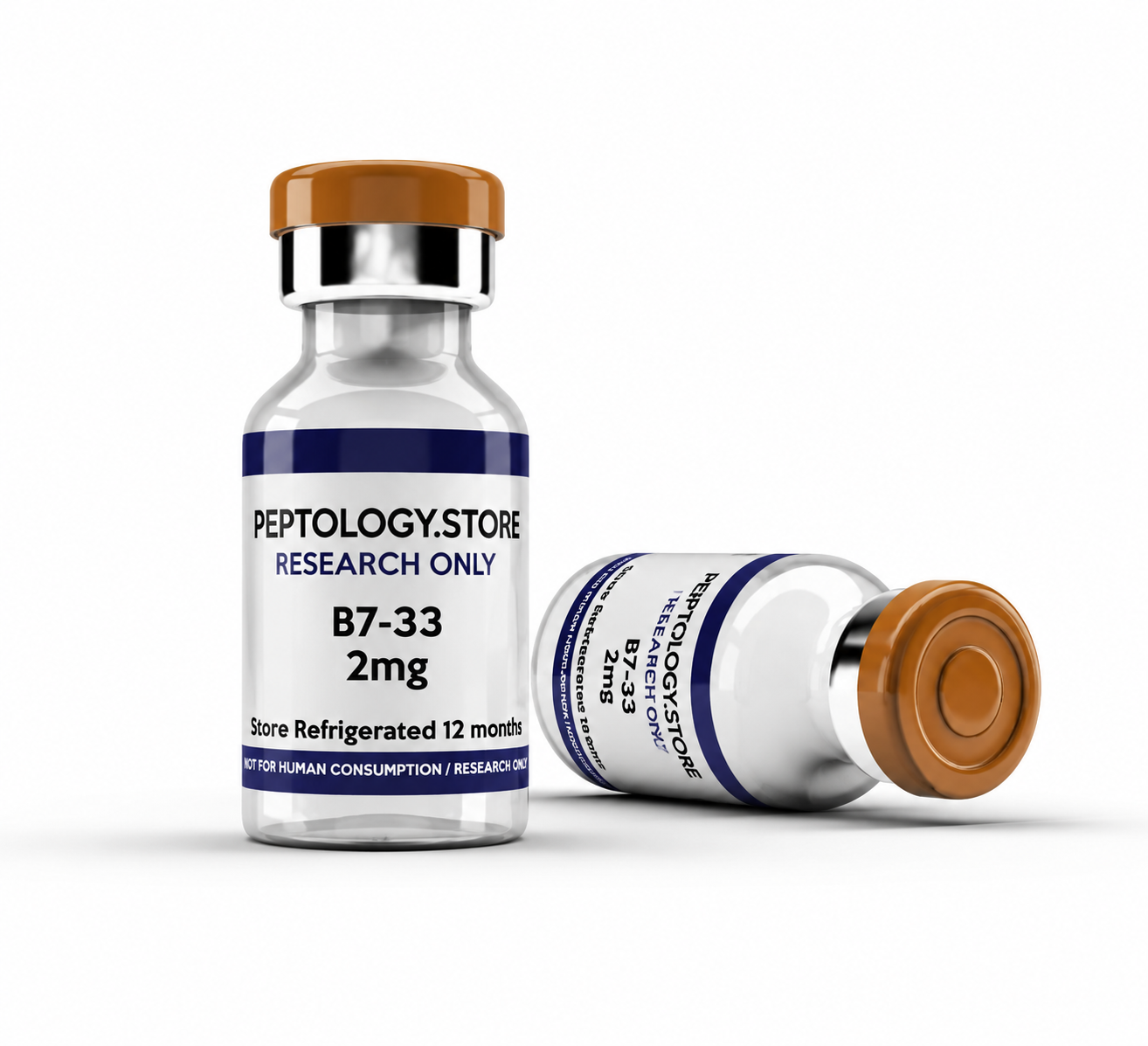
Premium B7-33 Research Peptide for Sale | 2mg Lyophilized Powder | Independent Lab Verified | 48-Hour Delivery Across EU & UK
B7-33 2mg – Research Grade Peptide
Buy B7-33 2mg Peptide EU & UK, peptology.store is proud to present B7-33 2mg Peptide, a premium research-grade tri-component synergistic blend manufactured to the highest analytical standards. As a trusted peptide vendor uk and leading EU peptide supplier, we provide researchers across Europe with B7-33 2mg Peptide for sale that delivers exceptional purity, consistency, and documented quality for advanced studies in gastrointestinal health, mucosal integrity, and inflammatory bowel research. Buy B7-33 2mg Peptide EU & UK
B7-33 is studied for its potential role in scientific investigations into fibrosis and tissue response. It is a focus of active research aimed at understanding cellular mechanisms and responses in various tissue types.
- Product Name: B7-33 2mg
- Catalogue Number: B7-33
- Unit Size: 2mg
- CAS:
- Other Names: GTPL 9321, Serelaxin Derivative, (B7-33)H2, RLN2 Derivative, GTPL-9321, H2 & H3 Relaxin Protein Derivative, B7-33 H2, Insulin-Like Peptide 3 & 5 Derivative, GTPL9321
- Form: Lyophilised Solid
Research into B7-33’s interaction with fibrotic pathways contributes to understanding relaxin receptor signalling across various experimental models.
Storage and Handling:
Supplied in a lyophilised form for stability, B7-33 requires careful handling for reconstitution and storage, as detailed on our website.
Legal and Safety Information:
All Peptology-Peptides products, including B7-33, are sold exclusively for scientific and research purposes. Enquiries about human consumption are strictly prohibited.
For researchers seeking to buy peptide online for investigations into intestinal barrier function, inflammatory bowel disease, mucosal healing, or gut-associated immune responses, peptology.store offers this premium research blend with comprehensive documentation, including Certificates of Analysis and batch-specific purity data. Whether your laboratory is based in London, Berlin, Paris, or anywhere in the European Union, our guaranteed 48 hour delivery peptide service ensures your research continues without interruption. Buy B7-33 2mg Peptide EU & UK
The Scientific Foundation of B7-33 Peptide Research
The Research Profile of B7-33 for Tissue Repair and Fibrosis Studies
B7-33 is a synthetic peptide derived from the EGF-like domain 2 of the secreted protein hormone relaxin-2. It represents a focused research tool for investigating relaxin-related signaling, tissue repair, vascular biology, and mechanisms involved in fibrosis and extracellular matrix remodeling.
Mechanism of Action
B7-33 in Tissue Repair and Fibrosis Research: B7-33 has been investigated as a relaxin-derived peptide that can reproduce selected biological activities associated with relaxin signaling. Research has particularly focused on its interaction with relaxin family receptor pathways and downstream signaling involved in tissue remodeling and fibrosis.
Research demonstrates that B7-33 has been investigated for:
- Anti-fibrotic activity through modulation of pathways involved in extracellular matrix deposition
- Tissue remodeling through effects on fibroblast activity and collagen-related processes
- Vascular research through investigation of signaling associated with endothelial and vascular function
- Cellular signaling relevant to relaxin-mediated tissue responses
- Organ protection research in experimental models involving fibrosis and tissue injury
Key Research Applications
Fibrosis Research
B7-33 has been investigated as a research tool for studying mechanisms underlying pathological fibrosis. Research applications include:
- Fibroblast Studies: Investigating peptide-mediated effects on fibroblast activation and behavior
- Collagen Regulation: Studying pathways involved in extracellular matrix collagen deposition
- Anti-Fibrotic Signaling: Exploring mechanisms that may limit excessive fibrotic remodeling
- Organ Fibrosis Models: Investigating relaxin-related pathways in experimental tissue fibrosis
Tissue Repair Research
B7-33 is relevant to research examining cellular and molecular mechanisms involved in tissue repair:
- Tissue Remodeling: Studying regulation of extracellular matrix turnover
- Fibroblast Function: Investigating cellular responses involved in repair and remodeling
- Wound-Healing Pathways: Exploring signaling mechanisms associated with tissue recovery
- Extracellular Matrix Research: Examining collagen organization and matrix remodeling
Cardiovascular and Vascular Research
Relaxin-related signaling has been investigated extensively in cardiovascular biology, making B7-33 relevant to studies of vascular function:
- Vascular Signaling: Investigating relaxin-associated signaling pathways
- Endothelial Function: Studying cellular mechanisms involved in vascular responses
- Vascular Remodeling: Exploring peptide-mediated effects on extracellular matrix and vascular tissue
- Cardiac Fibrosis: Investigating mechanisms associated with pathological cardiac remodeling
Renal Research
B7-33 has also been investigated in experimental research involving renal fibrosis and kidney tissue:
- Renal Fibrosis: Studying mechanisms involved in excessive extracellular matrix accumulation
- Kidney Tissue Remodeling: Investigating relaxin-related signaling in renal tissue
- Fibroblast Activity: Exploring cellular mechanisms associated with renal fibrotic responses
Extracellular Matrix Research
B7-33 provides a research model for investigating extracellular matrix regulation:
- Collagen Deposition: Studying mechanisms regulating collagen accumulation
- Matrix Remodeling: Investigating pathways involved in extracellular matrix turnover
- Fibrotic Signaling: Exploring signaling mechanisms associated with pathological matrix deposition
Quality Assurance: Independent Laboratory Verification
Third-Party Testing Confirmation
B7-33 research material may be evaluated through independent laboratory analysis to verify composition accuracy and labeling precision. Appropriate analytical testing can include peptide identity, purity, and batch-specific characterization to support research applications.
Manufacturing Excellence
peptology.store sources B7-33 Peptide from certified GMP facilities with rigorous quality control protocols:
- HPLC Purity Analysis: B7-33 purity verified by high-performance liquid chromatography
- Mass Spectrometry Verification: Molecular weight confirmation via LC-HRMS
- Batch-Specific Certificates of Analysis: Complete documentation for each production run
- Independent Laboratory Testing: Third-party verification of peptide identity and formulation precision
- Research-Use Only (RUO) Labeling: Full compliance with research compound regulations
Chemical and Product Specifications
| Molecular Weight (g/mol) | |
| Peptide Sequence | VIKLSGRELVRAQIAISGMSTWSKRSL |
| Physical and Chemical Properties | |
| Molecular Formula | |
| Physical Appearance | white lyophilised solid |
| Form | Sterile filtered white lyophilized (freeze-dried) |
| Solubility | Aqueous soluble |
| Appearance | White to off-white lyophilised powder |
| Melting Point | Not applicable (decomposes before melting) |
| Analytical and Quality Control | |
| HPLC Result | Shows min 99% Purity |
| Mass Spectrum | Consistent with structure |
| Purity % | >99% |
| Research Use and Safety | |
| Caution | Research use only / Not for human or veterinary use |
| Intended Use | For laboratory research use only. Not for human or veterinary use. |
| Hazard Classification | Not classified as hazardous under GHS for research quantities |
| Storage, Handling and Stability | |
| Storage Temperature, Opened | Lyophilized peptides although stable at room temperature for 3 months, should be stored desiccated below -18°C. Upon reconstitution of the peptide it should be stored at 4°C between 2-21 days and for future use below -18°C. |
| Storage Temperature, Unopened | -20 °C recommended for long-term storage |
| Shelf Life | 2 years unopened under recommended conditions |
| Reconstitution Stability | Stable for up to 28 days at 2-8 °C in aqueous solution under sterile conditions |
Stability and Handling Guidelines
Lyophilized Powder Storage: Store lyophilized B7-33 peptide powder at -20°C in a dry, dark environment, protected from light and moisture.
Reconstitution Protocol:
- Allow vial and solvent to reach ambient temperature before opening to prevent condensation
- Reconstitute using an appropriate research-grade solvent according to research protocol
- Inject solvent slowly down the inside wall of the vial to minimize foaming
- Gently swirl or roll the vial until fully dissolved—do not shake vigorously
- Label the vial with the date of reconstitution
- Refrigerate immediately at 2-8°C
Reconstituted Solution Storage: Store reconstituted B7-33 at 2-8°C for short-term use. For longer-term storage, aliquot into single-use portions and store at -20°C. Avoid repeated freeze-thaw cycles.
Protection from Light and Moisture:
- Store in original packaging protected from light
- Keep vials tightly sealed when not in use
- Allow refrigerated vials to reach room temperature before opening to prevent condensation
Key Benefits
- Premium Quality Manufacturing: GMP-certified production and quality control
- Independent Lab Verification: Third-party testing can confirm peptide identity and composition
- Focused Research Compound: B7-33 is a relaxin-derived peptide investigated in tissue remodeling and fibrosis research
- Anti-Fibrotic Research: Investigate mechanisms associated with pathological extracellular matrix deposition
- Fibroblast Research: Study peptide-mediated effects on fibroblast activity and signaling
- Tissue Remodeling Studies: Explore mechanisms involved in extracellular matrix regulation
- Vascular Research: Investigate relaxin-related signaling in vascular and endothelial biology
- Cardiovascular Research: Study pathways associated with cardiac tissue remodeling and fibrosis
- Renal Research: Investigate mechanisms involved in renal fibrosis and tissue remodeling
- Extracellular Matrix Studies: Explore collagen deposition and matrix turnover
- Cellular Signaling Research: Study signaling pathways associated with relaxin-family biology
- Tissue Repair Studies: Investigate cellular mechanisms involved in tissue recovery and remodeling
- Well-Characterized Research Target: Provides a focused model for investigating relaxin-derived signaling
- Single-Peptide Format: Enables researchers to study B7-33 independently rather than as part of a multi-component blend
- Comprehensive Documentation: Certificates of Analysis with batch-specific data
- 48-Hour EU & UK Delivery: Rapid shipping to research facilities across Europe
- Batch Consistency: Rigorous quality control supports lot-to-lot reproducibility
Frequently Asked Questions
Q: What is B7-33?
A: B7-33 is a synthetic peptide derived from the EGF-like domain 2 of relaxin-2. It is investigated as a research tool for studying relaxin-related signaling, tissue remodeling, fibrosis, and vascular biology.
Q: What is B7-33 used for in research?
A: B7-33 is investigated in fibrosis research, tissue remodeling studies, extracellular matrix research, fibroblast biology, cardiovascular research, vascular signaling studies, and renal fibrosis research.
Q: What purity level can I expect when I buy B7-33 from peptology.store?
A: Product purity should be established from the batch-specific Certificate of Analysis supplied with the material. Analytical characterization may include HPLC and mass spectrometry testing.
Q: Has B7-33 been independently tested?
A: Independent laboratory testing can be used to verify peptide identity, purity, and composition. Refer to the batch-specific analytical documentation for the material supplied.
Q: How should I reconstitute B7-33 for research use?
A: Reconstitute B7-33 using an appropriate research-grade solvent according to the applicable laboratory protocol. Add solvent slowly along the vial wall and gently swirl until dissolved; do not shake vigorously.
Q: How should I store B7-33 for long-term stability?
A: Store lyophilized B7-33 at -20°C in a dry environment protected from light and moisture. Following reconstitution, storage conditions should be determined according to the validated laboratory protocol and available stability data. Avoid repeated freeze-thaw cycles.
Q: What research areas commonly use B7-33?
A: B7-33 is investigated in fibrosis and extracellular matrix research, tissue remodeling, fibroblast biology, vascular and endothelial research, cardiovascular research, and renal fibrosis studies.
Q: Do you ship B7-33 to EU countries?
A: Yes. As a dedicated peptide supplier, we ship B7-33 to all European Union member states with our guaranteed 48 hour delivery peptide service. Our peptology fulfilment centre ensures rapid delivery without customs delays.
Q: What documentation do you provide with B7-33 orders?
A: Every order includes a Certificate of Analysis (COA) with batch-specific data. Additional documentation, including independent lab test results, is available upon request .
Q: Do you offer bulk quantities of B7-33 for institutional research?
A: Yes. We accommodate bulk orders for research institutions. Contact our team now for volume pricing, custom requirements, and supply agreements.
Advance Your Research with B7-33
peptology.store is your trusted source for B7-33, the premium choice for researchers investigating gastrointestinal health, mucosal integrity, and inflammatory bowel mechanisms. With independent laboratory verification confirming precise formulation and extensive peer-reviewed literature supporting each component, B7-33 represents a sophisticated research tool for exploring the complex biology of the gastrointestinal tract .
Whether you are exploring mucosal healing pathways, designing IBD studies, investigating tight junction regulation, or researching gut-associated immune responses, our rigorously tested blend provides the quality and consistency your work demands.
Order today and experience the peptology.store difference – premium quality, rapid 48-hour delivery across the EU and UK, and expert support for the European research community.