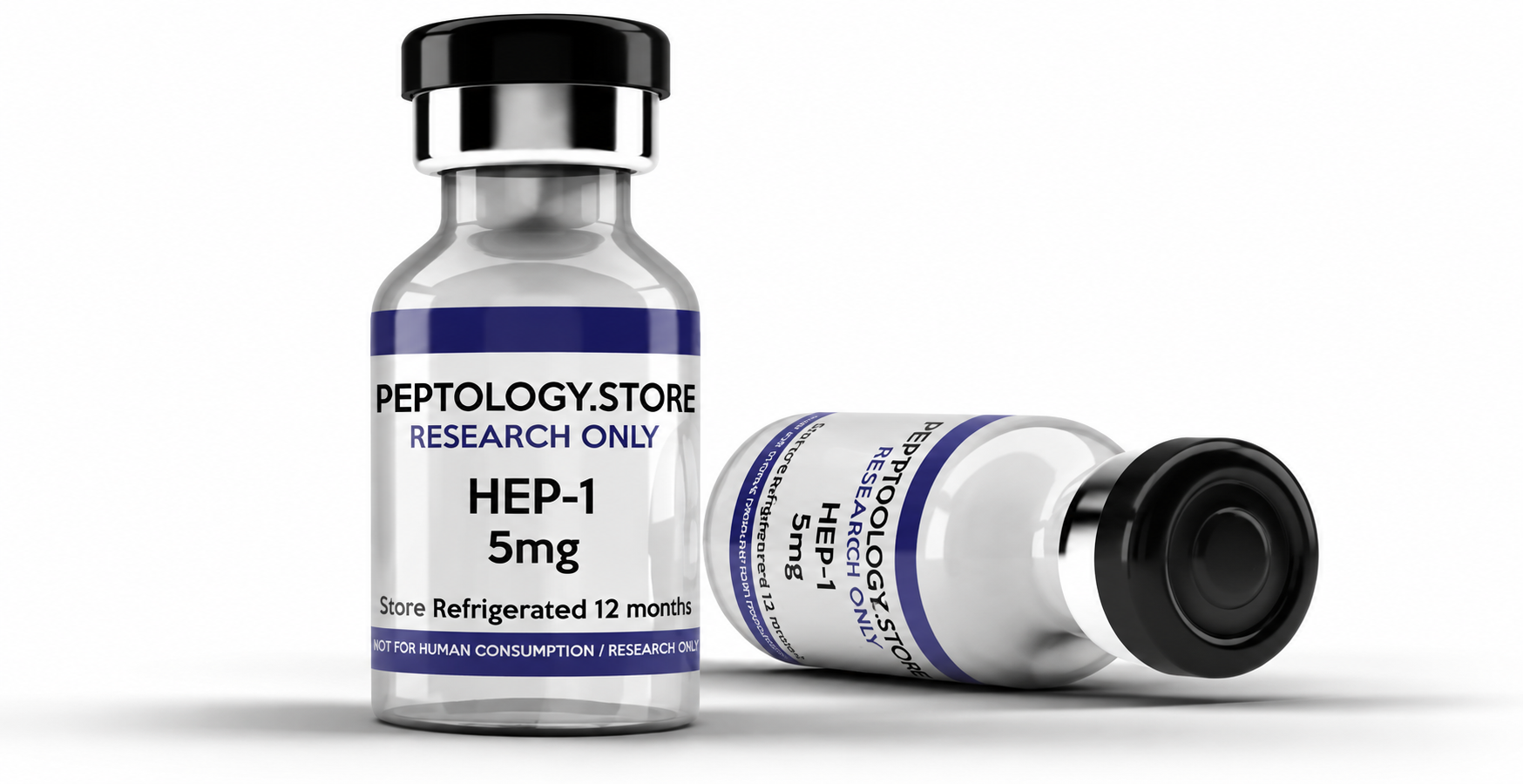
HEP-1 5mg (Gepon): Human Ezrin Peptide One for Immune-Modulation Research | 48-Hour Delivery Across EU & UK
Hardcore Labs BPC 157 Capsules: The Gold Standard in Oral Peptide Research
peptology.store is proud to present HEP-1 5mg (Gepon), a research-grade preparation of Human Ezrin Peptide One (HEP-1) intended for laboratory investigations into immune signaling, inflammatory pathways, epithelial responses, and host-defense mechanisms.
HEP-1 is a synthetic 14-amino-acid peptide with the sequence TEKKRRETVEREKE. It corresponds to a region of human ezrin, a membrane–cytoskeleton linker protein involved in cellular organization, membrane signaling, and immune-cell function. HEP-1 has been investigated as the active peptide associated with the Russian product Gepon.
The abbreviation “HEP-1” refers to Human Ezrin Peptide One, a synthetic 14-amino-acid peptide derived from a region of the human ezrin protein. The peptide sequence is TEKKRRETVEREKE and has been investigated in research involving immune regulation, inflammatory signaling, epithelial biology, and host-defense mechanisms.
For researchers seeking to buy peptide online for investigations into tissue regeneration, gut health, or recovery mechanisms, peptology.store offers HEP-1 5mg with comprehensive documentation, including Certificates of Analysis and batch-specific purity data. Whether your laboratory is based in London, Berlin, Paris, or anywhere in the European Union, our guaranteed 48 hour delivery peptide service ensures your research continues without interruption.
The Scientific Foundation of HEP-1 (Gepon) Research
Discovery and Biological Origin
Human Ezrin Peptide One (HEP-1) is a synthetic 14-residue peptide derived from a region of human ezrin. Its sequence is:
TEKKRRETVEREKE
Ezrin is part of the ERM family of proteins, which connect the plasma membrane with the actin cytoskeleton and participate in cell signaling, cellular shape, motility, and immune-cell organization.
HEP-1 has been investigated under the name Gepon and has been registered for human use in Russia since 2001. However, registration in one jurisdiction should not be interpreted as equivalent to approval by regulators such as the FDA, EMA, or MHRA.
Proposed Mechanism of Action
Researchers associated with HEP-1 have proposed that the peptide interacts with cellular structures associated with ezrin and may influence inflammatory and immune signaling.
Reported areas of investigation include:
- Cytokine regulation
- Immune-cell activation
- Adaptive immune responses
- Inflammatory signaling
- Mucosal immune responses
- Host-defense pathways
The proposed receptor and molecular mechanism remain incompletely established. Current reviews note that a specific HEP-1 receptor has not been independently molecularly identified or confirmed.
Immune-Modulation Research
HEP-1 has been investigated for its potential effects on both innate and adaptive immune responses.
Research models have examined changes involving inflammatory mediators such as IL-6, IL-1β, IL-8, and TNF-α, together with immune-cell activation and antibody responses. These findings provide a basis for continued laboratory investigation but should not be interpreted as proof of therapeutic efficacy.
Key Research Applications
Immune Signaling Research
HEP-1 can be investigated as an experimental peptide for studying cellular immune responses and inflammatory regulation.
Potential research areas include:
- Cytokine signaling
- Immune-cell activation
- T-cell and B-cell responses
- Innate immune pathways
- Adaptive immune signaling
- Host-defense mechanisms
Inflammation Research
Experimental studies have investigated HEP-1 in models involving inflammatory responses.
Researchers may examine:
- IL-6 signaling
- TNF-α expression
- IL-1β pathways
- IL-8 responses
- Inflammatory-cell activation
- Resolution of inflammatory signaling
Mucosal and Epithelial Research
Because ezrin participates in membrane organization and epithelial-cell biology, HEP-1 has also attracted interest in studies involving mucosal tissues.
Research applications may include:
- Epithelial barrier biology
- Mucosal immune responses
- Cellular repair pathways
- Inflammation of epithelial tissues
- Host–microbe interactions
Viral and Infection-Related Research
HEP-1/Gepon has been investigated in experimental and clinical contexts involving viral infections, including respiratory viral illness and herpesvirus-related conditions. Some published reports describe reductions in inflammatory symptoms, but the available evidence base is limited and includes small or uncontrolled studies.
Gastrointestinal Inflammation Research
HEP-1 has also been investigated in experimental inflammatory models involving the gastrointestinal tract. In a mouse model of chemically induced colonic inflammation, researchers compared HEP-1 with another ezrin-derived peptide and examined inflammatory cytokine expression.
Quality Assurance: Supporting Reproducible Research
When purchasing HEP-1 5mg, researchers should review the analytical documentation associated with the specific batch.
Important quality information may include:
- HPLC Purity Analysis: Chromatographic assessment of peptide purity
- Mass Spectrometry: Molecular-mass confirmation
- Batch-Specific Certificate of Analysis: Lot-specific analytical documentation
- Peptide Identity: Confirmation of the HEP-1 sequence
- Physical Appearance: Documentation of the supplied lyophilized material
- Storage Information: Recommended temperature and handling conditions
- Research-Use Labeling: Clear designation for laboratory research
| Product Specifications | |
| Molecular Weight (g/mol) | 1817.998 g/mol |
| Peptide Sequence | Thr-Glu-Lys-Lys-Arg-Arg-Glu-Thr-Val-Glu-Arg-Glu-Lys-Glu |
| Product Name | HEP-1 5mg |
| Catalogue Number | HEP-1-26 |
| CAS Number | |
| Physical and Chemical Properties | |
| Active Ingredient | HEP-1 |
| Appearance | White to off-white lyophilised powder |
| Melting Point | Not applicable (decomposes before melting) |
| Analytical and Quality Control | |
| Mass Spectrum | Conforms to specification (1479.6 g/mol) |
| Amino Acid Composition | Consistent with the theoretical peptide sequence |
| Research Use and Safety | |
| Caution | Handle using appropriate PPE and in compliance with relevant laboratory safety standards. |
| Intended Use | For laboratory research use only. Not for human or veterinary use. |
| Hazard Classification | Not classified as hazardous under GHS for research quantities |
| Storage, Handling and Stability | |
| Storage Temperature, Opened | -20 °C, minimise freeze-thaw cycles |
| Storage Temperature, Unopened | -20 °C recommended for long-term storage |
| Shelf Life | 2 years unopened under recommended conditions |
| Reconstitution Stability | Stable for up to 28 days at 2–8 °C in aqueous solution under sterile conditions |
Stability and Handling
HEP-1 5mg (Gepon) should be stored and handled according to the supplier’s batch-specific documentation.
- Lyophilized Material: Keep under the recommended low-temperature storage conditions specified for the batch.
- Light Protection: Protect the vial from unnecessary direct light exposure.
- Moisture Protection: Keep the container tightly sealed and protected from humidity.
- Reconstituted Material: Follow the validated laboratory protocol and supplier instructions after preparation.
- Freeze-Thaw Exposure: Avoid unnecessary repeated freeze-thaw cycles.
- Documentation: Record storage and preparation conditions as part of the experimental workflow.
Real-World Research Applications and Investigator Experiences
Immune Response Studies
Published research has investigated HEP-1/Gepon in connection with immune responses, inflammatory cytokines, and host-defense mechanisms. A review of the available literature describes investigations involving viral, bacterial, and fungal conditions.
Respiratory Inflammation Research
Research involving Gepon has included small clinical studies of acute viral respiratory illness and inflammatory respiratory complications. Reported studies have examined symptom duration, inflammatory responses, and immune markers. These studies should be interpreted cautiously because the evidence base is limited and does not establish broad clinical efficacy.
Cytokine Research
HEP-1 has been investigated in relation to inflammatory cytokines, particularly IL-6, IL-1β, IL-8, and TNF-α.
This makes it a potential experimental tool for researchers studying the relationship between peptide signaling and inflammatory mediator production.
Gastrointestinal Inflammation Models
Experimental work has evaluated HEP-1 in chemically induced intestinal inflammation models, including investigations of cytokine expression and inflammatory responses.
Key Research Features
- HEP-1 / Human Ezrin Peptide One
- 5mg Research Preparation
- 14-Amino-Acid Synthetic Peptide
- Sequence: TEKKRRETVEREKE
- Ezrin-Derived Research Compound
- Immune-Modulation Research
- Inflammatory Signaling Studies
- Cytokine Research
- Mucosal Immunology Research
- Epithelial Biology Studies
- Host-Defense Research
- Viral and Infection-Related Research
- Gastrointestinal Inflammation Research
- Research Documentation: Batch-specific analytical documentation should be reviewed before use
- Controlled Storage: Follow supplier-specific stability and handling requirements
- Research-Use Material: Intended for laboratory research rather than human or veterinary use
Frequently Asked Questions
Q: What is HEP-1 5mg?
A: HEP-1 (Human Ezrin Peptide One) is a synthetic 14-amino-acid peptide with the sequence TEKKRRETVEREKE. It is derived from a region of human ezrin and has been investigated in immune-modulation and inflammatory research.
Q: Is HEP-1 the same as Gepon?
A: Yes. HEP-1 is the active peptide associated with the product known as Gepon. The peptide is also referred to as Human Ezrin Peptide One or ezrin peptide.
Q: What is the amino acid sequence of HEP-1?
A: The reported HEP-1 sequence is:
TEKKRRETVEREKE
It consists of 14 amino acids.
Q: What receptor does HEP-1 act on?
A: A specific molecular receptor for HEP-1 has not been independently established. Some publications describe a proposed interaction with a structure associated with ezrin, but the proposed receptor mechanism remains unconfirmed.
Q: What research areas commonly use HEP-1?
A: HEP-1 has been investigated in immune modulation, inflammatory signaling, cytokine research, mucosal immunology, epithelial biology, infection-related research, and experimental gastrointestinal inflammation.
Q: Has HEP-1 been studied in humans?
A: Yes. HEP-1/Gepon has been investigated in several small clinical and observational studies, primarily reported from Russia. However, the international evidence base remains limited, and there is no robust body of independently replicated randomized, double-blind clinical evidence establishing efficacy across medical indications.
Q: Has HEP-1 been investigated for COVID-19?
A: A phase 1 study of HEP-1 in COVID-19 was registered with an anticipated enrollment of 20 participants. The registry information available through the indexed record lists the study status as unknown and does not provide posted efficacy results.
Q: How should HEP-1 5mg be stored?
A: Follow the manufacturer’s batch-specific storage instructions. Research peptide material should generally be protected from moisture, unnecessary light exposure, and temperature fluctuations.
Q: What documentation should I request with HEP-1?
A: Researchers should request the batch-specific Certificate of Analysis (COA) and, where available, analytical information such as HPLC purity data, mass-spectrometry results, lot identification, and storage recommendations.
Q: Is HEP-1 intended for human consumption?
A: Research-grade HEP-1 5mg should be designated for laboratory research only and should not be represented as a product for human or veterinary consumption.
Q: Do you offer bulk quantities of HEP-1?
A: Institutional and laboratory researchers seeking larger quantities should contact peptology.store to confirm current availability, batch documentation, pricing, and supply requirements.
Q: Do you ship HEP-1 to EU and UK research facilities?
A: Shipping availability, delivery times, and import requirements should be confirmed directly with peptology.store because these can vary by destination and current regulatory requirements.
Q: Where can I find HEP-1 5mg product information?
A: Product information and current availability can be reviewed through peptology.store.
Advance Your Research with HEP-1 5mg (Gepon)
peptology.store provides researchers with access to HEP-1 5mg (Gepon) for laboratory investigations involving immune signaling, inflammatory pathways, cytokine biology, epithelial responses, and host-defense mechanisms.
With its defined 14-amino-acid ezrin-derived sequence, HEP-1 provides researchers with a focused experimental compound for investigating peptide-mediated immune and inflammatory pathways.
With over three decades of preclinical research supporting its cytoprotective and regenerative properties , HEP-1 5mg represents one of the most versatile and well-studied peptides in the research community. Its unique stability in oral formulations, multimodal mechanisms of action, and emerging applications in neuroscience make it an invaluable tool for contemporary research.
Order today and experience the peptology.store difference – premium HEP-1 5mg quality, rapid 48-hour delivery across the EU and UK, and expert support for the European research community.