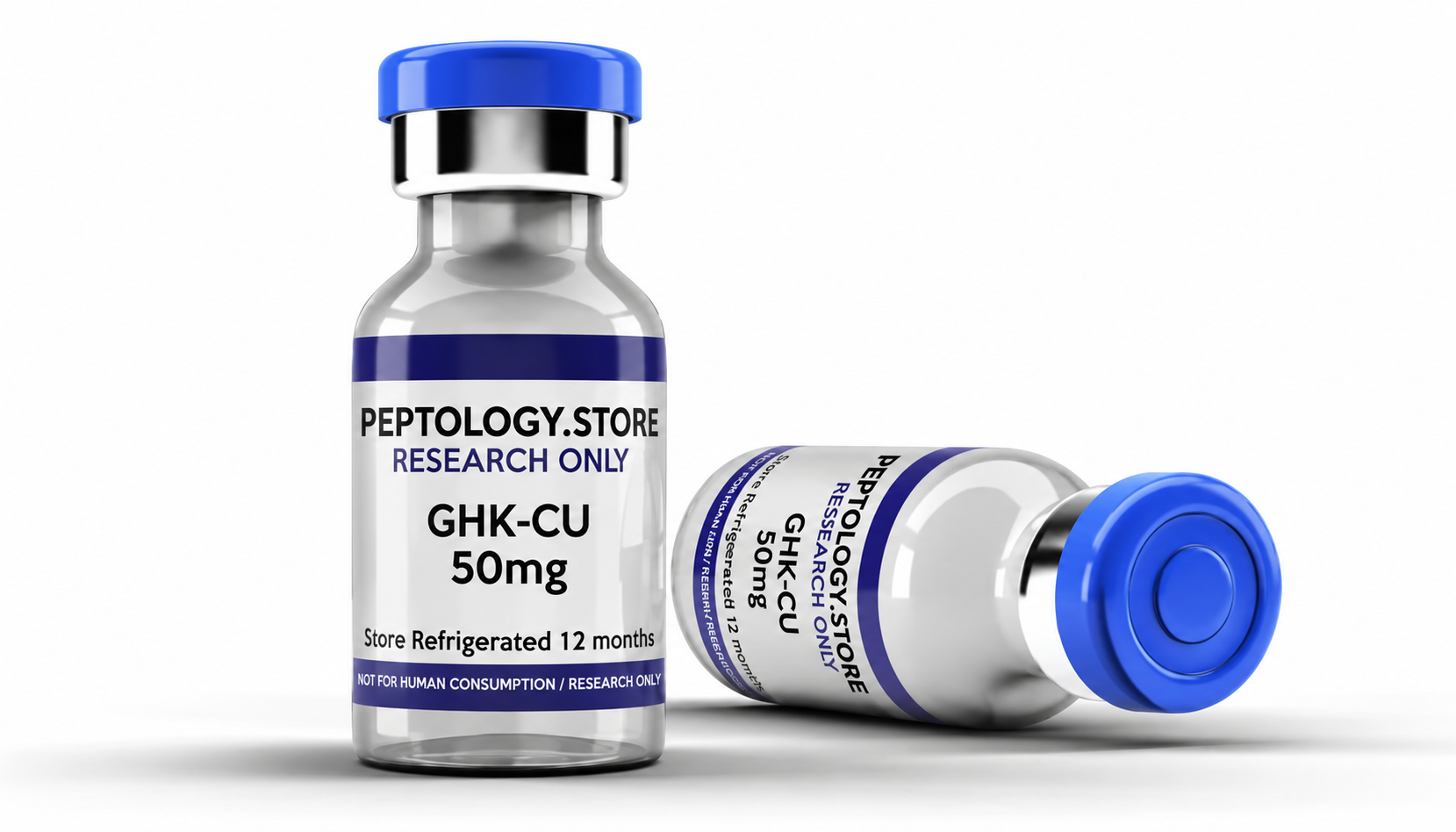
Premium GHK-Cu 50mg Copper Tripeptide Complex for Sale | 30mg Each per Vial | ≥99% Purity | 48-Hour Delivery Across EU & UK
GHK-Cu 50mg (Copper Peptide): Advanced Research Compound for Tissue Remodeling & Regenerative Biology
peptology.store is proud to present GHK-Cu 50mg (Copper Peptide), a research-grade copper-binding tripeptide supplied for laboratory investigations into tissue remodeling, extracellular-matrix biology, wound-healing pathways, fibroblast activity, angiogenesis, inflammation, and skin biology.
GHK-Cu (Copper Tripeptide-1) is the copper complex of the naturally occurring tripeptide glycyl-L-histidyl-L-lysine (GHK). GHK occurs naturally in human biological fluids and has a strong affinity for copper(II), forming the GHK-Cu complex. Research has investigated GHK-Cu for its effects on collagen, elastin, glycosaminoglycan production, fibroblast function, tissue repair, and inflammatory signaling.
As a dedicated EU peptide supplier and peptide vendor UK, Peptology Store provides research compounds with batch-specific documentation intended to support controlled laboratory workflows.
For researchers seeking to buy peptide online for investigations into growth hormone dynamics, tissue regeneration, metabolic regulation, or endocrine function, Peptology Store offers this premium GHK-Cu 50mg with comprehensive documentation, including Certificates of Analysis and batch-specific purity data. Whether your laboratory is based in London, Berlin, Paris, or anywhere in the European Union, our guaranteed 48 hour delivery peptide service ensures your research continues without interruption.
The Scientific Foundation of GHK-Cu Research
Discovery and Biological Background
GHK was identified as a naturally occurring human plasma peptide in the 1970s. It consists of three amino acids—glycine, histidine, and lysine—and has a strong affinity for copper ions. When complexed with Cu²⁺, it forms GHK-Cu, also known as Copper Tripeptide-1.
Research over several decades has examined GHK-Cu in relation to:
- Extracellular-matrix remodeling
- Collagen synthesis
- Fibroblast activity
- Wound-healing processes
- Angiogenesis
- Skin regeneration
- Inflammatory signaling
- Cellular protection
Molecular Structure and Classification
GHK-Cu consists of the tripeptide Gly-His-Lys complexed with copper(II).
The copper component is biologically relevant because copper participates in numerous enzymatic processes, including pathways associated with connective-tissue formation and antioxidant defense. GHK’s ability to bind copper has therefore been investigated as an important component of its biological activity.
Extracellular-Matrix Signaling
One of the major areas of GHK-Cu research concerns extracellular-matrix remodeling.
Experimental studies have reported effects involving:
- Collagen synthesis
- Elastin production
- Glycosaminoglycan synthesis
- Fibronectin-related pathways
- Matrix metalloproteinase activity
- Fibroblast function
- Tissue remodeling
These mechanisms have made GHK-Cu a frequently investigated compound in skin and connective-tissue research.
Fibroblast and Tissue-Repair Biology
GHK-Cu has been studied in experimental models examining fibroblast responses during tissue repair. Research has reported increased production of structural extracellular-matrix components and changes in cellular pathways involved in tissue remodeling.
Key Research Applications
Tissue Repair and Regeneration Research
GHK-Cu has been investigated extensively in experimental models of tissue repair and remodeling.
Research applications include:
- Wound-Healing Models: Investigate cellular and extracellular-matrix responses following injury
- Collagen Research: Study regulation of collagen synthesis and deposition
- Fibroblast Biology: Examine fibroblast proliferation, activity, and matrix production
- Tissue Remodeling: Investigate mechanisms responsible for restoration of damaged tissue
- Connective-Tissue Research: Examine structural protein production and extracellular-matrix organization
Preclinical literature has reported wound-healing and tissue-remodeling effects in several experimental systems, although the strength of evidence varies by model and route of administration.
Skin Biology and Regeneration Research
GHK-Cu is particularly well studied in skin-related research.
Research areas include:
- Dermal fibroblast activity
- Skin thickness and density
- Collagen production
- Elastin synthesis
- Skin barrier biology
- Photoaging models
- Extracellular-matrix remodeling
- Cellular responses to oxidative stress
Several topical studies have reported improvements in measures of skin appearance and structure, including wrinkle depth, skin density, and elasticity.
Angiogenesis and Vascular Research
GHK-Cu has also been investigated for its relationship with angiogenic signaling.
Experimental research has examined effects involving:
- VEGF-related signaling
- Fibroblast growth factor pathways
- Blood-vessel formation
- Tissue vascularization
- Wound-associated angiogenesis
Research in dermal fibroblasts has reported increased expression of angiogenesis-associated factors such as VEGF and bFGF under certain experimental conditions.
Anti-Inflammatory Research
GHK-Cu has been studied for potential effects on inflammatory signaling and cellular stress responses.
Research applications include:
- Cytokine signaling
- Inflammatory mediator expression
- NF-κB-associated pathways
- Oxidative stress
- Cellular protection
- Resolution of inflammatory responses
These findings are primarily derived from cellular and preclinical research and should not be interpreted as established systemic therapeutic effects.
Hair-Follicle and Scalp Research
GHK-Cu has attracted research interest in hair biology because copper-binding peptides have been investigated for their effects on vascularization, extracellular-matrix turnover, and dermal-cell signaling.
Research areas include:
- Dermal papilla biology
- Hair-follicle signaling
- VEGF-related pathways
- Microvascular development
- Collagen and glycosaminoglycan production
- Scalp tissue remodeling
A recent review describes experimental evidence linking GHK-Cu with VEGF production in dermal fibroblasts and hair-related vascular pathways.
Oxidative-Stress and Cellular Protection Research
GHK-Cu has been investigated in models of oxidative stress and cellular injury.
Researchers may examine:
- Reactive oxygen species
- Antioxidant-defense pathways
- Cellular stress responses
- DNA-repair-associated signaling
- Tissue-protective mechanisms
The published literature suggests that GHK/GHK-Cu can influence multiple gene-expression and cellular-protection pathways, although these findings remain an active research area.
Quality Assurance: Setting the Standard for Research Compounds
Manufacturing Excellence
peptology.store supplies GHK-Cu 50mg with an emphasis on analytical quality and batch traceability.
Quality documentation may include:
- HPLC Purity Analysis: Analytical assessment of peptide purity
- Mass Spectrometry Verification: Molecular-mass confirmation
- Batch-Specific Certificates of Analysis: Documentation associated with the individual production batch
- Lyophilized Research Format: Dry presentation intended for controlled laboratory storage
- Research-Use-Only Labelling: Clearly designated for laboratory research
| Molecular Weight (g/mol) | 401.9 g/mol |
| Peptide Sequence | Glycyl-L-histidyl-L-lysine |
| Physical and Chemical Properties | |
| Molecular Formula | C14H22CuN6O4 |
| Physical Appearance | Blue lyophilised solid |
| Form | Lyophilised (freeze-dried) solid |
| Solubility | Aqueous soluble |
| Appearance | Blue lyophilised solid |
| Melting Point | Not applicable (decomposes before melting) |
| Analytical and Quality Control | |
| HPLC Result | Shows min 99% Purity |
| Mass Spectrum | Consistent with structure |
| Purity % | >99% |
| Research Use and Safety | |
| Caution | Research use only / Not for human or veterinary use |
| Intended Use | For laboratory research use only. Not for human or veterinary use. |
| Hazard Classification | Not classified as hazardous under GHS for research quantities |
| Storage, Handling and Stability | |
| Storage Temperature, Opened | Lyophilized peptides although stable at room temperature for 3 months, should be stored desiccated below -18°C. Upon reconstitution of the peptide it should be stored at 4°C between 2-21 days and for future use below -18°C. |
| Storage Temperature, Unopened | -20 °C recommended for long-term storage |
| Shelf Life | 2 years unopened under recommended conditions |
| Reconstitution Stability | Stable for up to 28 days at 2-8 °C in aqueous solution under sterile conditions |
Stability and Handling
GHK-Cu 50mg should be handled according to the supplier’s batch-specific documentation and established laboratory procedures.
- Lyophilized Material: Store according to the temperature specified on the product documentation.
- Light Protection: Protect the material from unnecessary light exposure.
- Moisture Protection: Keep the container tightly closed and protected from humidity.
- Reconstituted Material: Establish solution-storage conditions according to validated laboratory procedures and available stability data.
- Aliquoting: Where appropriate, aliquot prepared research solutions to reduce repeated freeze-thaw exposure.
- Handling: Avoid unnecessary agitation and prolonged exposure to unsuitable temperatures.
- Documentation: Record preparation dates and storage conditions for reproducible laboratory workflows.
Real-World Research Applications and Investigator Studies
Collagen and Extracellular-Matrix Studies
GHK-Cu has been investigated extensively for its influence on extracellular-matrix biology.
Experimental studies have reported effects involving collagen, elastin, glycosaminoglycans, and fibroblast activity. These properties make GHK-Cu useful for laboratory models investigating matrix synthesis and tissue remodeling.
Wound-Healing Models
Preclinical studies have examined GHK-Cu in wound-healing systems, including models involving tissue contraction, collagen formation, and repair-associated cellular activity.
The available evidence supports continued investigation of GHK-Cu as a research tool for understanding mechanisms of tissue recovery rather than establishing it as a clinically proven systemic treatment.
Skin-Aging and Photoaging Studies
Topical GHK-Cu has been evaluated in controlled human studies involving photoaged skin.
Published research has reported changes in:
- Skin thickness
- Skin density
- Elasticity
- Fine lines
- Wrinkle depth
- Overall skin appearance
These studies primarily concern topical formulations, and their results should not automatically be extrapolated to injectable or systemic administration.
Fibroblast Research
Human dermal fibroblast models have been used to investigate GHK-Cu-associated changes in collagen, elastin, and growth-factor-related pathways.
These models provide a useful platform for studying extracellular-matrix regulation and tissue-remodeling mechanisms.
Angiogenesis Research
GHK-Cu has been investigated in relation to angiogenic pathways involving VEGF and bFGF.
Such research can help characterize how extracellular-matrix signaling, fibroblast activity, and vascular development interact during tissue repair.
Key Research Features
- 50mg Research Presentation
- GHK-Cu / Copper Tripeptide-1
- Naturally Occurring GHK-Based Copper Complex
- Extracellular-Matrix Research
- Collagen and Elastin Studies
- Fibroblast Biology
- Wound-Healing Research
- Skin Regeneration Studies
- Angiogenesis Research
- VEGF-Related Signaling Studies
- Inflammatory-Pathway Research
- Oxidative-Stress Research
- Hair-Follicle and Scalp Biology
- Lyophilized Research Format
- Batch-Specific Documentation
- Research-Use-Only Material
- Laboratory-Oriented Handling Guidance
- EU & UK Research Supply through Peptology Store
Frequently Asked Questions
Q: What is GHK-Cu?
A: GHK-Cu, also known as Copper Tripeptide-1, is a copper complex of the naturally occurring tripeptide glycyl-L-histidyl-L-lysine (GHK). It has been investigated extensively in tissue remodeling, skin biology, wound healing, fibroblast activity, and extracellular-matrix research.
Q: What is GHK-Cu 50mg used for?
A: GHK-Cu 50mg is supplied for laboratory research involving collagen synthesis, fibroblast biology, extracellular-matrix remodeling, wound-healing pathways, angiogenesis, skin biology, oxidative stress, and inflammatory signaling.
Q: What is the primary biological role investigated for GHK-Cu?
A: Research has primarily focused on GHK-Cu’s relationship with extracellular-matrix remodeling, collagen and elastin production, fibroblast activity, tissue repair, and angiogenesis.
Q: Does GHK-Cu affect collagen production?
A: Yes. Experimental studies have reported increased collagen-related activity following GHK-Cu exposure, including in dermal fibroblast models. Several topical human studies have also reported changes in skin collagen and structural measures.
Q: Is GHK-Cu studied for wound healing?
A: Yes. GHK-Cu has been investigated in preclinical wound-healing and tissue-repair models, including studies examining wound contraction, collagen formation, tissue remodeling, and inflammatory responses.
Q: Is GHK-Cu studied for skin research?
A: Yes. GHK-Cu is extensively studied in skin biology and topical cosmetic research. Human topical studies have reported improvements in measures such as skin density, thickness, elasticity, fine lines, and wrinkle appearance.
Q: Is GHK-Cu studied in hair research?
A: Yes. Research has examined GHK-Cu in relation to hair-follicle biology, dermal fibroblast signaling, vascularization, VEGF-related pathways, and extracellular-matrix turnover.
Q: Does GHK-Cu have anti-inflammatory properties?
A: GHK-Cu has demonstrated anti-inflammatory activity in cellular and preclinical research models. However, these findings should be distinguished from evidence of established clinical efficacy in humans.
Q: How should GHK-Cu be stored?
A: Store the lyophilized research material according to the storage conditions specified in the product’s batch documentation. Protect it from excessive moisture, light, and unsuitable temperatures. Reconstituted material should be handled according to an appropriate laboratory stability protocol.
Q: Is GHK-Cu suitable for human consumption?
A: GHK-Cu 50mg supplied by peptology.store is intended for research and laboratory use only. It should not be represented as an approved therapeutic product or used as a substitute for clinically evaluated treatment.
Q: Can GHK-Cu be used in cell culture research?
A: Yes. GHK-Cu has been investigated in experimental cell systems, including human dermal fibroblast models. Researchers should establish concentrations, exposure times, controls, and formulation conditions according to their validated laboratory protocols.
Q: What documentation is available with GHK-Cu orders?
A: Batch-specific analytical documentation such as a Certificate of Analysis (COA) may be provided with the material. Additional analytical information should be confirmed for the specific production batch.
Q: Do you offer bulk quantities of GHK-Cu 50mg?
A: Bulk research supply can be discussed for qualified laboratory and institutional requirements. Contact Peptology Store for current availability and batch documentation.
Q: Do you ship GHK-Cu to EU countries?
A: Shipping availability for GHK-Cu 50mg can be confirmed through peptology.store. Researchers should verify applicable destination-country requirements before ordering.
Q: Does topical GHK-Cu research prove systemic therapeutic effectiveness?
A: No. Published topical studies provide evidence about specific topical formulations and outcomes. They should not automatically be interpreted as evidence that injectable or systemic GHK-Cu has the same effects or safety profile. Current reviews note that large-scale clinical evidence for systemic GHK-Cu remains limited.
Q: What makes GHK-Cu interesting for regenerative research?
A: GHK-Cu has a broad experimental profile involving collagen and extracellular-matrix production, fibroblast activity, angiogenesis-associated signaling, tissue remodeling, and inflammatory pathways. This combination makes it a useful research model for investigating interconnected mechanisms of tissue repair.
Advance Your Research with GHK-Cu 50mg
Peptology Store provides GHK-Cu 50mg (Copper Peptide) for researchers investigating extracellular-matrix biology, collagen synthesis, fibroblast signaling, wound-healing mechanisms, skin regeneration, angiogenesis, and cellular stress responses.
Whether your work focuses on dermal biology, connective-tissue remodeling, wound-healing models, hair-follicle research, or copper-dependent cellular pathways, GHK-Cu provides a well-characterized research model for controlled laboratory investigation.
The extensive preclinical literature surrounding GHK-Cu provides a foundation for continued investigation, while the limitations of current systemic clinical evidence should be considered when interpreting experimental findings.
Order today and experience the peptology.store difference – premium GHK-Cu quality, rapid 48-hour delivery across the EU and UK, and expert support for the European research community.