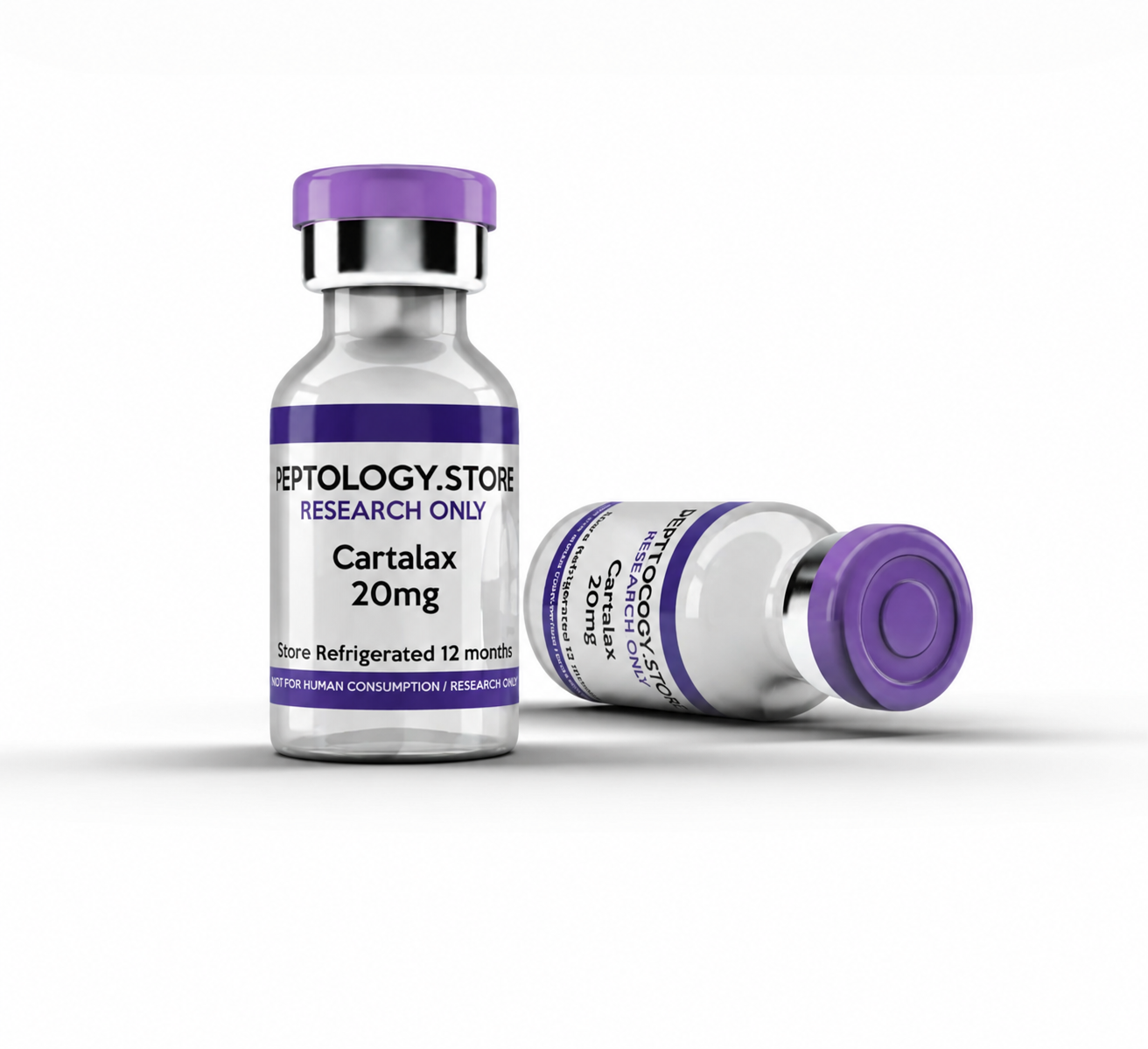
Cartalax 20mg – Research Bioregulator Peptide | ≥99% Purity | 48-Hour Delivery Across EU & UK
Cartalax 20mg is a synthetic bioregulator peptide offered at a 20mg concentration, developed for advanced scientific research in chondrocyte biology and cartilage-related pathways. Known for its short-chain structure, Cartalax is used to explore cellular regeneration and age-related changes in connective tissue.
- Product Name: Cartalax 20mg
- Catalogue Number: CART20-031
- Molecular Formula: C12H19N3O8
- Molecular Weight: 333.29 g/mol
- Purity: ≥99% (HPLC)
- Form: Lyophilised Solid
- Class: Synthetic Bioregulator Peptide
- Research Area: Joint & Cartilage Studies
Cartalax is a short synthetic peptide and does not share the characteristic cyclic disulfide-bonded structure of oxytocin or vasopressin. Its biological activity is proposed to arise from interactions with cellular regulatory mechanisms, particularly those associated with gene expression and tissue-specific cellular processes. However, the precise molecular targets and receptor interactions of Cartalax have not been definitively established.
Mechanism of Action
Cartalax is described as a short synthetic peptide bioregulator associated with cartilage and connective-tissue research. Unlike oxytocin, it does not have an established GPCR-based signaling pathway. Proposed mechanisms are based primarily on preclinical research and the broader Khavinson short-peptide bioregulator model.
Gene Expression Modulation: Cartalax has been investigated for its potential to influence gene-expression patterns in cells. The proposed bioregulator model suggests that short peptides may interact with cellular regulatory systems and influence the expression of genes involved in tissue maintenance and cellular function. However, Cartalax-specific molecular targets have not been firmly established.
Chondrocyte and Connective-Tissue Signaling: Research and research-oriented literature describe Cartalax as a cartilage-associated peptide investigated for possible effects on chondrocytes and connective-tissue cells. Proposed areas include cellular renewal, extracellular-matrix regulation, and maintenance of cartilage-related cellular functions.
Extracellular-Matrix Regulation: Cartalax has been investigated in relation to cartilage matrix biology and proteins involved in maintaining connective-tissue structure. These findings remain preliminary and have not established a confirmed therapeutic mechanism in humans.
Cellular Aging and Gene Regulation: Experimental studies involving short peptides from the Khavinson research program have examined changes in gene expression associated with cellular aging. Cartalax is consequently studied within the broader context of cellular renewal and age-associated tissue changes.
Physiological Functions
Cartilage and Connective-Tissue Research: Cartalax is primarily investigated in connection with cartilage, chondrocytes, and connective-tissue biology. Research interest focuses on whether the peptide can influence cellular processes involved in cartilage maintenance and tissue integrity.
Chondrocyte Function: Experimental research has explored the possibility that Cartalax and related short peptides may influence chondrocyte activity and gene-expression patterns. These findings are currently considered preliminary rather than established physiological effects in humans.
Extracellular-Matrix Integrity: Cartalax is studied for its proposed relationship with extracellular-matrix proteins and cartilage structure. The objective is to understand whether short peptide regulators can influence processes involved in maintaining connective-tissue architecture.
Cellular Renewal: The broader short-peptide bioregulator research program investigates whether specific peptides can modulate cellular processes associated with tissue renewal and aging. Evidence specific to Cartalax remains limited and predominantly preclinical.
Key Research Applications
Cartilage and Musculoskeletal Research
Cartalax is primarily discussed in research involving cartilage and connective-tissue biology:
- Chondrocyte Research: Investigate potential effects on chondrocyte activity, cellular signaling, and gene expression
- Cartilage Biology: Study mechanisms involved in cartilage maintenance and extracellular-matrix regulation
- Connective-Tissue Research: Explore potential effects on connective-tissue cellular processes
- Cartilage Degeneration: Investigate whether Cartalax-related mechanisms may be relevant to age-associated cartilage changes
- Gene Expression: Examine changes in genes associated with cartilage and connective-tissue function
Cellular Aging Research
Cartalax is also considered within the broader research field of short-peptide regulation of cellular aging:
- Gene Regulation: Investigate peptide-associated changes in gene-expression profiles
- Cellular Renewal: Explore potential effects on cellular processes associated with tissue maintenance
- Age-Related Cellular Changes: Study peptide effects in experimental models of cellular aging
- Stem-Cell Research: Examine reported effects of short peptides on cellular differentiation and aging models
Extracellular-Matrix Research
Research involving Cartalax and related peptides includes investigation of extracellular-matrix biology:
- Matrix Protein Expression: Study regulation of proteins associated with tissue structure
- Cartilage Matrix: Investigate cellular mechanisms involved in cartilage-matrix maintenance
- Tissue Integrity: Explore potential relationships between peptide signaling and connective-tissue integrity
- Cell-Matrix Interactions: Study how changes in cellular regulation may influence extracellular-tissue organization
Inflammation and Tissue-Response Research
Cartalax is also discussed in research concerning inflammatory signaling within cartilage and connective tissue:
- Cytokine Signaling: Investigate potential effects on inflammatory signaling pathways
- Cartilage Inflammation: Explore molecular responses associated with inflammatory cartilage environments
- Cellular Stress: Study cellular responses associated with tissue aging and degeneration
- Tissue Protection: Investigate whether peptide-mediated regulation may influence cellular responses to stress
Musculoskeletal and Joint Research
Cartalax has attracted research interest because of its proposed association with cartilage and joint tissue:
- Joint-Tissue Biology: Study cellular mechanisms relevant to cartilage and connective tissue
- Osteoarthritis Research: Explore potential relevance to experimental models of cartilage degeneration
- Cartilage Repair Research: Investigate whether Cartalax-related signaling could influence cartilage-maintenance processes
- Age-Related Joint Changes: Study molecular changes associated with aging cartilage
Important Research Status
Cartalax should currently be regarded as a research-stage compound rather than an established therapeutic medicine. Available evidence is limited, with much of the proposed mechanism coming from preclinical research and the broader short-peptide bioregulator hypothesis. There is no robust, independently replicated human clinical evidence establishing its effectiveness or safety for treating cartilage or joint disease.
Cartalax — Chemical and Product Specifications
| Specification | Detail |
|---|---|
| Product Name | Cartalax |
| Alternative Designation | Ala-Glu-Asp (AED); T-31 |
| Chemical Class | Synthetic linear tripeptide |
| CAS Number | Not conclusively established; verify against the batch-specific documentation |
| Molecular Formula | C₁₂H₁₉N₃O₈ |
| Molecular Weight | 333.29 Da |
| Amino Acid Sequence | Ala-Glu-Asp (AED) |
| Full Peptide Representation | H-Ala-Glu-Asp-OH |
| Structure | Linear tripeptide with free N- and C-termini |
| Purity | Batch-specific; verify by HPLC/LC-MS |
| Appearance | Typically white to off-white lyophilized powder |
| Form | Lyophilized powder |
| Solubility | Water-soluble; exact solubility depends on formulation and experimental conditions |
| Target | No specific validated receptor has been established |
| Research Classification | Research-use compound / investigational peptide |
| Storage | Follow the supplier’s batch-specific Certificate of Analysis and storage instructions |
| Documentation | Certificate of Analysis and analytical identification data where available |
The chemical identity above follows the PubChem-associated Cartalax record, which identifies Cartalax as Ala-Glu-Asp (AED), a linear tripeptide with molecular formula C₁₂H₁₉N₃O₈ and molecular weight 333.29 Da.
Stability and Handling Guidelines
Lyophilized Powder Storage:
Store according to the manufacturer’s validated storage conditions and the batch-specific Certificate of Analysis. Research suppliers commonly recommend frozen, dry storage for the lyophilized material, but storage specifications should be confirmed for the particular batch rather than assigning a universal stability period.
Reconstitution and Experimental Handling:
- Allow the vial and appropriate laboratory solvent to equilibrate according to the laboratory’s handling protocol.
- Use a suitable research-grade solvent or buffer compatible with the planned experiment.
- Add solvent carefully to minimize foaming.
- Mix gently until the material is completely dissolved.
- Label the preparation with the compound identity, concentration, preparation date, and relevant batch information.
- Store the resulting preparation according to validated laboratory stability data.
Reconstituted Material:
There is insufficient independent evidence to assign a universal shelf life to reconstituted Cartalax. Stability depends on concentration, solvent, container, temperature, and handling conditions. Avoid repeated freeze-thaw cycles where possible.
Protection From Environmental Exposure:
- Keep the original container tightly closed.
- Protect the material from excessive moisture and unnecessary light exposure.
- Follow the supplier’s SDS and batch-specific storage instructions.
- Do not assume a generic 24-month shelf life unless it is supported by the manufacturer’s stability data.
Key Research Areas
- Cartilage and Connective-Tissue Research: Investigates Cartalax within experimental models of cartilage and connective-tissue biology.
- Cellular Aging: Studies short-peptide effects on cellular processes associated with aging and senescence.
- Gene-Expression Research: Examines whether Cartalax may influence gene-expression patterns in experimental cell systems.
- Fibroblast Research: Investigates cellular responses in fibroblast and aging-related experimental models.
- Mesenchymal Stem-Cell Research: Explores short-peptide effects on gene-expression profiles and cellular aging models.
- Extracellular-Matrix Research: Investigates potential relationships between short peptides and extracellular-matrix biology.
Evidence for Cartalax remains predominantly preclinical and experimental. There are currently no established human clinical indications supported by robust clinical evidence.
Frequently Asked Questions
Q: What is Cartalax?
A: Cartalax is a synthetic short peptide generally identified as the tripeptide Ala-Glu-Asp (AED). It belongs to the group of short peptide bioregulators associated with the Khavinson research program and has been investigated primarily in cellular and preclinical research.
Q: What is the molecular weight of Cartalax?
A: The commonly documented molecular weight for the AED form of Cartalax is 333.29 Da, with molecular formula C₁₂H₁₉N₃O₈.
Q: What is the amino acid sequence?
A: The better-supported Cartalax identity is Ala-Glu-Asp (AED), represented as H-Ala-Glu-Asp-OH.
Q: Does Cartalax have a specific receptor?
A: Unlike oxytocin, Cartalax does not have a well-established specific receptor such as a GPCR. Proposed mechanisms involve broader cellular and gene-regulatory effects, but its precise molecular targets have not been definitively established.
Q: Is Cartalax a cyclic peptide?
A: No. The commonly documented AED form is a linear tripeptide, not a cyclic peptide and not a disulfide-bonded nonapeptide like oxytocin.
Q: What research areas commonly investigate Cartalax?
A: Research has investigated Cartalax and related short peptides in areas including cellular aging, gene-expression regulation, fibroblast biology, mesenchymal stem-cell models, and cartilage/connective-tissue research.
Q: Do you ship Cartalax to EU countries?
A: Yes. As a dedicated EU peptology supplier, we ship Cartalax Peptide to all European Union member states with our guaranteed 48 hour delivery peptide service. Our EU fulfilment centre ensures rapid delivery without customs delays. All shipments use protective packaging to maintain compound integrity during transit.
Q: Do you offer bulk quantities of Cartalax for institutional research?
A: Yes. We accommodate bulk orders for research institutions. Contact our team here now for volume pricing, custom requirements, and supply agreements for ongoing research programs.
Q: What documentation should accompany a research batch?
A: Appropriate documentation may include a batch-specific Certificate of Analysis, HPLC or RP-HPLC purity data, LC-MS/ESI-MS identity confirmation, and relevant storage information. The exact specifications should be verified against the actual batch rather than assumed from a generic product page.
Scientific Background
Cartalax is generally characterized as a short synthetic tripeptide with the sequence Ala-Glu-Asp (AED). It has been investigated within the broader short-peptide bioregulator research program associated with tissue-specific cellular regulation and aging-related biology.
Experimental research has examined short-peptide effects on gene-expression profiles and cellular aging models. However, claims concerning cartilage regeneration, disease treatment, or clinical effectiveness should be distinguished from laboratory findings because human clinical evidence remains limited.
Research-Use Notice
Cartalax should be described as an investigational research compound rather than an established therapeutic. It is not appropriate to represent experimental findings as proven medical benefits. Researchers should verify compound identity, purity, storage requirements, and applicable regulatory requirements using the relevant batch documentation and institutional procedures.
Quality-Control Considerations
For laboratory research, quality documentation should ideally establish:
- Compound identity
- Molecular mass
- Peptide sequence
- HPLC/RP-HPLC purity
- LC-MS or equivalent mass confirmation
- Batch or lot number
- Manufacturing date
- Storage conditions
- Certificate of Analysis
Because commercial listings for Cartalax contain conflicting sequences, molecular formulas, and CAS numbers, batch-specific analytical documentation is particularly important.