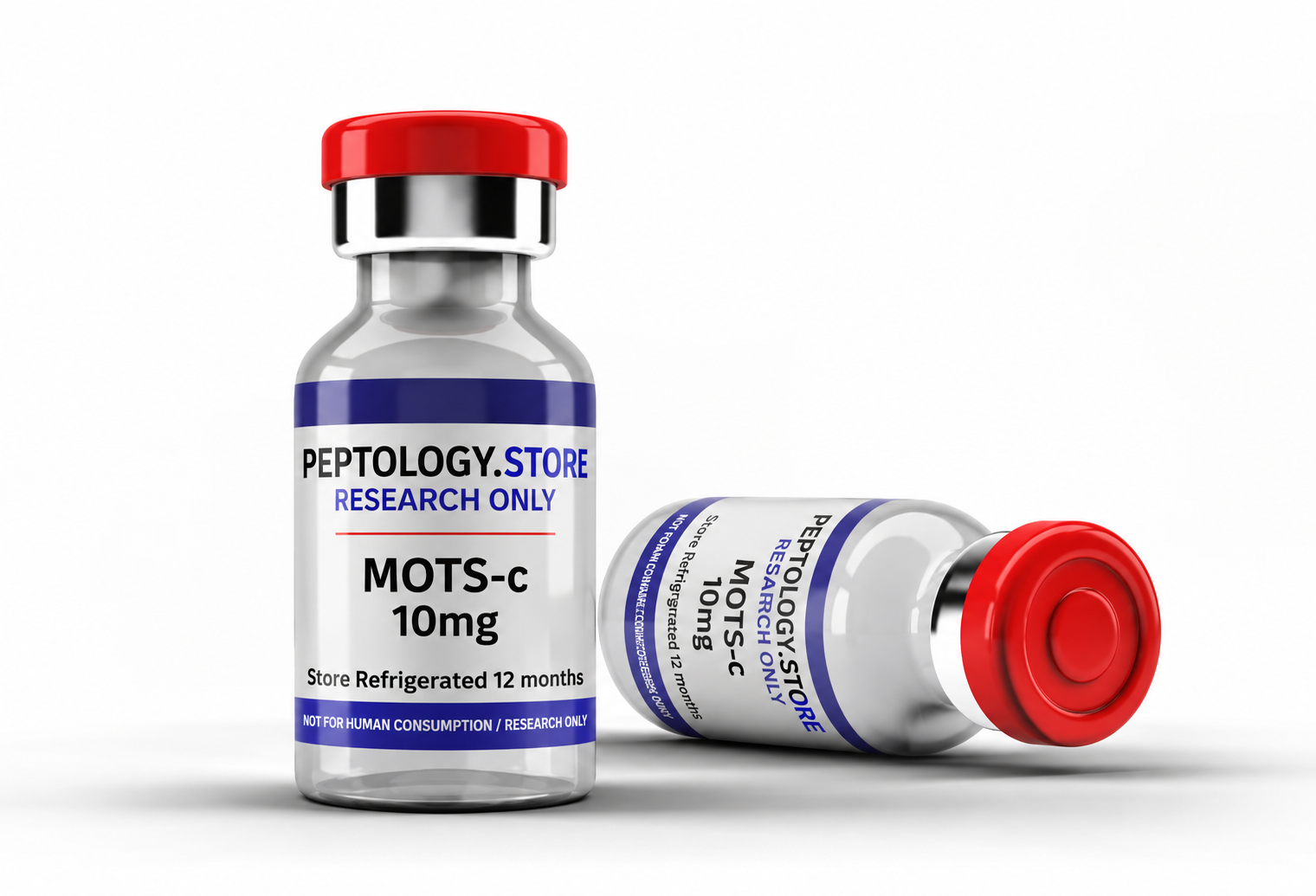
MOTS-c Acetate 10mg – High-Quality Research Peptide | ≥99% Purity | 10mg per Vial | 48-Hour Delivery Across EU & UK
MOTS-C 10mg: Advanced Mitochondrial-Derived Peptide for Metabolic & Cellular Research
peptology.store is proud to present MOTS-C 10mg, a research-grade mitochondrial-derived peptide supplied for laboratory investigations into mitochondrial signaling, metabolic homeostasis, insulin sensitivity, oxidative stress, cellular stress responses, exercise biology, and aging-associated pathways.
MOTS-C (Mitochondrial Open Reading Frame of the 12S rRNA Type-C) is a 16-amino-acid mitochondrial-derived peptide encoded within the mitochondrial 12S rRNA gene (MT-RNR1). It was first described in 2015 and has since become a major subject of research into mitochondrial-to-nuclear signaling and metabolic regulation.
As a dedicated EU peptide supplier and peptide vendor UK, Peptology Store provides research compounds with documented specifications intended to support controlled and reproducible laboratory workflows.
For researchers seeking to buy peptide online for investigations into cellular metabolism, mitochondrial function, neurodegenerative diseases, or aging mechanisms, peptology.store offers this premium research compound with comprehensive documentation, including Certificates of Analysis and batch-specific purity data. Whether your laboratory is based in London, Berlin, Paris, or anywhere in the European Union, our guaranteed 48 hour delivery peptide service ensures your research continues without interruption.
The Scientific Foundation of MOTS-C Research
Discovery and Biological Classification
MOTS-C belongs to the emerging family of mitochondrial-derived peptides (MDPs). Unlike conventional peptides encoded by nuclear DNA, MOTS-C is encoded by a short open reading frame within mitochondrial DNA.
The peptide is encoded by the 12S ribosomal RNA (MT-RNR1) region of mitochondrial DNA and consists of 16 amino acids.
This discovery expanded the understanding of mitochondria beyond their traditional role in energy production and established mitochondrial-derived peptides as potential signaling molecules involved in cellular and systemic metabolic regulation.
Mitochondrial-to-Nuclear Signaling
One of the distinctive features of MOTS-C research is its ability to participate in retrograde mitochondrial-to-nuclear signaling.
Under metabolic or cellular stress, MOTS-C has been reported to translocate to the nucleus, where it can influence expression of genes associated with stress adaptation and metabolic homeostasis.
This provides a research framework for investigating:
- Mitochondrial stress signaling
- Nuclear gene regulation
- Cellular adaptation
- Metabolic homeostasis
- Oxidative-stress responses
- Mitochondrial-nuclear communication
AMPK and Metabolic Signaling
MOTS-C has been investigated extensively in relation to the AMP-activated protein kinase (AMPK) pathway.
Research suggests that MOTS-C can influence metabolic pathways involving folate metabolism and purine biosynthesis, with downstream effects involving AMPK signaling.
This has made MOTS-C particularly relevant to experimental studies of:
- Glucose metabolism
- Insulin sensitivity
- Energy balance
- Exercise adaptation
- Metabolic stress
- Cellular energy regulation
Key Research Applications
Metabolic and Energy-Homeostasis Research
MOTS-C is extensively investigated as a mitochondrial-derived signaling peptide involved in metabolic regulation.
Research applications include:
- Glucose Metabolism: Investigate cellular mechanisms controlling glucose utilization
- Insulin Sensitivity: Examine insulin-response pathways in experimental models
- Energy Homeostasis: Study mitochondrial and cellular energy regulation
- Lipid Metabolism: Investigate relationships between mitochondrial signaling and lipid handling
- Metabolic Stress: Examine cellular responses to metabolic challenge
The original experimental work demonstrated effects on insulin sensitivity and metabolic homeostasis in mice, including protection against diet-induced obesity and insulin resistance.
Mitochondrial Research
Because MOTS-C is encoded within mitochondrial DNA, it provides a unique research model for investigating mitochondrial signaling.
Researchers can study:
- Mitochondrial stress responses
- Mitochondrial-nuclear communication
- Cellular energy metabolism
- Mitochondrial homeostasis
- Oxidative stress
- Metabolic adaptation
Exercise and Metabolic Adaptation Research
MOTS-C has been investigated in relation to physical stress and exercise.
Research suggests that MOTS-C expression and signaling may respond to metabolic stress associated with exercise, providing a model for investigating how mitochondrial-derived signals coordinate cellular adaptation.
Potential research areas include:
- Exercise-induced metabolic signaling
- Skeletal-muscle metabolism
- Energy expenditure
- Stress adaptation
- Mitochondrial responses to exercise
Aging and Longevity Research
MOTS-C has attracted considerable attention in aging research because circulating and tissue levels have been reported to decline with age in experimental and human studies.
Research applications include:
- Cellular aging
- Mitochondrial dysfunction
- Metabolic decline
- Cellular stress responses
- Age-associated insulin resistance
- Mitochondrial homeostasis
Insulin Resistance and Diabetes Research
MOTS-C is being investigated extensively in models of insulin resistance and diabetes.
Research has examined:
- Glucose uptake
- Insulin signaling
- AMPK activation
- Metabolic flexibility
- Skeletal-muscle metabolism
- Obesity-associated insulin resistance
Reviews of the literature identify MOTS-C as an emerging mitochondrial-derived peptide relevant to both type 1 and type 2 diabetes research, while emphasizing that clinical application remains under investigation.
Oxidative Stress and Cellular Protection Research
MOTS-C has been investigated as part of cellular stress-adaptation mechanisms.
Research areas include:
- Reactive oxygen species
- Antioxidant responses
- Cellular stress signaling
- Mitochondrial oxidative stress
- Metabolic adaptation
- Cellular protection
Recent experimental research continues to investigate MOTS-C in oxidative-stress-related disease models, including studies involving Nrf2-associated pathways.
Inflammation Research
MOTS-C has also been investigated in relation to inflammatory signaling.
Potential research areas include:
- Inflammatory cytokine pathways
- Metabolic inflammation
- Cellular stress responses
- AMPK-associated anti-inflammatory signaling
- Chronic inflammation associated with metabolic dysfunction
The literature describes interactions between MOTS-C, metabolic homeostasis, inflammation, and cellular stress, although the precise mechanisms remain an active area of investigation.
Neuroprotection and Neurological Research
Mitochondrial-derived peptides, including MOTS-C, are being investigated in models of neurological and neurodegenerative disease.
Research areas include:
- Mitochondrial dysfunction
- Oxidative stress
- Neuronal survival
- Neuroinflammation
- Age-associated cognitive decline
Reviews identify MOTS-C among mitochondrial-derived peptides being investigated for potential roles in neurodegenerative disease models, but these applications remain experimental.
Quality Assurance: Setting the Standard for Research Compounds
Manufacturing Excellence
peptology.store supplies MOTS-C 10mg with an emphasis on analytical quality and batch traceability.
Quality documentation may include:
- HPLC Purity Analysis: Batch-specific chromatographic purity assessment
- Mass Spectrometry Verification: Molecular identity and molecular-weight confirmation
- Batch-Specific Certificates of Analysis: Documentation associated with individual production lots
- Lyophilized Research Format: Dry presentation intended for appropriate laboratory storage
- Research-Use-Only Labelling: Clearly designated for laboratory research
- Batch Consistency: Quality-control procedures designed to support reproducible research
Physical and Chemical Properties
| Molecular Weight (g/mol) | 2174.6 g/mol |
| Peptide Sequence | MRWQEMGYIFYPRKLR |
| CAS Number | 1627580-64-6 |
| Molecular Formula | C101H152N28O22S2 |
| Appearance | White to off-white lyophilised powder |
| Melting Point | Not applicable (decomposes before melting) |
| Research Use and Safety | |
| Caution | Research use only / Not for human or veterinary use |
| Intended Use | For laboratory research use only. Not for human or veterinary use. |
| Hazard Classification | Not classified as hazardous under GHS for research quantities |
| Storage, Handling and Stability | |
| Storage Temperature, Opened | Lyophilized peptides although stable at room temperature for 3 months, should be stored desiccated below -18°C. Upon reconstitution of the peptide it should be stored at 4°C between 2-21 days and for future use below -18°C. |
| Storage Temperature, Unopened | -20 °C recommended for long-term storage |
| Shelf Life | 2 years unopened under recommended conditions |
| Reconstitution Stability | Stable for up to 28 days at 2-8 °C in aqueous solution under sterile conditions |
Stability and Handling
MOTS-C 10mg should be handled according to the product-specific documentation and established laboratory procedures.
- Lyophilized Material: Store according to the temperature specified in the applicable batch documentation.
- Light Protection: Protect the material from unnecessary direct light exposure.
- Moisture Protection: Keep the container tightly closed and protected from humidity.
- Reconstituted Material: Establish solution-storage conditions according to validated laboratory procedures and available stability information.
- Aliquoting: Where appropriate, aliquot prepared research solutions to minimize repeated freeze-thaw exposure.
- Temperature Control: Avoid unnecessary temperature fluctuations.
- Documentation: Record preparation dates and storage conditions as part of the experimental record.
Researchers should consult the batch-specific COA and supplier documentation before establishing long-term storage or solution-stability protocols.
Real-World Research Applications and Investigator Studies
Metabolic Homeostasis Studies
The original characterization of MOTS-C demonstrated that the peptide can influence metabolic homeostasis in experimental models.
In mice, MOTS-C treatment was associated with improved insulin sensitivity and protection against diet-induced obesity and insulin resistance. These findings established a foundation for subsequent research into mitochondrial-derived peptides and metabolism.
Skeletal-Muscle Metabolism
Skeletal muscle has been identified as an important tissue in MOTS-C metabolic research.
Studies have examined MOTS-C in relation to:
- Glucose utilization
- Insulin sensitivity
- AMPK signaling
- Energy metabolism
- Exercise-associated metabolic adaptation
These findings have contributed to continued investigation of MOTS-C as a mitochondrial-derived metabolic signal.
Stress-Response Studies
MOTS-C can translocate toward the nucleus under certain cellular stress conditions, where it has been reported to influence stress-adaptation gene expression.
This provides an experimental system for studying:
- Mitochondrial stress
- Nuclear transcription
- Antioxidant responses
- Metabolic adaptation
- Cellular resilience
Aging Research
MOTS-C concentrations have been reported to decline with age, generating interest in its potential relationship with age-associated metabolic changes.
Researchers are investigating whether alterations in mitochondrial-derived peptide signaling contribute to:
- Metabolic aging
- Insulin resistance
- Mitochondrial dysfunction
- Cellular senescence
- Reduced physiological resilience
Diabetes and Insulin-Resistance Research
MOTS-C is being studied in experimental models of insulin resistance and diabetes because of its relationship with glucose metabolism and AMPK-associated signaling.
Current literature supports continued investigation but does not establish MOTS-C as an approved treatment for diabetes.
Key Research Features
- 10mg Research Presentation
- 16-Amino-Acid Mitochondrial-Derived Peptide
- Mitochondrial 12S rRNA Origin
- Mitochondrial-to-Nuclear Signaling Research
- AMPK-Associated Metabolic Research
- Glucose-Metabolism Studies
- Insulin-Sensitivity Research
- Skeletal-Muscle Metabolism
- Exercise-Adaptation Research
- Mitochondrial Function Studies
- Oxidative-Stress Research
- Cellular Stress-Response Research
- Aging and Longevity Research
- Metabolic-Disease Research
- Inflammation Research
- Neuroprotection Research
- Lyophilized Research Format
- Batch-Specific Documentation
- Research-Use-Only Material
- Laboratory-Oriented Handling Guidance
- EU & UK Research Supply through Peptology Store
Frequently Asked Questions
Q: What is MOTS-C?
A: MOTS-C is a 16-amino-acid mitochondrial-derived peptide encoded by a short open reading frame within the mitochondrial 12S rRNA region. It has been investigated extensively in relation to metabolism, mitochondrial signaling, stress adaptation, and aging.
Q: What is MOTS-C 10mg used for?
A: MOTS-C 10mg is supplied for laboratory research involving mitochondrial signaling, metabolic homeostasis, insulin sensitivity, AMPK-associated pathways, oxidative stress, exercise biology, cellular stress, and aging-related research.
Q: Where does MOTS-C come from genetically?
A: MOTS-C is encoded by a short open reading frame within the mitochondrial 12S ribosomal RNA (MT-RNR1) region of mitochondrial DNA.
Q: What pathway is associated with MOTS-C?
A: MOTS-C has been investigated particularly in relation to the AMPK pathway. Research also describes interactions with folate metabolism and purine biosynthesis, as well as mitochondrial-to-nuclear stress signaling.
Q: Is MOTS-C studied for insulin sensitivity?
A: Yes. Experimental research has investigated MOTS-C in relation to glucose metabolism and insulin sensitivity. The original mouse studies reported protection against diet-induced insulin resistance and obesity.
Q: Is MOTS-C studied in aging research?
A: Yes. MOTS-C has attracted substantial interest in aging research because circulating and tissue levels have been reported to decline with age and because mitochondrial dysfunction is closely associated with age-related metabolic changes.
Q: Is MOTS-C suitable for human consumption?
A: No. MOTS-C 10mg supplied by peptology.store is intended for research and laboratory use only and is not supplied as an approved human therapeutic product.
Q: Has MOTS-C been clinically established as a treatment for diabetes or obesity?
A: No. Although preclinical studies have reported effects on glucose metabolism, insulin sensitivity, obesity, and related pathways, reviews emphasize that effective clinical application of MOTS-C has not yet been established.
Q: Can MOTS-C be used in cell-based research?
A: MOTS-C can be investigated in appropriately designed in-vitro experimental systems. Researchers should determine concentrations, exposure periods, solvents, controls, and assay conditions according to validated laboratory protocols and relevant literature.
Q: What research areas commonly investigate MOTS-C?
A: Research areas include mitochondrial biology, metabolic regulation, insulin sensitivity, AMPK signaling, oxidative stress, exercise physiology, aging, cellular stress responses, inflammation, and neurodegenerative disease models.
Q: How should MOTS-C be stored?
A: Store the lyophilized material according to the product-specific storage instructions and batch documentation. Protect it from excessive moisture, unnecessary light exposure, and unsuitable temperatures. Reconstituted material should be handled according to an appropriate laboratory stability protocol.
Q: What documentation is provided with MOTS-C orders?
A: Batch-specific analytical documentation may include a Certificate of Analysis (COA) and relevant analytical data, depending on the production batch and product specification.
Q: Do you offer bulk quantities of MOTS-C 10mg?
A: Bulk research supply can be discussed for qualified laboratories and institutional research programs. Contact Peptology Store for current availability, quantity options, and batch documentation.
Q: Do you ship MOTS-C to EU & UK countries?
A: Research-product shipping availability can be confirmed through peptology.store, subject to destination-country requirements and applicable regulations.
Q: Does MOTS-C have established anti-aging effects in humans?
A: No established human anti-aging benefit should be inferred from current research. MOTS-C remains an investigational peptide, and much of the evidence concerning aging, metabolism, and longevity comes from cellular and animal models.
Advance Your Research with MOTS-C 10mg
Peptology Store provides MOTS-C 10mg for researchers investigating mitochondrial-derived signaling, metabolic homeostasis, insulin sensitivity, AMPK-associated pathways, oxidative stress, exercise adaptation, and cellular aging.
Whether your work focuses on mitochondrial-to-nuclear communication, metabolic regulation, skeletal-muscle biology, aging-associated dysfunction, or cellular stress responses, MOTS-C provides a distinctive experimental model for studying how mitochondria communicate metabolic information to the wider cell.
The existing literature provides substantial preclinical evidence supporting continued investigation of MOTS-C, while clinical translation remains an active research area. Findings from animal and cellular models should therefore be interpreted within their appropriate experimental context.
Whether you are exploring mitochondrial bioenergetics, designing aging studies, investigating DNA repair pathways, or researching neuroprotective mechanisms, our rigorously tested compound provides the quality and consistency your work demands.
Order today and experience the peptology.store difference – premium quality, rapid 48-hour delivery across the EU and UK, and expert support for the European research community.