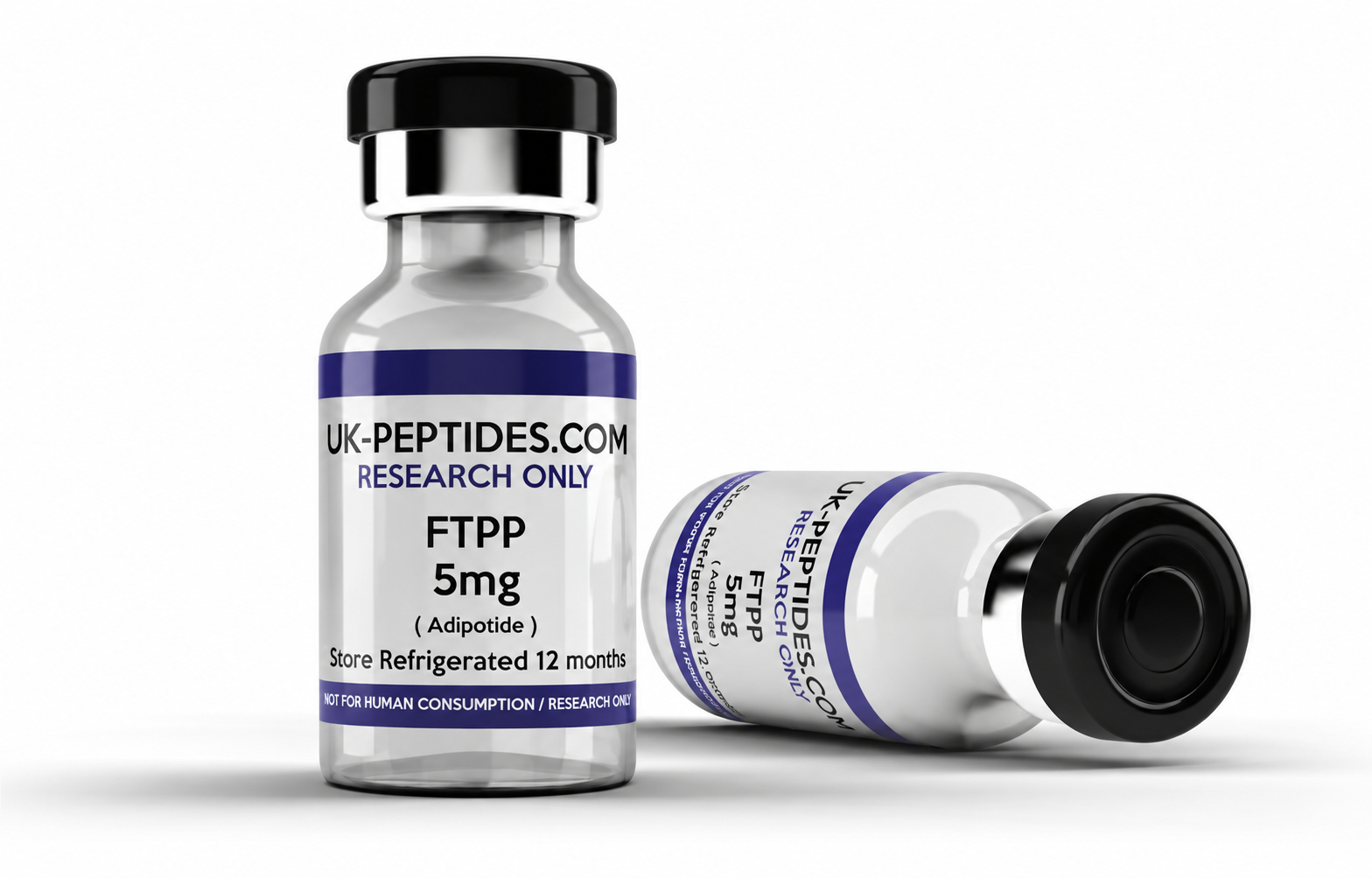
FFTP Adipotide 5mg – High-Quality Research Peptide | ≥99% Purity | 48-Hour Delivery Across EU & UK
FTPP Adipotide 5mg: Advanced Research Peptide for Adipose Vascular Biology & Metabolic Research
peptology.store is proud to present FTPP Adipotide 5mg, a research-grade peptide supplied for laboratory investigations into adipose-tissue vascular biology, prohibitin-1 signaling, adipocyte biology, angiogenesis, metabolic regulation, and obesity-related research.
Adipotide is a chimeric peptide designed to target prohibitin-1 (PHB1) expressed on the surface of vascular endothelial cells associated with white adipose tissue. Its research profile has attracted interest because experimental studies have investigated how selective targeting of adipose-tissue vasculature can influence adipose tissue integrity and whole-body metabolic parameters.
As a dedicated EU peptide supplier and peptide vendor UK, Peptology Store provides research compounds with documented specifications intended to support controlled laboratory workflows.
For researchers seeking to buy peptide online for investigations into cellular metabolism, mitochondrial function, neurodegenerative diseases, or aging mechanisms, Peptology Store offers this premium FTPP Adipotide research compound with comprehensive documentation, including Certificates of Analysis and batch-specific purity data. Whether your laboratory is based in London, Berlin, Paris, or anywhere in the European Union, our guaranteed 48 hour delivery peptide service ensures your research continues without interruption.
The Scientific Foundation of Adipotide Research
Discovery and Development
Adipotide emerged from research using phage-display approaches to identify peptides capable of targeting vascular components associated with white adipose tissue.
The resulting peptide was designed as a chimeric molecule incorporating:
- A targeting sequence associated with adipose-tissue vasculature
- A linker region
- A pro-apoptotic sequence
Published research describes adipotide as targeting PHB1 on the surface of vascular endothelial cells in white adipose tissue.
PHB1-Targeted Vascular Biology
PHB1 is a multifunctional protein associated with cellular membranes and mitochondria. In the context of adipotide research, PHB1 serves as a molecular target associated with the vasculature of white adipose tissue.
This provides a research framework for investigating:
- Endothelial-cell targeting
- Adipose-tissue vascular biology
- PHB1-associated signaling
- Adipose vascular remodeling
- Vascular contributions to metabolic regulation
Adipose-Tissue Vascular Targeting
Adipose tissue expansion depends in part on vascular support and angiogenic processes. Consequently, targeting adipose-tissue vasculature has become an area of experimental obesity research.
Studies of adipotide have investigated whether disruption of the vascular supply to white adipose tissue can alter adipose-tissue mass and metabolic physiology.
Key Research Applications
Adipose-Tissue Vascular Research
Adipotide is primarily investigated as a tool for studying the relationship between vascular biology and adipose-tissue regulation.
Research applications include:
- Endothelial Targeting: Investigate selective targeting of adipose-associated endothelial cells
- Adipose Vasculature: Study vascular structures supporting white adipose tissue
- PHB1 Biology: Examine the role of PHB1 in adipose-associated endothelial cells
- Vascular Remodeling: Investigate changes in adipose-tissue vascular integrity
- Adipose-Tissue Regression: Study experimental mechanisms associated with loss of established white adipose tissue
Obesity and Metabolic Research
Preclinical adipotide research has examined whether adipose-vascular targeting can influence body weight and metabolic parameters.
Experimental models have investigated:
- Body-weight changes
- Adipose-tissue mass
- Food intake
- Insulin sensitivity
- Glucose metabolism
- Energy expenditure
- Metabolic adaptation
In obese rhesus monkeys, published research reported reduced body fat and improved metabolic parameters following adipotide treatment, although the compound’s safety profile and translational limitations require careful consideration.
Angiogenesis Research
Because adipose expansion is closely associated with angiogenesis, adipotide provides an experimental model for studying interactions between vascular development and adipose biology.
Research areas include:
- Endothelial-cell survival
- Adipose angiogenesis
- Vascular remodeling
- Pro-angiogenic signaling
- Adipose vascular density
- Endothelial-cell apoptosis
Prohibitin-1 Research
Adipotide provides a useful experimental system for investigating PHB1-associated cellular mechanisms.
Researchers may investigate:
- PHB1 expression
- PHB1 localization
- PHB1-mediated signaling
- Endothelial-cell responses
- Membrane-associated PHB1
- PHB1-targeted peptide interactions
Adipocyte Biology
Adipotide research also provides an opportunity to investigate how changes in adipose-tissue vasculature influence adipocytes.
Potential research endpoints include:
- Adipocyte size
- Adipose-tissue cellularity
- Lipid storage
- Adipose remodeling
- Vascular-adipocyte interactions
- Metabolic signaling
Quality Assurance: Setting the Standard for Research Compounds
Manufacturing Excellence
peptology.store supplies FTPP Adipotide 5mg with an emphasis on analytical quality and batch traceability.
Quality documentation may include:
- HPLC Purity Analysis: Analytical assessment of peptide purity
- Mass Spectrometry Verification: Molecular-mass confirmation
- Batch-Specific Certificate of Analysis: Documentation associated with the individual production lot
- Lyophilized Research Format: Dry presentation intended for appropriate laboratory storage
- Research-Use-Only Labelling: Clearly designated for laboratory research
| Molecular Weight (g/mol) | 2555.22 g/mol |
| Physical and Chemical Properties | |
| Form | C111H204N36O28S2 |
| Appearance | White to off-white lyophilised powder |
| Melting Point | Not applicable (decomposes before melting) |
| Analytical and Quality Control | |
| HPLC Result | 99.8 |
| Research Use and Safety | |
| Caution | Handle using appropriate PPE and in compliance with relevant laboratory safety standards. |
| Intended Use | For laboratory research use only. Not for human or veterinary use. |
| Hazard Classification | Not classified as hazardous under GHS for research quantities |
| Storage, Handling and Stability | |
| Storage Temperature, Opened | -20 °C, minimise freeze-thaw cycles |
| Storage Temperature, Unopened | -20 °C recommended for long-term storage |
| Shelf Life | 2 years unopened under recommended conditions |
| Reconstitution Stability | Stable for up to 28 days at 2-8 °C in aqueous solution under sterile conditions |
Stability and Handling
FTPP Adipotide 5mg should be handled according to the product-specific documentation and established laboratory procedures.
- Lyophilized Material: Store according to the temperature specified in the batch documentation.
- Light Protection: Protect the material from unnecessary direct light exposure.
- Moisture Protection: Keep the vial tightly sealed and protected from humidity.
- Reconstituted Material: Establish storage conditions according to validated laboratory stability procedures.
- Aliquoting: Where appropriate, aliquot prepared research solutions to minimize repeated freeze-thaw exposure.
- Temperature Control: Avoid unnecessary temperature fluctuations during storage and handling.
- Documentation: Record preparation and storage conditions as part of the experimental record.
Real-World Research Applications and Investigator Studies
Adipose-Tissue Targeting Studies
Preclinical studies established adipotide as a peptide capable of targeting PHB1-associated vascular structures in white adipose tissue.
The underlying research concept is that selective targeting of adipose-associated endothelial cells can influence the vascular support of white adipose tissue.
Obese Animal Models
Experimental studies in obese rodents reported substantial reductions in adipose tissue and body weight following adipotide treatment.
These studies also investigated metabolic parameters and observed changes beyond simple reductions in food intake, supporting continued investigation of vascular-adipose interactions.
Nonhuman Primate Research
Adipotide has also been investigated in obese rhesus monkeys.
One published study reported approximately 28% reduction in body fat over four weeks, together with reduced food intake and improvements in metabolic parameters. The same research reported renal effects, emphasizing the importance of safety monitoring in translational research.
Renal Safety Research
Renal effects are an important part of the published adipotide research profile.
In nonhuman primate studies, investigators reported changes including:
- Reduced serum phosphorus
- Reduced serum potassium
- Glucosuria
- Proteinuria
- Changes in urinary parameters
- Increases in renal epithelial cells
The reported renal effects were generally described as mild and reversible in that study, but they remain relevant when evaluating adipotide’s experimental safety profile.
Translational Research
Adipotide has progressed beyond purely cell-based research into animal and limited human investigation. However, published reviews note that its first human trial was discontinued, and adipotide remains an investigational compound rather than an approved treatment for obesity or metabolic disease.
Key Research Features
- 5mg Research Presentation
- Adipotide / FTPP Research Compound
- PHB1-Associated Vascular Targeting
- White Adipose Tissue Research
- Adipose Vascular Biology
- Endothelial-Cell Research
- Angiogenesis Studies
- Adipocyte Biology
- Obesity Research
- Metabolic Research
- Adipose-Tissue Remodeling
- PHB1 Signaling Research
- Animal-Model Research
- Preclinical Translational Research
- Lyophilized Research Format
- Batch-Specific Documentation
- Research-Use-Only Material
- Laboratory-Oriented Handling Guidance
- EU & UK Research Supply through Peptology Store
Frequently Asked Questions
Q: What is Adipotide?
A: Adipotide is a chimeric peptide developed to target prohibitin-1 (PHB1) associated with the vascular endothelium of white adipose tissue. Research has investigated its effects on adipose-tissue vascular biology, adipose mass, and metabolic parameters.
Q: What is FTPP Adipotide 5mg used for?
A: FTPP Adipotide 5mg is supplied for laboratory research involving adipose vascular biology, PHB1-associated mechanisms, endothelial-cell targeting, adipose-tissue remodeling, angiogenesis, obesity models, and metabolic research.
Q: What is the primary research target of Adipotide?
A: Published research identifies PHB1 on the surface of vascular endothelial cells associated with white adipose tissue as an important target of adipotide.
Q: How does Adipotide work in research models?
A: Adipotide was designed as a targeting peptide linked to a pro-apoptotic sequence. In experimental models, targeting of PHB1-associated adipose vasculature has been linked to endothelial-cell damage and subsequent effects on adipose tissue.
Q: Has Adipotide been studied in animal models?
A: Yes. Adipotide has been studied in obese rodent models and nonhuman primates. Experimental studies reported reductions in adipose tissue and body weight, while primate studies also identified renal effects that are important to the compound’s research safety profile.
Q: Has Adipotide been studied in humans?
A: Adipotide has entered limited human investigation, but it remains an investigational compound rather than an approved treatment. Reviews have reported that its first human trial was discontinued.
Q: Is Adipotide suitable for human consumption?
A: No. FTPP Adipotide 5mg supplied by peptology.store is intended for research and laboratory use only and is not marketed as an approved human therapeutic.
Q: What research areas commonly use Adipotide?
A: Research applications include adipose vascular biology, obesity models, metabolic research, angiogenesis, endothelial-cell signaling, PHB1 research, adipocyte biology, and tissue-remodeling studies.
Q: Does Adipotide directly destroy adipocytes?
A: The principal mechanism described in the published literature involves targeting PHB1-associated vascular endothelial cells in white adipose tissue, rather than simply acting directly on adipocytes. The resulting vascular effects can subsequently influence adipose-tissue integrity.
Q: Has Adipotide been associated with metabolic changes?
A: Yes. Preclinical research has reported changes in body weight, adipose tissue, food intake, insulin sensitivity, and other metabolic parameters. These observations are primarily from animal research and should not be interpreted as established human therapeutic effects.
Q: Are there safety considerations with Adipotide?
A: Yes. Safety is an important consideration in adipotide research. Nonhuman-primate studies reported renal effects including glucosuria, proteinuria, electrolyte changes, and urinary epithelial-cell changes. Researchers should therefore follow appropriate institutional safety procedures and experimental monitoring requirements.
Q: How should FTPP Adipotide 5mg be stored?
A: Store the lyophilized research material according to the product-specific batch documentation. Protect it from moisture, excessive light exposure, and unsuitable temperatures. Reconstituted material should be handled according to an appropriate laboratory stability protocol.
Q: Can Adipotide be used in cell-based research?
A: Adipotide-related mechanisms can be investigated in appropriate experimental cellular systems, particularly models involving endothelial cells, PHB1-associated signaling, and adipose vascular biology. Experimental concentrations and exposure conditions should be determined from validated protocols and relevant literature.
Q: What documentation is provided with Adipotide orders?
A: A batch-specific Certificate of Analysis (COA) may provide analytical information about the supplied material. Additional analytical documentation should be confirmed for the specific production batch.
Q: Do you offer bulk quantities of FTPP Adipotide?
A: Bulk research supply can be discussed for qualified laboratory and institutional requirements. Contact Peptology Store for current availability and batch documentation.
Q: Do you ship FTPP Adipotide to EU countries?
A: Shipping availability for FTPP Adipotide 5mg can be confirmed through peptology.store. Researchers should verify applicable destination-country requirements before ordering.
Q: Is Adipotide an approved obesity treatment?
A: No. Adipotide remains an investigational research compound. Its reported effects in animal models do not establish approved efficacy or safety for treating obesity in humans.
Q: What makes Adipotide valuable for research?
A: Its value as a research tool comes from its unusual vascular-targeting approach to adipose tissue. Rather than functioning as a conventional appetite suppressant or metabolic drug, adipotide provides an experimental model for studying how adipose-tissue vasculature, PHB1, endothelial-cell survival, and adipose metabolism interact.
Advance Your Research with FTPP Adipotide 5mg
Peptology Store provides FTPP Adipotide 5mg for researchers investigating adipose-tissue vascular biology, PHB1-associated mechanisms, endothelial-cell targeting, angiogenesis, adipocyte biology, and metabolic regulation.
Whether your research focuses on obesity models, adipose vascular remodeling, endothelial-cell signaling, PHB1 biology, or the relationship between vascular networks and adipose-tissue expansion, Adipotide provides a distinctive experimental model for controlled preclinical investigation.
The existing evidence remains predominantly preclinical, and published studies also identify important safety considerations. Accordingly, experimental findings should be interpreted within the appropriate laboratory and translational context.
Order today and experience the peptology.store difference – premium quality, rapid 48-hour delivery across the EU and UK, and expert support for the European research community.